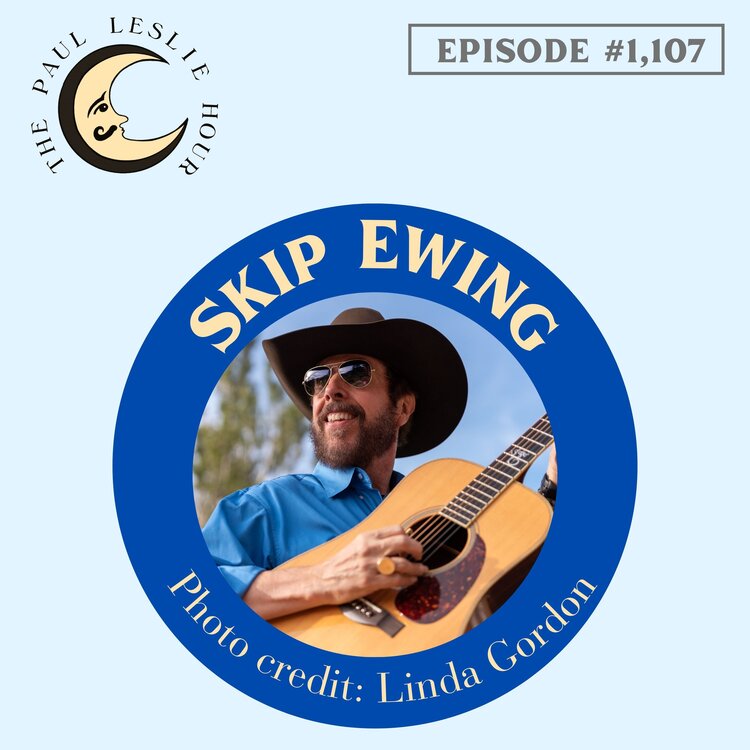
Skip Ewing joins The Paul Leslie Hour for an in-depth interview!
Are you here?
Welcome to episode 1,107 of The Paul Leslie Hour, where we bring you captivating conversations with the most intriguing personalities in arts and entertainment. We are thrilled to present an exclusive, in-depth interview with Skip Ewing, an award-winning recording artist and songwriter whose work has left an indelible mark on the world of country music.
Skip Ewing is renowned not only for his own chart-topping records but also for penning #1 hits for some of the biggest names in the industry. Join us as we delve into the real Skip Ewing, a man who is at home on a horse as he is on stage.
In this earnest discussion, Skip opens up about his latest projects and the inspirations that continue to drive his work. Whether you’re a long-time fan or new to Skip’s music, this conversation promises to be both enlightening and inspiring.
So, settle in and get cozy as we embark on this musical journey with Skip Ewing. The conversation is about to begin, and you won’t want to miss a moment of it.
Help Support the Show Here
A conversation with Skip Ewing
Hosted by Paul Leslie
Paul Leslie: Well folks, thanks so much for tuning in to another episode of the Paul Leslie Hour. And on this episode, I have an artist that I’ve been wanting to speak to for years now. And I’ll tell you all, it wasn’t that long ago we were doing an interview with somebody named Eric Darken, a percussionist. And I was aware of the name Skip Ewing, but he said, you know who’s somebody that you ought to interview? You would probably really get along with Skip Ewing.
And so here we are, I’ll tell you a little bit about him. He’s a recording artist, singer, songwriter, live performer. He’s made many acclaimed records, as well as having songs he wrote recorded by the best in country and beyond. And I’m gonna read from this list here, and this is by no means the whole list, but we’ve got George Strait, Reba McIntyre, Willie Nelson, Shania Twain, Clint Black, even greats like Kenny Rogers and Andy Williams. I think Skip Ewing is a great singer, somebody who could appeal to not just country music fans, but has real appeal for anybody who likes well-written songs, performed well. So, Skip, thank you for making time to talk to me. I sure appreciate it.
Skip Ewing: It’s my pleasure, Paul. Happy to be here.
Life on the road and in Wyoming
And I was surprised to find out that you are actually being a traveling musician. You’re in South Carolina at the moment.
I am. I’m down in Myrtle Beach. It’s a super busy time for us right now, for me right now. I’m actually here, not on business. I’m here to do a couple of things to help a friend who got hurt before I go up to Nashville.
I’ll go up to Nashville later this week. And then I’m in Nashville. I live in Wyoming, so I’m staying in Nashville for what, a month and a half. I’ve got two videos to shoot, the rest of an album to record. It’s a crazy fun time, Paul.
Well, anybody who’s an artist, the work never stops. There’s always something you can be working on. Skip, what are you the happiest doing?
You mean just anything in life or are you talking about work? Hmm. That’s a good question.
I can tell you one of the happiest things. One of the things that makes me the happiest is to just be on a horse up in the mountains. And whether I’m all by myself or not, but all by myself is fine with a small group is fine. But I’m an out in the nature guy.
Absolutely. I’ve seen so many pictures of you with horses. I’ve seen some music videos where the horses are shown and I understand that Wyoming is one of the absolute most beautiful places in the country. I haven’t been there but it’s number one on my list believe it or not.
Well, it’s beautiful for a number of reasons, Paul. I don’t know if you probably are aware of this. I’m sure that not all our listeners or viewers are aware of it. But even though I wrote all those songs that you, or many, many hit songs, and for a lot of artists, I got to a place where I just needed, was artistically unfulfilled in a way from my own artistry.
But in the meantime, I had fallen in love with horses. And when I say with horses, I don’t mean just hanging around with them. I mean that I was discovering that if I dug into the kind of relationships that humans can have with horses and the intricacies thereof, I found that they had a lot to teach me and that I was learning about myself. And that’s something I always do.
And I sold everything in Nashville. I sold everything, my house, my furniture, everything but my instruments and some art. And I went on the road and I was away from Nashville for 10 years, something like that. I worked on a lot of ranches and I worked with as many, I rode as many horses and trained and worked with just, I mean, hundreds and hundreds of horses. And I learned a great deal.
And so now when I say that we moved to Wyoming, well, we moved to Wyoming, it’s wide open space and that’s where I started falling in love with horses in the first place. And we live up in the northwestern corner, so I jokingly, but not so jokingly say, if you take Yellowstone and the Grand Tetons and pour them in a bucket, and then take that bucket and pour it in my backyard, that’s honestly where I live.
I don’t own the place where we live. I went over there to care take a farm. In fact, they didn’t even know I had anything to do with music. They just knew I had worked with horses and I went to Caretake, this historic ranch, and we were supposed to be there for about three months, and it’s been eight years.
And so if you go on our socials especially, really and truly, most of the animals and shots that you see are on our driveway or on our property. All of the bighorn sheep, the moose, the… that, you know, the huge deer, it’s amazing what we have on our property, plus our horses and Shotgun and Holly, our dogs.
And so when I say that, that’s coming from a space of I’ve ridden thousands of miles horseback in the mountains, guiding from guest ranch, running pack trips, and just being there myself and helping horses understand how to be with humans in that kind of space. And so it fills my heart with joy and that is one of the places I’m most happy. I would say yes.
The wisdom of the horse
That sounds really rich. I remember Willie Nelson saying “The horse is human.” So skip what is the biggest lesson that horses can give us human beings?
Well, don’t want to, you know, I’m not quick to say that I don’t feel the same way as someone, but I do have to say that it’s important to remember that horses aren’t human. And that is, that’s something that’s not good for the horse. When we expect a horse to be human, then we ask him for something he can’t give us.
I think, you know, I mean, I don’t want to speak for Willie and I know Willie and so Willie, if you’re watching, because we’ve hung out quite a bit, you know, Willie’s an awesome, he’s an awesome guy. And so I think maybe sometimes when people say something that they mean that, again, they put us in touch, they, horses can help us get in touch with how we are most beautifully human.
So it’s easy to recognize a relationship and sort of anthropomorphize that, know, to turn the horse into something that seems like a human. But it’s not. It’s a horse. And if we allow the horse to be a horse, it’s a beautiful gift to the horse to always recognize that.
You know, I mean, this affects everything in my music as well, because horses, I don’t know if you want to wax into horses, but I’m happy to. Horses, you know, they experience the world. And the reason this is important for people and for music, bear with me here, but horses see monocularly. They see one thing on the left side and one thing on the right side. Humans and predators see things binocularly. So we see something with both eyes.
So a horse, as we’re working with a horse, he’s never going to see his right hip with his left eye. He’s never going to see that. And that’s an interesting something, but he also experiences pressure differently, and he listens differently, and he’s concerned about things that we’re not necessarily concerned with differently.
And what this helped me do, at least for me, is it was an effort in compassion. So basically, I kept going, okay, if I’m going to be everything I can be for this horse, because the horse already knows how to be a horse. He doesn’t have any problems knowing how to be a horse.
But I have to, if I’m working with him, I have to invite that horse skillfully. I have to say, hey, the best life that you can have, because most horses are dependent upon humans, is to be with a human and to be with that human with really good understanding. So the horse feels great about it. He understands and he wants to, know, most horses just want to help. They just want to get along. They’re herd mentality. Let’s be together.
And so that develops a relationship, Paul, with a horse to where we’re sharing that space. He understands what we might call pressure. We as humans, we have pressure. It’s like, there’s a certain distance we stand if we’re talking to one another, right? If we weren’t on this, we wouldn’t get right up in each other’s face, we’d give some space.
And there’s a place where at some point if the person wasn’t known to you, it would feel uncomfortable. Horses can feel that in a zillion different ways. And so, at any rate, the more that I spent time, and I say it’s an effort in compassion, the more I spent time endeavoring to think, wait a minute, I usually walk around on two legs, but this guy or this girl this sis, she’s got four legs, and she can move them independently so many different ways.
And she hears differently, and she sees differently. So in order to be everything I can be for a horse, which is different than asking the horse or telling the horse to be everything they can be for me. That is an effort in trying to experience the world in a way that I don’t experience the world. I don’t have monocular vision. I have binocular vision, but I can do my very best to try to understand her situation, the way she experiences the world.
Applying compassion to music and artistry
Well, flip-flop that man, and now let’s talk about music. I do not know who’s gonna listen, especially the new music. mean, a lot of the stuff I wrote before I went and worked with horses, I was trying to write music hits for other artists, because that’s the box I was put in, man. After that, I got to a place where I went, if I’m gonna do music, go get back to music. I wanna do what my heart says, this is what I wanna say, And maybe it’s really unique. Maybe it’s just because I really feel it. As I’m doing that now, I sort of have a different way. Even with my band, how is it for the band to be hanging with me? Because I’m learning from them and I’ve learned that I listen to the world differently. And that’s a weird thing to say, but if they’re playing, I’m listening differently. It’s like I’m listening together. I am, I’m not getting in the way. And when I mean that, what I mean is I want them to blossom. want to be on stage and when we’re playing, man, it’s like, mean, come on, share your heart, share what’s there. The audience is going to feel that. It’s the same thing when we go and play on a record. And I want to give everything I have to give. But part of that is an invitation.
Especially live. I don’t want to walk out on stage and expect someone to go nuts because I walked out on stage. I mean, is that nice when you’re an artist? Heck yeah. It’s an audience telling you they appreciate you. And that’s part, that’s one direction.
But there’s the other direction. There’s the what’s it like to be that audience? What are they paying for? What did they come to do? And how can I be the best I can be for them? All of those things are elements. That’s a way to say, I don’t know if it’s all of those efforts are elements that are similar when I’m working with horses.
So I haven’t been able to work with horses like I had, like certainly like I did for a while because we’ve been so busy. We’ve got, you know, the new music and things are, things are taken off. Thank you for that. But, but you know, yeah, that’s, that’s why it ended up being powerfully important.
It’s why I like, that’s why I like horses, but it’s also why I say, you know, although horses aren’t human, they can teach us and they can open a door of understanding, almost like a mirror sometimes where you go, man, that horse felt something and I didn’t even realize I was offering that. Like for instance, if part of my body is reacting a certain way with a horse, he’ll respond to it.
But sometimes as humans, we’re not as aware as we need to be. Where I’ve got to say, man, I’m sorry, I’m sorry, sis, I was working with you and I asked you to move this direction, but I didn’t open the door up enough. I didn’t move my body out of the way enough for you to feel confident moving through that space. That’s my fault. I’ll do that more skillfully.
And I think we should do that with people. I think we should say, hey man, I can do that better. In fact, I’ll share this with you. One thing that excites me, if I mess up, and believe me, I mess up a lot. I started realizing that if I, as soon as possible, I said, wait a minute, I just handled that very poorly. Allow me to try that again. I didn’t do that well. Allow me to try that again.
People respond to that, to that too. And that’s just a life thing for me. So it’s a lot, it’s a lot, Paul. I, and I’m glad I got to do it. And I’m glad I’m back writing music because all of that is in the songs and efforts that I make. And then I think we make all of it, all of my whole team and the people with me on stage, people who are making music with me, that’s a respectable effort. I look at anyone who’s making that effort and go, I want to be more like you.
The daunting pursuit of being an artist
Well, you’ve got some very, very interesting things. You’ve already provoked some interesting ideas in my head, that’s for sure. You know, you were talking about how you look at an artist and you say, yeah, you know, there’s a bit of acknowledgement that you have there. Would you say that being an artist is an intimidating thing?
You mean am I intimidated by being an artist or are others intimidated by me being an artist which one did you?
Well, kind of a little bit of both. Like, would you say in general, the pursuit of being an artist? Is it something that is intimidating? Including you.
Hmm, that’s good question. I have to say that it can be daunting. You know, it can, but also being an artist, for me anyway, being an artist means being the focal point.
If I’m talking about a record, for instance, I have made an effort, even if someone misunderstands it at times, to say, “We have a record coming out.” I don’t have a single out, we have a single coming out. Now I say that because, you know, my name might appear. If you buy a Skip Ewing album or see the artwork from it or go to a show, my name is biggest. Usually it’s going to be the biggest name in our, at least in our organization.
You might not even see our electric guitar player’s name. You might not know who my co-producers are. You might, there’s a whole lot of people that you won’t know. But for me, and I’ll go back to horses. For me, again, it would not be what it is without that.
Now, the new songs, I’m writing those, I’ve written almost all of them 100 % just me. This is what I’d like to say and how I’d like to say it. But when we go to make a record to do that, Paul, there are amazing decisions that get made. I mean, on this new, on the new album, for instance, it’s Derrek Phillips and Dave Cohen and, yeah, I mean. I can’t, there’s too many to keep going.
Those are a drummer and a piano player. And even if, even just the decision that Derrek made about what’s going on in this record made a huge difference in what’s there. So I don’t see it as I am it. I’m just able to do it because the pyramid is strong.
And, and, and the people who are listening to our music, to my music, to the music that Skip Ewing is putting his arms around and saying this is the music we want to make and all these people are jumping and say we want to make that with you because we believe in it. If that’s moving, if that’s moving people and it is now, God love them, all the rest of those people are part of it. Every single one of them because we can’t do what we do without it.
It’s the same thing if I’m with a horse and I start thinking I’m the one who’s in control. I know I’ve got the ego, I’m the human, I’m the boss. There’s some times where I need to be decisive, yes, but it needs to be more of an invitation than a demand. And as soon as it turns in to the human and the horse somehow don’t think they have a relationship or the human thinks he’s more important, man, the horse goes one way and the human goes the other and it never works out very well.
I think of when I’m doing a performance, for instance, it’s not even my performance. I’m giving everything I can, but I’m breathing the same air as everyone else. You know, Josh, there’s a guy named Josh Matheny. He’s an amazing dobro player, right? And I love to play with him because for me, he’s always in touch with that. If anything changes, we just on the fly.
You know, if I come up with something, we’re in a, doing a solo section and I come up with something, I move differently, man, we’re on the fly and it’s something together. Those moments happen together when you’re musicians. And when I’m able to sing and I don’t want to get in the way of my singing, by that I mean that I just want to share what I really feel.
And I’m going to sing it that way that night for that audience. We’re all breathing the same air. I hear where the spaces are. I hear where the applause is. I am there for them. I’m really there for them. In fact, we’re all there for them. So, a little oblique in my answer about that, but suffice to say that sometimes maybe it’s a responsibility, but more often than not, it’s an opportunity. And I want to take that opportunity to do my very best. There are parameters that we have to think about.
Creative integrity in the country music environment
Dude, seriously, if I’m making a record for country, it’s gotta be like, there’s a certain sonic environment that’s happening in radio right now. And our listeners expect that. It’s gonna have to have production at a certain level or it’s not gonna fit in. And not that as an artist, it’s interesting. You wanna fit in, but you also wanna be unique. So push the envelope, but don’t push it too far.
And this is something when you’re really creative, we can make a, we can do a lot of different things. Then I can write, you know, I’ve written songs for, you know, for animated features. I’ve written songs for other artists that aren’t my voice. I’ve written jazz songs, blues songs, you know.
And so who am I as an artist? I start looking at my songwriting. There’s a certain lyrical integrity that I have to believe what I’m saying. I have to say, now does it have to be, you know, super happy? Can it be sad? Can it be poignant? Can it be just fun? Of course.
But I want that same lyrical and musical and artistic integrity to be there. I have done my best. And if you’re listening to Skip Ewing music, at this point in my career, it’s not like even what it used to be. I am making that because I believe that it’s strong and powerful and worthy.
And it’s the people who are listening and these opportunities like talking to you, Paul, that make the difference. It’s going to be the reason why we get to continue. And sustainability right now as an artist in music, man, it’s tough. It’s tough. So I don’t know, daunting. Is it difficult? Heck yeah. It’s hard. It’s hard. There’s a lot on you.
But I think that we… I think that that understanding of a community of everyone who’s with me and part of that, the people, the fans, the listeners, it’s real hearts out there that are listening. It’s individuals who got their headphones on like we do right now, who are listening on their phone or cranking whatever they crank or going to a show. They want that. And I want to deliver that. I want to say, you show up, we’re going to give you something that you’re going to go, dang man, that’s quality. There you go.
The transition from Wyoming silence to Nashville energy
You know, just like you were talking about how you just don’t know about the listener. You’re doing what you’re doing, but you don’t know how something’s going to be taken. There have been times I’ve told different songwriters, like I remember telling this songwriter in Nashville, great writer named John Goodwin, I said, I love this song. It makes me think about this and this and this. And he was like, I like your take and I like that you like the song. That’s not what the song is about at all. But, you know, I was listening to some of the songs from this upcoming EP of yours, Dragonfly, that’s going to be coming out. And it made me think about how, you know, you’re living out there in Wyoming and then Nashville becomes this city of, I mean, every time I go back to Nashville, it seems like there’s more people than the time before. And I think you can’t get any bigger, but it manages to. What’s it like for you, that kind of transition, going from Wyoming and now, you know, to record in Nashville, you go there and that means get to it, down to business.
You know, one of the reasons why I love Wyoming is not because of what is there, but because of what is not there. And what’s not there where I live is a whole lot of people and a lot of sound, a lot of noise.
I can’t hear traffic where I live. There’s traffic, don’t get me wrong. We live on a dirt road. There’s cars that come up and down there. Not very many planes go across, but there are some. But for the most part, there’s not any stress in that kind of noise, if you would. And I feel in touch with my own humanness. There’s an earthiness about being in that. Caring for horses, caring for dogs, if you’re that way.
Man, there’s all the great stuff and there’s all the poop to pick up. I mean, it’s still the same. There’s that same contrast. So I like that because it gives me room to think and it doesn’t raise my stress or keep pulling me away from things. And I think it’s important to be focused by the same token.
Nashville is still an alive place. There’s a lot of tourism. I’m not talking about downtown, but I am talking about the artistic community that I’m aware of and that I work with and the musicians, especially as we’re working with live musicians, not AI, don’t want to open that door, but humans who come in and are influenced by the other people who are there with them, by their spirit, by their intention, their talent, what they’ve worked on, and their decisions and ideas.
And this is something that I treasure. It is actually a Nashville treasure still. So not thinking of Nashville as a city, but thinking of Nashville as a hub where a great deal of music is still made and written. It is a vibrant place to spend time.
So even for this, we’re, you know, we’re about to cut the Dragonfly 2, the second half of this project. Well, it’s sort of, there’s more than that. We’ll cut more than two, you know, we’ll cut five songs for the Dragonfly EP and we’re sort of calling the next one Dragonfly 2 before it comes out. But then there’ll be more and it’ll be a whole project. You know, least five more songs coming.
And I’ll go to Nashville and I will write there, even if I don’t co-write. And I’ll spend time with other people. I like to do some things for our social media content. Like, you know, there’ll be a day that I’ll invite several different people just over to the Airbnb that I hang out at in Nashville. And I say, come over. I have no idea what we’re going to play. I have no idea. We’re going to play maybe some, you know, obviously some songs that I play, but we’ll talk
The Magic of the “Knife Edge”
Skip Ewing: Who’s thinking about this? Maybe we come up with a Jerry Reed song. Maybe we play a James Taylor song, or a Genesis song. I don’t know, but we all go, “Let’s just have fun with it and make some moments that would never otherwise be.”
It’s part of the magic that comes with musicians who are very capable and willing to walk that little knife edge of making a mistake. That is such a fun place to be. Nashville has that, but if we’re not careful, we will lose it.
I know Nashville has gotten big; it’s not the same city anymore and the downtown doesn’t feel the same, but it’s still a hub for music made with heart and soul. To me, that is essential to the definition of country music. It’s not just about having a fiddle or a steel guitar—you can put those in a lot of things that aren’t “country.”
The tradition of country grew up predominantly in Nashville, so I have a reverence for it. I want to do everything I can to help cultivate and protect the amazing talent and history we have there.
Collaborating on “Stronger Where You’re Broken”
Paul Leslie: One of those songs I wanted to go into is “Stronger Where You’re Broken,” featuring Mae Estes. What was it about her that made you want to work together?
Skip Ewing: I will jump up and down for someone when I think they are a true talent and a true heart, and that’s what Mae Estes has. To me, she’s a star. She’s true to herself, she has a truly beautiful voice, and she’s a great writer.
The first time we met, we just went to a Mexican restaurant with Josh Matheny and talked about life. She’s a real person. On this album, there were two songs I felt would blossom differently if a female vocalist was on them with me. It shares both sides of the energy because men and women experience life differently.
I knew I could trust Mae to “get” it, and she did. She told me she wanted to do it because it reflected her own journey. The concept is simple: it’s about the places where we’ve been hurt that have eventually healed.
When a physical scar heals, that tissue is actually stronger than the skin around it. In an emotional space, I believe the same thing. I’ve lived a lot of life and had some incredibly difficult experiences, but as I’ve worked through them, those healed places have helped me be resilient without sacrificing my vulnerability.
The song says, “I’ve got scars where you can’t see them… you’d think the whole damn thing would come apart, but it doesn’t.” We are beautifully human in that way.
The Roots of Creativity: A Pink Foam Curler
Paul Leslie: You write both solo and with others. Who taught you the most about songwriting?
Skip Ewing: I don’t know if there’s a single person. When I was a kid, I didn’t have much time to practice guitar. I would take a pink foam curler—the kind that are everywhere—and stick it under the strings at the saddle to mute them. That way, I could play at night without making a sound.
I didn’t know what I was doing; I just made things up. I’d use my hand for percussion and just play. That started the habit of “making stuff up.” I think it’s important to just go wherever your mind and fingers take you. Change the tuning on your guitar until you don’t recognize it—those are the roots of creativity.
From a lyrical standpoint, life has taught me the most. I write about the human experience. If it doesn’t resonate with truth, listeners won’t embrace it. Every co-writer has taught me something too—whether it’s a new energy, how to steer the ship, or most importantly, how to let go of an idea that isn’t working for the song.
Writing by myself now is a different animal. I can be tenacious. If I feel something is there, I’ll dig in for months. I might have a musical idea or a title that acts as a rung on the ladder until I reach what I really wanted to say.
On Dean Dillon and “Would If I Could”
Paul Leslie: You co-wrote “Would If I Could” with Dean Dillon. You once mentioned you didn’t know if he liked you at first. What can you tell us about the real Dean Dillon?
Skip Ewing: Dean is the only one who could answer that. The truth is, I haven’t spent much time with him. The morning we wrote that song, we weren’t even together very long before he decided he was done. He’s just like that.
I don’t “know” him deeply, but I know he has been part of some incredibly powerful music. It’s no secret he’s had a lot to contend with in his life, and he’s deep because of it. I have a song called “Knots” that says you can’t see the gravel in someone else’s shoes. I assume it’s there for everyone. I wish I could spend more time with him because I think we’d write something else really strong, but he’s the one to ask about who he really is!
Why Keep Performing?
Paul Leslie: What drives you to keep recording and performing live for the public?
Skip Ewing: It goes back to being “beautifully human.” We all have similar experiences. I wrote a song called “Love Me” for Collin Raye. My producer originally told me it was a terrible song that would never get played on the radio. But it became a huge record because people connected with that story of a grandmother and grandfather.
The story might not be their exact life, but they understand the hope and the connection. As humans, we want to reach across boundaries. I love that exchange. I believe that if I write skillfully enough, I can put something in the world that matters.
When we are on stage, that moment is never going to happen again. I don’t want it to be exactly the same every night. I want to offer my heart right then and there. It’s a vulnerable, powerful place to share. At the root of it, we all just want to matter. We want to live a meaningful life. This is my way of making sure I don’t waste the gift of the life I have.
Real Life and Real Lighting
Skip Ewing: I gotta say this, this is making me laugh. I can just see myself in a little bitty box and I’m traveling, right? When we started this, the sun was up and I’m in Myrtle Beach, kind of by the ocean.
It’s not right by the ocean now. It’s like this dark thing behind me and I’ve got this glowing face. It’s funny. I know if you’re watching this, you’re going, “Man, what’s the deal?” Well, I didn’t turn any lights on because it was sunny when we started!
Paul Leslie: It’s quite alright. Folks, you’re getting real life here—the sun is, in fact, going down. I want to encourage everyone to follow Skip Ewing on socials and check out his YouTube channel. He’s got some really good lyric videos; I especially like “I Want It All.” To me, it has that 90s kind of sound, and I mean that as a compliment.
Looking Ahead: The Hall of Fame and New Music
Skip Ewing: I’m glad you liked that! We have a lot starting to happen. If you’re in Nashville, I’ll be doing a show for the Country Music Hall of Fame on March 28th. It’s part of their Songwriter Series, which I was really honored to be asked to do. It goes in their archives, and I’ll have some other artists and musicians there with me.
There’s a show in Utah coming up too, and more on the way. Things are really starting to open up with this new album. Our whole approach on it is for radio, but without looking to be… well, let’s just say we have a specific vision.
I’m not on a major label, but I have a “major label capable” team. The producers and musicians I’m working with are phenomenal. I love that they’re even willing to work with me! From management to publicity and digital marketing, it is difficult behind the scenes and takes a while to grow, but it is starting to take root.
I especially love the people who come and play with me. We make moments on stage that are just for that night. I hope I see you on the road too, Paul. That’d be great.
The Final Word: The Gift of Listening
Paul Leslie: I always like to give the last word to my guest. Is there anything you’d like to say in closing to our viewers—totally open-ended?
Skip Ewing: Wow. To just say anything… the very first thing would be “Thank you.” If you watched this far, then you thought it was important enough to stay. Hopefully, there was something in the content that meant something to you.
I will also say that listening is a gift. When someone truly listens, it’s a gift to the person speaking. Our attention spans have shortened so much; they’re decaying because of what we’re pushed at every day.
Social media is a study in how quickly we can move on to the next thing after three seconds. But spending time with something that is meaningful, that has “meat” and something to offer—if you’re offering that kind of time to me or anyone else, I recognize it and I appreciate it hugely.
I hope you’ll do it more, and I hope you’ll come do it with me. I’m going to do everything I can to give you something that is worthy of your time.
Paul Leslie: Well said. Skip Ewing, thank you so much. I appreciate this a great deal.
Skip Ewing: My pleasure, Paul. You’re delightful. Let’s do it again. And when I’m playing somewhere, make sure and let me know!