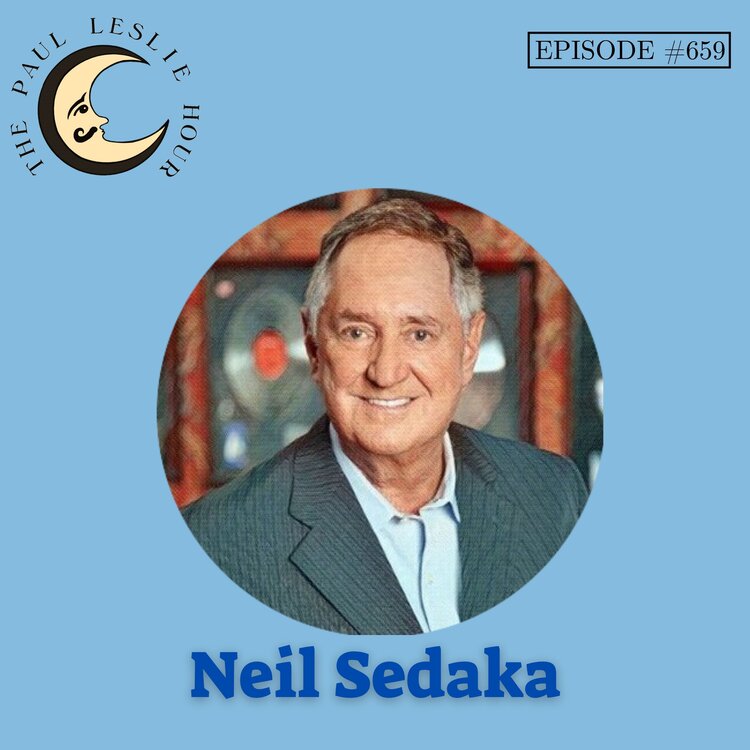
The Neil Sedaka Interview is featured on The Paul Leslie Hour.
Neil Sedaka is one of the most well-known and enduring people in American music, and for that matter the world. Sedaka is a singer, songwriter and record producer. Neil is known for his many hit songs.
On this episode, Neil Sedaka has a chat with Paul Leslie about the art of songwriting and his popular songs. You know many of Neil Sedaka’s songs: “Oh! Carol,” “Calendar Girl,” “Breaking Up is Hard to Do,” “Laughter in the Rain,” “Love Will Keep Us Together,” and so many others. To say Neil Sedaka is a genius is an understatement.
Did you know The Paul Leslie Hour is made possible by viewers and listeners like you? That’s right. If you’d like to help us in our mission of helping people tell their stories, just go here. Thank you to everyone who is contributing.
And now, it’s time to enjoy Paul’s short, but lovely interview with Neil Sedaka. Right here on The Paul Leslie Hour.
Help Support the Show Here.
Consider sharing this interview on Social Media.
Visit Neil Sedaka online.
The Official Neil Sedaka Interview Transcript
Hosted by Paul Leslie
Paul Leslie: Ladies and gentlemen, our special guest is Neil Sedaka. Thank you so much for joining us.
Neil Sedaka: Thank you for inviting me, Paul.
Early influences and classical roots
It’s a great pleasure. I kind of want to go back a little bit. What kind of music did your parents listen to?
We had on Make Believe Ballroom on the radio in the late 40s. People like Rosemary Clooney, Les Paul and Mary Ford, Johnny Ray, Jo Stafford. These are the songs I grew up with.
Who would you say is the greater, lesser known influence on your music?
I would say one of the great composers. I started as a concert pianist at the Juilliard here in New York. I would have to say either Chopin, Schumann, or Rachmaninoff.
And who would you say of the popular songwriters has been a big influence on you?
George Gershwin, Irving Berlin, Rodgers and Hart, Rodgers and Hammerstein, Frank Loesser, these were my heroes.
The Brill Building era
Our special guest is Neil Sedaka. Take us back a little bit to the Brill Building. What was that like?
Well, Howie Greenfield and I were teenagers. We were the first team to be signed to the Brill Building. It was a building filled with young publishing firms and young writers, specifically writing for young listeners. And I was the first in the Brill Building to sing my own songs. But I did bring Carole King, who I dated for a time then. She was the second writer to be signed. There were little rooms with a piano. And we wrote from 10 in the morning until five in the afternoon. It was a very good training ground.
The craft of songwriting
Now today, when you write songs, what is your preferred place to write?
I have two homes, one here in New York and the other in Los Angeles. Usually, I’m at the piano. I have to discipline myself and say today I’m going to write. And it’s not easy after 60 years of songwriting. That page is quite scary. You have to top yourself. You have to raise the level of Neil Sedaka. You have to write something that you haven’t written before.
When you write songs, what is your greatest well of inspiration?
I think listening to contemporary music, I think listening to vocalists, I was always very influenced by listening to different singers. Ella Fitzgerald, Mel Tormé, Dinah Washington, these were Barbara Streisand, these were my influences in writing. The human voice.
It’s interesting that you think it’s important to listen to other recordings of the people out there who are writing songs today. Who would you say are some of the best?
I think there’s several. I like Maroon 5 and Snow Patrol and Adele. Who else do I listen to? Well, of course, the great Stevie Wonder and Elton John and Billy Joel. They are the great standard writers, evergreen, you know, writers. But I think that one has to get out of their comfortable sphere when they’re writing. That creative force has to push you into something else, another direction. Otherwise you repeat yourself.
We’re talking with Neil Sedaka. What makes a good song a good song?
If I knew that, I would sell millions and millions and millions. Today, the record business is very, very strange. You know, it’s world music, it’s computerized on the internet. What makes a good song? Basically, I think a melodic, listenable, memorable tune with a lyric that’s meaningful, that has a sentiment that appeals to the masses. If I can describe it that way.
Legacy and cover versions
There have been so many recording artists who have recorded your songs in addition to the songs you’ve recorded yourself. Of other artists who have interpreted your work, could you pick a favorite recording?
Well, I think Love Will Keep Us Together by the Captain and Tenille. I did the original version on the Sedaka’s Back LP in 1975 and they heard it and covered it. It was a marvelous recording and I got a Grammy for it. But I’ve been very fortunate some of the great singers from Elvis to Frank Sinatra have covered my songs. I think maybe because I write vocally and the range is not wide and as I said the Brill Building taught us to write memorable, singable songs.
We’re talking with Neil Sedaka. It wasn’t too long ago there was a very young girl and she was telling me that her favorite song was Calendar Girl. What’s it like to write a song that so many years later people still know and enjoy?
Well, I think everybody wants some form of immortality and I’m very blessed that I have a gift of singing and songwriting and to know that these songs will outlive me is a great accomplishment. Funny you mention that song because I have a children’s book coming out called Dinosaur Pet that’s based on the tune of Calendar Girl. My son and I wrote a story about a pet dinosaur. It’s a illustrated and it has a 3D song set at the end and the words fit to the tune of Calendar Girl and it’s wonderful to be able to start Little Ones to read. This is my second children’s book but it’s very funny because my grandchildren, I have three grandchildren, they love Papa Neil’s old rock and roll songs and it was their idea for me to change the words to Calendar Girl and Breaking Up Is Hard To Do.
On that note, tell us about waking up is hard to do. I got to listen to that and I really enjoyed it.
Thank you. You know, it did very well. It was in the top ten on many of the Amazons and iTunes. And it’s nice to reach young people. It was a book about a little crocodile who had trouble getting up going to school in the morning. And it also had a three CD set at the end, three songs. It is, I just looked on YouTube a few months ago and there was a three year old girl singing Waking Up Is Hard To Do for her parents and they put it on YouTube and I was very moved by it. You know, you try to reach people but I never really thought that the young ones would take to the tunes.
Life on the Road and the Power of Music
You’ve had the chance to do so many things that many could only dream of and you’ve had the chance to perform all over the world. What has been your favorite place to perform?
Yes, I’ve been very lucky. I’ve played almost every country in the world. I was a musical ambassador, the beginning of rock and roll, to go to so many countries. Better than a politician going. I think my favorites are Rio de Janeiro, Brazil, Sydney, Australia, and London, England. I just love the temperament and the climate and the feeling of the people, the spirit.
What do you think music is supposed to do?
Reach the emotions, forget your worries, get you out of your own world. Music can be very therapeutic. If you are ill emotionally or physically, it’s been proven that music is very therapeutic. And I’ve seen it, I’ve gotten letters from people who said that the music has helped them.
What is the best thing about being Neil Sedaka?
The best part, I would say, is getting a good table at a restaurant or a theater ticket that’s hard to come by. The worst thing is you have to give up your privacy. You know, you have to… I do love people. I’m very fortunate. Even if I’m stopped for an autograph or a photograph, I find it very flattering. But you do have to give up your privacy.
I have two final questions. The first one, kind of light hearted. What is your favorite meal?
Veal Parmesan with Spaghetti Bolognese.
You were talking about YouTube and the fascinating thing about this age we’re living in, communication has become so rapid you’re able to reach people from anywhere. What would you, Neil Sedaka, say to our listeners?
Well, I want to thank them for staying with me more than 55 years of singing in a very trendy fickle business and I think it’s a two-way street, you know? I have this creative gift but I certainly have gotten it back from the audience tenfold and I thank them for keeping me creative. I just wrote my first piano concerto called Manhattan Intermezzo that I just recorded with the London Philharmonic and I think I would not have been able to do that if not for people who knew that I started out as a classical musician and prodded me to write something serious.
Mr. Sedaka, it has been a great pleasure to talk to you.
Well, same here. I thank you for calling and Paul, a very happy and healthy holiday to you.
Thank you and the same to you.