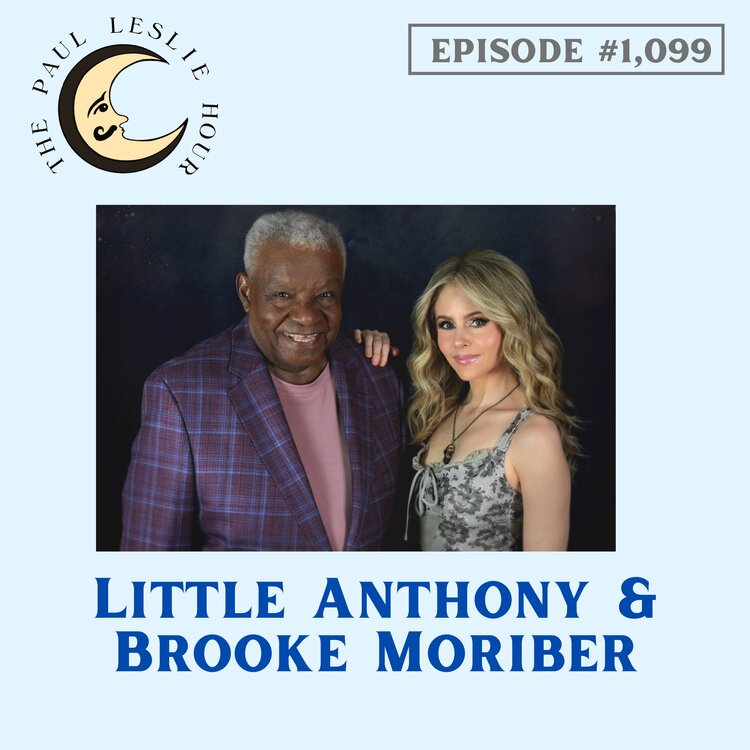
Join us for an engaging episode of The Paul Leslie Hour featuring the legendary Little Anthony Gourdine and the talented Brooke Moriber.
We get into the story behind their incredible duet of “Hurt So Bad,” a classic song reimagined with fresh energy. Discover the magic of their collaboration, the artistry of songwriting, and the timeless appeal of music that transcends generations.
Tune in for an inspiring, short conversation filled with insights, laughter, and the passion that drives these two remarkable artists.
Buy Paul a Coffee.
Support the Show
Subscribe to Paul Leslie’s YouTube
The Official Little Anthony & Brooke Moriber Interview Transcript
Paul Leslie: Ladies and gentlemen, welcome to another episode of the Paul Leslie Hour where we say, isn’t technology wonderful sometimes? It is a great pleasure to be joined by two singers. I’m looking at them right now. They’re two very talented, very attractive people. Brooke Moriber and Anthony Gourdine, known to the world as Little Anthony and
Little Anthony: Yeah.
Brooke Moriber: You. I’m—
Paul Leslie: Anthony, is my second time speaking with you. The last time we did it old school, we were on the phone, but now…
Little Anthony: Yes! Remember, yeah, that’s why I remember that. We grabbed the phone. What was weird about it, it wasn’t synced up to the desktop in the picture and my mouth was moving. I didn’t know what to do. So I just said, just do it, just talk, man. It’ll be synced up where you are, but it won’t be synced up where I am. Yeah, but we’re cool. I mean, so all is well.
Paul Leslie: Yeah. Everything is copacetic. Well, there is nothing in this world, in my opinion, better than when there are two voices coming together and something classic becomes new. And that is exactly what I thought when I heard your incredible duet of Hurt So Bad, a classic song, it feels new. First of all, congratulations on the song.
Brooke Moriber: Thank you.
Little Anthony: Yeah, yes, good stuff, good stuff.
Paul Leslie: Absolutely. So I want to start with you, Brooke, not just because lady’s first, but do you remember the first time you heard this song?
Brooke Moriber: David Ross from Reviver Records is who put Anthony and I together for this. And he thought of us doing Hurt So Bad as a duet because Linda Ronstadt had done it back in the 80s as a cover. And I sing lots of Linda Ronstadt songs in my repertoire because she is my vocal idol. But the crazy thing is I had actually never heard her sing this song. So the first time I actually heard the song was when David pitched the idea to me and I looked up Linda Ronstadt and I couldn’t believe I hadn’t actually heard that song of hers before. And then it’s an amazing difference between the original cover, original Little Anthony original of it, which is so brilliant. And then such a different take on it by Linda. It made me think, wow, well, let’s do something third generation of this and even more different. And I couldn’t be more proud of what we did with it.
The legacy of Hurt So Bad
Paul Leslie: And yes, the first version, Little Anthony and the Imperials. Anthony, can you tell us what is it about this song that you think has given this incredible life, where singers want to keep going back to it?
Little Anthony: I don’t know. First of all, it’s good stuff, which I always like to tell Brooke it’s good work. It’s what it was. It was at a time when groups singing groups at that time outside of the Drifters who were working with Stan Appelbaum, what’s his last name? I can’t remember, was a great producer at that time, Appelbaum, Stan Appelbaum. He was a great producer and he was using violins and the whole orchestra, all the pieces, I mean it was huge, it was like big. So they were the only ones that was doing that.
But when I got to work with the great Don Costa, that’s when he wrote the book, it had been Nelson Riddle. Hearing how he wanted to do it was quite exciting. And when we got in the studio, I mean, in those days, you had everybody in the studio at the same time. There’s like 46, 47 pieces of instruments. They had oboes, had violins, cellos, violas, everybody was in that house. And some of the best musicians in the world. And so right there, even in my little younger mind, I was saying to myself, if I could just do this thing with really all I’ve got, maybe it could be something, you know?
And it didn’t take long before we start listening to it all together as they began to do take after take. I don’t, I don’t remember. I think I may have done it on maybe six or seven takes. And finally they got it together and and Don loved it. He gave the thumbs up. And that was it. And we didn’t think much about it. Now, we remember we just came off of Going Out of My Head, which was a huge hit. So we had some momentum. I think that had something to do with it. So to be able to come back with that, with Bobby Weinstein and Teddy Randazzo’s lyrics and music, and give it the same big sound, but the song was so entirely different from Going Out of My Head.
And it was in particular, I had developed this reputation for going back when I was a kid. They used to tell me I cry songs or I act them out. And so in my mind I’m saying, well, this is really good stuff. Next thing you know, those are old days, there was a disc jockey it just started somewhere, blew up. And all of a sudden we’re in the top 20, we’re in the top 10 and we’re on our way. So, it’s anything that’s really, really good. I have learned in my years in this business, never count that somehow certain people have to approve of it or this one has to like it or in order to have the stamp of approval. No, the people you want is the public. They like it. That’s it. And some great movies were made, were canned by critics, but yet they were great movies. Yeah.
Paul Leslie: Great.
Brooke Moriber: Mm-hmm.
Paul Leslie: That’s so true.
Little Anthony: So music is that way. It still hasn’t changed. So I, like I told Brooke many times, I’ve won so many awards, I’ve won just a bunch of stuff. This one and that one and this one. And you get, you start to idol worshiping. I mean you start looking at your, I know some performers who do it. They begin to take those rewards and that tells them who they are. Or somehow they make this a affirms their character or from who they are which it doesn’t it’s just your peer saying you’re good and that part I love. I love that my peer said you could love to get this award. But the award itself we can get caught up in that we start shooting for that and it doesn’t work. You know you see you listen to Tony Bennett. Tony Bennett never changed the thing he did not once. It was Lady Gaga who went with Tony Bennett and did the thing that Tony Bennett was always doing. And then the audience heard that and they said, this is good. And one of the things that is so, put everything on that is when you can walk out that studio, you feel good about what you did. Or maybe you walk out the studio saying, I could have done that better. Or I could have this, get that note. That’s all.
Capturing the final cut
Paul Leslie: Well how did you all feel? How did you all feel when you listened to that final, the final cut? This is what we put down today. Here it is.
Brooke Moriber: I’m going to go back a little further than that final day. The day that we first got together with the band and recorded the track, I just had goosebumps all over. And Fred Mollin, our producer, we chose him for this because we wanted to do something epic and that is his thing. And the song starts off very, you know, minimalistic and builds and builds and builds and the crescendo that we get to at the end is just an incredible payoff and to hear it live with the band and sing it live with the band that’s that’s the peak of the thrill of recording the song. Yep.
Little Anthony: I concur.
The power of the songwriter
Paul Leslie: Well, Anthony mentioned the late, great Bobby Weinstein, who was a guest on this show years and years ago. And Brooke, I know that you write songs, but I want to ask both of you, what do songwriters mean to you? The men and women who put pen and paper or put the music to the words and make songs happen?
Little Anthony: Well, I’ll start and Brooke, you can take it. For me, I’m very blessed, man. I’ve been around some of the best in the business. I think as an artist, you really grow with that. I don’t know, because Brooke writes her own music. That’s kind of different. Where I don’t call myself a writer, I’m just a singer that happens to write sometimes, you know? Like I’m working on a song right now that came to my mind. Something happened to me. It’s every like, every 10 years. It’ll pop up in my head. And I started working with this young fella. We started working on it. I was so surprised at where it was going. The lyric and the artist, the writers. Okay, what I’ve learned is the one thing you want to do when you get the great writers or the ones that proving themselves over and over is you want to paint a picture through your voice or what that writer’s saying.
And it is not just the words and syllables and all that. It’s what is that person, that lady or that guy trying to say. So it’s very, very important for me to get with a guy like Bobby Weinstein and Teddy Randazzo and really talk about that. And this is what Don Costa told me. He said, that separates you as a singer from just being, you know, like all the run of the mill kind of cats coming out of, you know, doo-wop, whatever you call it. It’ll separate you if you understand that little business. So it’s really when it comes down to it, the king is the song. We are just the instrument that, that interprets it. We make the, we get the sketch and then we are the painters that put all the colors in it. So same with acting. Same thing, remember the directors telling me, you know, really, they don’t really know what they’re looking for, you have to show them what they’re looking for.
So you have to develop something in that character or something, where you can go, what? Or, that’s what I wanted. Well, the same thing with people who write songs. And those are different with Brooke, because she writes her own songs. So she’s married to that relationship with herself. And I’ve always said, people write their own songs, really write sometimes some of the best stuff in the world, obviously. But also, guys like me and Johnny Mathis and all the rest of them, we tend to wait for somebody to write it for us. It’s the song. The song is king.
Paul Leslie: Great.
Brooke Moriber: That you know sometimes I get pitched songs as well and sometimes I pitch my songs to other artists and the thing that always clicks because like you said and what we both kind of have in common is the interpretation of the song it has to be it’s an acting experience and a vocal experience. So if the writer is not being as truthful and open as they can it’s not going to connect as much. Where you know songwriters who write about the human experience and the more vulnerable and odd you think that that lyric is it’s usually the right one where it’s like I don’t know if I should say this but I’m gonna go there. So you know songwriters are they’re the beginning of the truth telling. You know what I mean? They’re truth tellers and it’s a collaborative effort with the writer and then the singer and the band and all of it.
So for me songwriting is very therapeutic. It’s been that way for a long time. I started writing music when I was a teenager. I lost my eyesight for four years from a rare eye disease and I wasn’t supposed to get it back. But I started writing music just because I needed a friend to talk to somebody who understood what I was going through. It was the most isolating time in my life. And I truly believe that music healed me and songwriting has been such a part of my soul since then because it’s my medicine. And singing always was my thing. I’ve been singing since, Anthony, you have probably the same experience. Before you can remember, you were probably a very loud child just singing since the age of like 0.1. Exactly. So singing was always there, but the songwriting wasn’t until, you know, the worst and the best thing that ever happened to me happened.
Little Anthony: I was three. Yeah, you can make examples of a lot of the different songs that are written, especially the Beatles. When I first started hearing the Beatles, I said, for goodness sakes, what’s that? We call that ice cream music. They ain’t hear it, man. That’s not it. But as they grew, they really actually grew as writers. They started to take their own careers in their own hand and start saying, well, we’re going to do whatever. And what came out, oh my goodness, George Harrison, Paul McCartney, John. It was amazing. And I think that’s the same with just about anybody. Really, they grow as songwriters as they go along. I know for a fact arrangers grow as they go along. Music arrangers. And our business, it’s collaboration of so many people. And the trick is, how do you get it’s just almost like it’s like a magical thing you get the right producer the right song the right singers like the planets lining up or something and that’s when you get the great material.
It’ll come out, you know in that respect now. We don’t know that until we actually sing it. They’ll get together in the studio and start singing it because I think Brooke would know this most times I can sing something and even as a new song and it’s, yeah, that’s cool. It isn’t until I get in the studio that I start hearing it back at me. And I go, whoa, did I do that? Yeah, I, you know, my mother tried to get me into music and art in New York. My dad didn’t want no part of it. He didn’t know, I don’t know, because he was a musician and he went through, you know, that was a tough life living in the big band era. And he just didn’t want that, but I’m the last kid and the other, my other brothers are very talented. But for me, when they found out I was singing at a very young age, the whole family became a unit behind me because they were all singers. My aunts were singers. My mother was a singer. They tell me my great-great-grandfather was a great singer. So that was all, I just there.
And so I really, really believe again, it’s just a whole bevy of things in your life that kind of brings out whatever it is. I hear things in Brooke’s voice. I say, wait a minute, that’s, that’s, that’s, that’s different. That her approach is coming from somewhere else and the way she can transition. I wish I could do that.
Paul Leslie: Ha ha ha.
Brooke Moriber: Are you kidding? You do that as a male singing in my range.
Little Anthony: I mean, you switch so quickly and so clear, know, like it’s not… I do it and there’ll be trouble. Or sometimes I’ll just grab it in the middle of somewhere and it happens. But I can’t repeat it that many times. It’s crazy. I have no real basis of anything. As a singer, it’s just there. I know it’s a gift from God as far as I’m concerned. And it’s just that when I get to a certain point, I guess what all these years, I kind of know when I nailed it and when I didn’t nail it.
Closing thoughts and future collaborations
Paul Leslie: Well, you all definitely nailed it.
Brooke Moriber: I think we both knew that we nailed this one. We knew.
Little Anthony: Yeah, we knew it. Yeah, we knew.
Paul Leslie: Yeah, you all nailed it. You said that you write sometimes, so let’s hope, let’s just hope that you two will collaborate and record again, because I will tell you, this recording, sounds like award-winning in my headphones. So congratulations to Little Anthony Gourdine, Brooke Moriber, Fred Mollin, all the engineers, all the musicians who made this incredible, incredible rendition of a classic. And thank you all so much for joining us on the Paul Leslie Hour. It has been a pleasure. You’ve brought a great big smile to my face. First when I heard the song and now to reconnect with you and to meet you, Brooke. Thank you both.
Brooke Moriber: Thank you. Yeah.
Little Anthony: Thank you.
Paul Leslie: All right, well folks, I hope that this isn’t our last visit. I hope we can connect and talk again.
Little Anthony: Well, I’ve learned how to work this thing again. There is a little thing over here that I never paid attention to. When I noticed it was off, like, you know, like on your phone, where you gotta hit that little round circle and then a blue light comes on or whatever it’s on. That’s right here. And I didn’t, there was no sign to say it was the sound or nothing. And I just saw it was off in the last minute when all was lost. I just looked at it, there you are.
Paul Leslie: Right. As Shakespeare said, all’s well that ends well.
Little Anthony: That’s it! That’s it!
Brooke Moriber: Yeah, exactly.
Paul Leslie: Alright, well you all have a wonderful evening. I’ve got to run. God bless you all and I hope to see you all singing live and in person.
Little Anthony: Thank you. See you later. See you later, Brooke.
Brooke Moriber: Thanks so much.
Paul Leslie: Thank you.
Brooke Moriber: See ya. Bye.
Paul Leslie: Bye bye.
Frequently asked questions
How did the duet between Little Anthony and Brooke Moriber come together?
The collaboration was orchestrated by David Ross of Reviver Records, who envisioned the pair recording a new version of the classic Hurt So Bad. While the song was originally a hit for Little Anthony and the Imperials, the idea for the duet was inspired by Linda Ronstadt’s 1980s cover. Moriber, who considers Ronstadt her vocal idol, jumped at the chance to create a “third generation” version of the track that honored the original while offering a fresh, modern perspective.
What inspired Brooke Moriber to begin her journey as a songwriter?
Moriber’s transition into songwriting was born out of a period of intense personal adversity. As a teenager, she suffered from a rare eye disease that caused her to lose her sight for four years. Facing an uncertain recovery and profound isolation, she turned to music as a form of “medicine” and a way to communicate her experiences. She credits this therapeutic process with helping her heal, transforming the most difficult chapter of her life into the foundation of her creative soul.