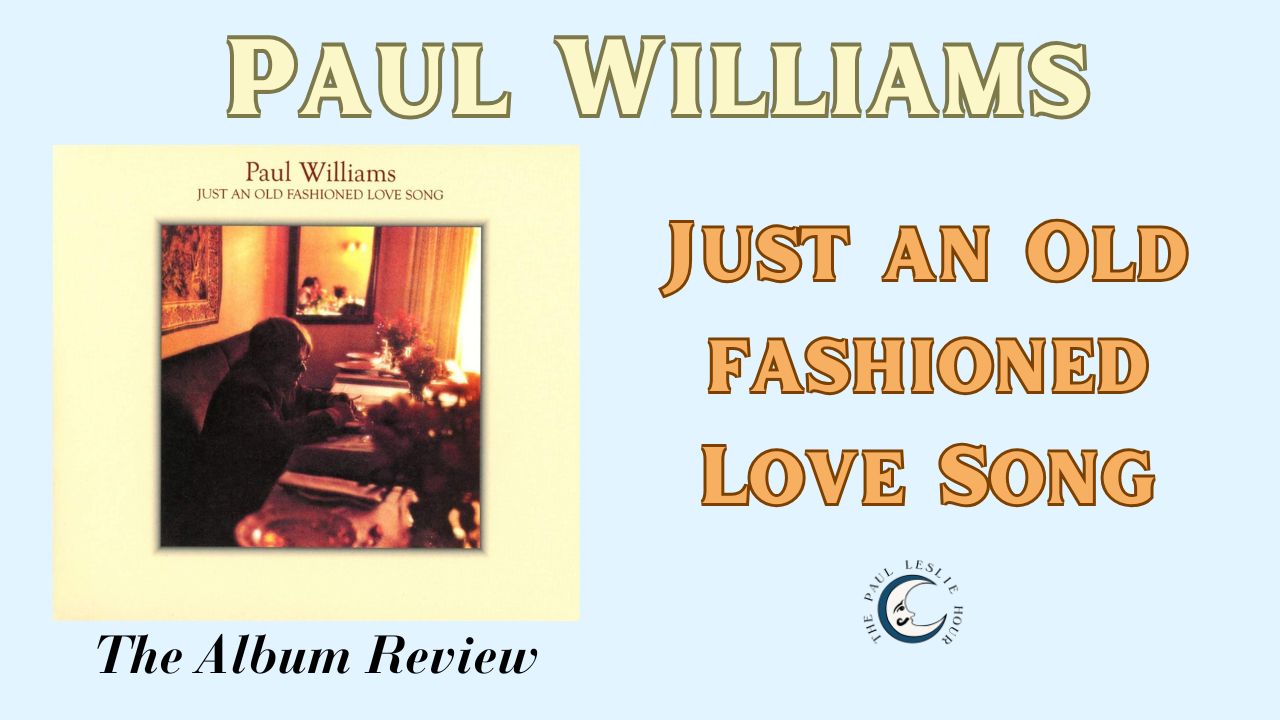
Are you here? It stands to reason that you’d be here, listening attentively to The Paul Leslie Hour’s review of Paul Williams 1971 album, “Just An Old Fashioned Love Song” on A&M Records.
I’m writing this after a full day, which also happened to be Paul Williams birthday. I wanted to listen to one of his albums. I ended up listening twice.
Paul Williams came out with his debut studio album “Someday Man” in 1970. Just a year later this sophomore effort came out entitled “Just an Old Fashioned Love Song,” on A&M Records.
Paul Williams the singer
Paul’s songs are more famous than his albums, become of the many famous acts that recorded them. Among the Paulie fans, as I like to call them, “Just an Old Fashioned Love Song,” is the one to have. It seems to hit on a lot of the things people like about him. The heartfelt lyrics. This album feels the most personal, although I’m sure to him they all are.
Paul sings all of the songs here with a kind of intimacy that is utterly endearing. His soft croon is something I find particularly comforting. It speaks to what excites me about a singer. Some of my favorite singers aren’t exactly cookie cutter.
While some many not like Bob Dylan, I’ve heard Dylan do some things that I haven’t heard replicated. It reminds me of something that Bob Dylan told Sam Cooke. He told Sam Cooke that he had a beautiful voice. As Dylan would tell the story, Sam Cooke told him: “Well that’s very kind of you, but voices ought not to be measured by how pretty they are. Instead they matter only if they convince you that they are telling the truth.”
I like the way Paul Williams sings Paul Williams.
“Just an Old Fashioned Love Song” leans into storytelling
“Just an Old Fashioned Love Song” was produced by Michael James Jackson, not to be confused with the King of Pop.
It has some of the best session musicians ever: percussionist Russ Kunkel, bass legend Leland Sklar and the prolific saxophonist Tom Scott. It’s got Michael Utley on organ, this was just before Utley embarked on a more than 50 year long journey with Jimmy Buffett. David Spinozza who’s worked with McCartney, Lennon and Starr is on guitar. Craig Doerge is on piano.
Lots of musicians, who Paul Williams refers to as the “magicians” on this work.
I like to imagine how it must have felt for Paul Williams. The songs he wrote and co-wrote were playing on the radio, as recorded by Three Dog Night and the Carpenters. And here he was with his own LP. He was experiencing life from a lot of vantage points.
The songs on “Just an Old Fashioned Love Song”
“Waking Up Alone” starts the album. It leans heavily into the storytelling. It’s evocative and kills me with the simplicity of the line “I could get back to the place, but not the time.”
Then, you’ll hear “I Never Had It So Good,” written with Roger Nichols. This is the first recorded version, but many singers would resonate with it and record their own version. Kris Kristofferson & Rita Coolidge, Dobie Gray, Jack Jones, Barbra Streisand.
Speaking of songs that have endured, the following song is “We’ve Only Just Begun.” I love the honesty of Paul’s delivery. I hear Roger Nichols’ beautiful melody and the tightness of the lyrics. There’s a reason why everyone from Karen Carpenter to Barry Manilow thought “Yeah, I want to record this.” What more could you want?
“That’s Enough for Me,” is a moody piece Williams wrote alone. The melody perfectly reflects a very intense, startling lyric.
Paul ends side one with “A Perfect Love.” It’s quite a feat when such a short song can tell such a complete tale. I’ll also recommend you check out the versions from Gladys Knight and the Pips and the New Seekers.
“An Old Fashioned Love Song,” starts side two. It’s the most raucous the album gets. It’s almost dixieland.
This gives way to “Let Me Be the One,” which had been recorded by the Carpenters earlier that year. Paul really emotes the earnestness of this album.
There’s also the one outside song, Graham Nash’s “Simple Man.” Clearly this song resonated with Williams. Every so often his albums feature a song that he didn’t write. I like it when singer-songwriters do this. It’s a nod.
“When I Was All Alone,” is my favorite song on “Just an Old Fashioned Love Song.” The lyrics are so good. “Love was not an easy word to laugh about, and it’s still not an easy word to say.” Man, it’s weepy, but there’s something in Paul’s vocal that lets you know it’s not hopeless.
Then the beat picks up on “My Love and I,” which I believe a country singer could and should record, even today. Mary Travers would cut it the year after this album came out.
The last song on an LP can be the most important. It leaves the listeners with a final embrace from the singer. On this album it’s “Gone Forever,” a teary lament, and then you hear the keys of Craig Doerge, who plays the piano on every track. As the music went silent it brought me back to the first time I listened to this album. The understated cover pulled me in as I picked it up.
“Those who listen”
I knew by the time the last note played that this man was someone I would pay attention to. He was miles away from Little Enos in Smokey and the Bandit, yet somehow he was there too.
I’ll take his music any way I can get it. I love hearing someone like Willie Nelson sing “Rainbow Connection,” but Paul Williams is a writer that can sing his songs too.
This album feels like it was tailor made for me. Maybe it was. Just pick up the album and look at the back. You’ll read two sentences: “There are those who listen, and those who wait to talk. This album is dedicated to the listeners.”
That’s me. Maybe it’s you too. No matter what, I hope you’ll give yourself the gift of listening. There’s an art to listening to these great songs and everyone can practice it.
Great songs endure. As Paulie once wrote, “No need in bringing ‘em back, cause they’re never really gone.”