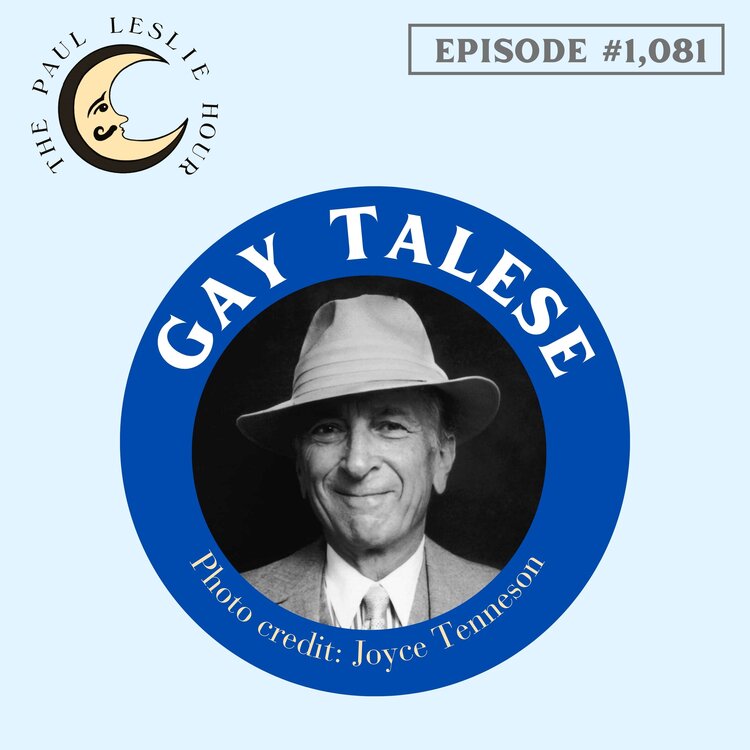
Renowned writer Gay Talese joins The Paul Leslie Hour!
Are you here? This is episode 1,081 of The Paul Leslie Hour! Join us for a personal phone interview with Gay Talese, the legendary journalist and author whose iconic Frank Sinatra Has a Cold redefined narrative nonfiction.
Subscribe to Paul Leslie’s YouTube channel for the video version of this interview, complete with captions for nearly effortless listening / reading.
Let’s dive into the show!
Help Support the Show Here
• Apple • Spotify • Audible • iHeartRadio •
Support the Show
Subscribe to Paul Leslie’s YouTube
Follow Paul Leslie on Instagram
The Official Gay Talese Interview Transcript
Paul Leslie: We are in business, sir.
Gay Talese: Okay, Mr. Lester.
Paul Leslie: Thank you so much for making time to talk to us. Gay Talese is one of our great American writers. He’s been called one of the pioneers of journalism. It’s such a pleasure to have you on the line. You’re joining us from New York City, correct?
Gay Talese: I’ve been here for about seventy-five years. I’m ninety-three now. I’ve spent most of my life in New York. I’ve traveled a lot, though. As a reporter, I’ve traveled a lot, including Asia and Europe and all over South America.
Italian heritage and perspective
Paul Leslie: A lot of different places, yet you still make New York City your home. Talese is undoubtedly an Italian-flavored name. How did having Italian immigrant parents affect you?
Gay Talese: I was born in 1932. My father came to America in 1920. He was a seventeen-year-old. He was a tailor. He trained for a while in southern Italy, then he went to Paris where one of his cousins was a master tailor. Then my father left Paris in 1921 and resettled in Ocean City, New Jersey. That was in 1942, twenty years later, when the war was on. My father’s brothers were in the Italian Army. My two uncles, younger men than my father, and I got a sense of what it was like to be on the wrong side of history. I got a sense of seeing the war from the American side as an American citizen, and I was rooting for America, of course. On the other side, I was related to the enemy, and it helped me. I always saw the other side of the enemy. I don’t care who it was, whether it was the world of sports or politics or international affairs. I see sides. I see Putin now. I see Zelenskyy. I see the side of people in Afghanistan. I see the Taliban. I see a little bit from each side. I imagine what it’s like being the enemy.
Paul Leslie: How interesting.
Writing for the underappreciated
Paul Leslie: You feel underappreciated?
Gay Talese: Writers or downtrodden ordinary people, non-newsworthy people, not famous people, most of them. Sinatra’s an exception. I didn’t even want to do that article for Esquire. I did it because I was forced to do it by the editor. I write about that a lot, but on the other hand, I’m really a writer for the undiscovered or the underappreciated people, like I am myself.
Representing the unrecognized
Paul Leslie: You feel underappreciated?
Gay Talese: Under-recognized. I represent people who are underappreciated. Not that they feel they don’t even want fame. They don’t want recognition. They just live ordinary lives going unrecognized. When they die, they don’t get an obituary in the newspaper. In the big newspaper, in The New York Times, obituaries are status; people of status get those. But the people who own the drug store down the street, or own the shoe store, or work at a hardware store, or work at a department store, they die obscurely as they live obscurely. Those are the people I like to write about.
Growing up in Ocean City
Paul Leslie: I have a bit of that in my makeup as well. This makes me think of Bob Dylan singing about “a complete unknown.” Tell me about what it was like for a guy growing up where you did to go to Alabama to get your university training.
Gay Talese: I was born in Ocean City, New Jersey, which is near Atlantic City. It was founded by Methodist Ministers in the 1840s. A very Puritanical town, no drinking; even to this day, you can’t buy a drink, there are no bars in the town. It was made up of really white Protestant Republican Conservatives, and the flags are waving all around it, all year long, not just on holidays. There was the Klan there, and when I grew up in the 1930s, I was born in 1932, as I said. The 1940s. There was the Klan, and on the beach, they’d parade on the boardwalk. Not that they bothered anybody. In fact, the people of the fire department or the pharmacist of the town was the head of the Klan. You didn’t know it by the white sheets, but everybody knew it was true. When I went to Alabama as a student in 1949, I graduated in 1953. I didn’t see any difference between Ocean City, New Jersey, and Tuscaloosa, Alabama, where the university is located. The Klan was there; the Klan was in my town. The racism of my town: Black people were in the balcony of the movie theater. No one protested. It was before the protest movement, of course. But I didn’t see any difference in the Deep South, in South Jersey, where I was from. When I later became a reporter, I was sent to Alabama to cover civil rights, among other people, for the Times, and I wrote about that a lot. The North was hypocritical. They blamed the South for all the problems of racism that existed undercover in New York and New Jersey and Pennsylvania—hypocritical. I wrote about that.
Paul Leslie: I applaud you for making that point. When you wrote “Frank Sinatra Has a Cold,” before you wrote that piece, which I read for the first time in a bookstore, I’m curious, what was your way of feeling about Sinatra before you had written the piece? How did you look at him?
Writing about Frank Sinatra
Gay Talese: I grew up with Sinatra. I heard his songs on Lucky Strike Hit Parade radio in the 1940s. He was so famous. He was very famous in the 1940s and 50s. I grew up with him, but I didn’t want to write about him. I admired his singing very much, but I didn’t want to write about him. I wanted to write about those obscure people I mentioned earlier. Plus, I wanted to write about some of the interesting people who are on the staff of the New York Times. The obituary writer was so interesting. I wanted to write about him. I wanted to write about the managing editor. I wanted to write about a foreign correspondent named Harrison Salisbury. Terrific people. And that’s why, when I joined them for a one-year contract in 1965, the same year I left the Times, the editor said I could write about these people, but I also want to be able to write about people that he wanted. Who did he want? Frank Sinatra! I said, “No, no, no, I don’t want … Everybody’s written. He’s over-written, everybody knows about him. There’s no new story. What could you write about? What could you write about Frank Sinatra that hasn’t been written already?” I asked the editor. He said, nevertheless, that’s a cover story. Write it. I did. Best I did, I didn’t get any cooperation. I talked to the little people around Sinatra. That was my way of doing things. Little people tell a big story. That’s what happened with Sinatra. Then I wrote his piece, and there it is, if you read it.
Paul Leslie: Has it surprised you, the longevity of that piece and how renowned it is?
The lasting impact of the Sinatra piece
Gay Talese: It surprises me. I don’t know why that’s true. You tell me?
Paul Leslie: I just think there’s a certain poetry without being overly fluffy. You know what I mean?
Comparing other works to Sinatra
Gay Talese: Most of my pieces are well written like that. I’ve written pieces, “Ali in Havana,” “Mr. Bad News,” the article I wrote about the obituary writer, “Thy Neighbor’s Wife,” “Honor Thy Father,” “The Kingdom and the Power,” “The Bridge.” I wrote a book on the building of a bridge. Every bit as good: they’re better than Sinatra. But for some reason, the Sinatra thing became my trademark, my marquee’s point, my point of reference. And that’s the way it is. I shouldn’t be complaining, I’m grateful. At least he was something. It’s better than nothing. But I’ve written so many other things I think are superior, but that’s the way it is. You don’t know. You can’t pick your route to some recognition.
Paul Leslie: That does seem to be the case. It seems that that’s the case with actors. It’s the case with singers, and it’s the case with writers. They write something, it becomes famous, and they say, “Hey, did you not notice this one? This one’s better.” Is there a piece that you’re particularly proud of that you think, “Hey, if you’re interested, check this one out. This is a good one.”
Pride in “Bartleby and Me”
Gay Talese: A couple of years ago, a book of mine called “Bartleby and Me” was published. And I’ve written a book since, called “New York,” a book about New York, called “A Town Without Time,” published last year. But two years before that, “Bartleby and Me” has a wonderful section called “Dr. Bartha’s Brownstone.” It’s about a doctor in New York who blew up his brownstone because he didn’t want to leave it to his wife, divorced wife, and said a court order to the court settlement, but it was a story about a man and his house. It’s tragic. Sad, but wonderfully written and wonderfully researched piece that’s an example of what I could do with a man that’s not known and make it into a really important story. That’s in “Bartleby and Me.” To me, it’s a good book.
Paul Leslie: Very good. Well, on the note of well-written, what writers would you say have impressed you the most of any era whatsoever?
Influential writers
Gay Talese: Tom Wolfe. I’m a great fan of his, great friend of his. You can’t imitate Tom Wolfe. He has such a great style. Among the fiction writers, Philip Roth was a wonderful, wonderful writer, storyteller. John Updike was a good short story writer and a novelist as well. Norman Mailer, who I knew and befriended. And William Styron, he’s a wonderful writer. “Sophie’s Choice.” And “The French Lieutenant’s Woman” by Mr. John Fowles, who’s a wonderful writer: English writer. Of course, I grew up with Fitzgerald and Hemingway. They’re great writers. You read them now. They’re still great. Irwin Shaw, no one heard of him. Irwin Shaw and John O’Hara, I grew up with those writers. The New Yorker.
Paul Leslie: Undoubtedly.
The fading of writers
Gay Talese: No one’s heard of them now, but they’re wonderful writers. Writers die as their audience dies. That’s sad, but some of them live on like Hemingway and Fitzgerald, but most of them do not.
Paul Leslie: Going back to Mr. Tom Wolfe, what would you say his greatest talent as a writer was?
Tom Wolfe’s talent
Gay Talese: Language. He could make the language sing and dance and jump off a cliff. He was such a word merchant. Also, he was funny. He was a satirical writer. Also, he was courageous. When he decided, after criticizing novelists, he’d write a novel himself and did it and succeeded. He wrote a number one bestseller. I thought he was courageous to do that because he’ll get particularly bad reviews from his enemies in the press. And the one he wrote on Lenny Bernstein, and then on the Black Panthers. What courage. No one would write that today. Today, that wouldn’t be published. Political correctness would never allow that to be published, but Tom Wolfe was courageous. He did it and wrote about it in The New Yorker. Tom Wolfe did things that no one would do because no one had his courage. Very, very remarkable man.
Paul Leslie: You brought up political correctness and something that I’m observing. It seems like people of all types of political backgrounds, there’s almost a uniformity of people saying they’re getting tired of that. Do you think that’s true?
Views on political correctness
Gay Talese: I think they are. I’m going in! You can’t be a writer and be politically correct. You can’t be a good writer and be. You have to see all sides. I said when I was growing up, I saw the enemy. I was interested in the enemy. I wanted to tell the enemy’s point of view as well as my own hero’s point of view. Right now, it’s one side. Either right or wrong. You’re a nightmare or you’re an angel. You’re right or you’re wrong, it’s just terrible.
Paul Leslie: Very well put. You turned 18 in 1950. If you could hypothetically go back to the Gay Talese who was turning 18 and give him advice, what would you say?
Advice to a younger self
Gay Talese: When I was 18, I was a sophomore in Alabama. I was then doing what I do now. I was reporting stories for the Birmingham Post-Herald, a Scripps-Howard paper. I was a campus correspondent for that paper. I also was a college sports editor for my college newspaper. I wrote a column as well. I was doing at 18 what I do at 93, 92, 91. I haven’t changed. I never had a cell phone in my life. I don’t use computers. I mean, I use computers to write emails, but I don’t write, I don’t use the technology. I don’t do Zooming, and I don’t like this modern tech. I want to see people face to face. It’s too bad we can’t see one another face to face. Telephone’s okay. I need it sometimes like this, but I try to avoid it.
Paul Leslie: There’s something when it comes to interviews, there’s something pure about keeping the technology as much out of the way as possible.
Thoughts on modern technology
Gay Talese: You know, when you go to a restaurant and sometimes you see people, a man and a woman having dinner. Both of them are talking on their goddamn telephone. It’s a sad story. It’s really nuts.
Paul Leslie: Well, I’m glad you brought up man and woman. You have been married. You’ve had a long marriage.
A 67-year marriage
Gay Talese: 67 years. Nan is 92, and I’m 93. We have two daughters that are in their 60s. They live in different parts of New York. One of them lives in Brooklyn, and the other in downtown Manhattan. So that’s just the four of us. We see one another once a week at least.
Paul Leslie: What do you credit the success of your marriage, which by the way, congratulations.
Secrets to a lasting marriage
Gay Talese: I think the fact that my wife had her own career as a top editor. She was the woman that discovered Margaret Atwood, “The Handmaid’s Tale,” Ian McEwan, Pat Conroy, Antonia Fraser. My wife had a great list of writers. You’ve probably interviewed McEwan, Ian McEwan, English writer, or Margaret Atwood. My wife was a great editor and had her job. She had her own life, and I had mine. I traveled a lot, but then she was busy all the time. Also, we’re lucky having a house that had rooms. We had our own bathrooms. That’s very important. We were not crowded. She was always busy with her own career. She was never relying on me as the provider. I supported her, and she supported me, but it was never dependency. That’s important. No dependency. Easy, easy marriage.
Paul Leslie: I’m curious if you met her associate, the author Pat Conroy. He’s somebody I corresponded with. You did. What was he like?
Memories of Pat Conroy
Gay Talese: Oh! A jovial, wonderful guy. He drank a little bit, but it didn’t bother his writing. He was a wonderful, wonderful man. Generous to a fault. He was always delightful to be around. Very funny. He was almost a comedian, but he gave speeches to book societies. He was droll, and he was hilarious. He was very modest but a wonderful guy, and a wonderful writer. My wife loved working with him.
Paul Leslie: Something that I have noticed about people who live into their 90s, having interviewed a lot of people through the years, is there’s almost nobody, going back to that politically incorrect thing, there’s almost nobody who makes it to their 90s who isn’t also thin.
Gay Talese: Thin. You said thin?
Paul Leslie: Yeah, thin.
Aging and health
Gay Talese: Well, I’m getting thinner. The problem is you lose your taste when you get old, for food. And you don’t enjoy it that much. And you eat because you have to, but what you eat, you don’t eat much of anything. It’s just you lose your taste. You lose your joy of dining. That’s one thing. Number two, you don’t use up a lot of energy because right now it’s hot out, as you know. I don’t go out very much. I used to go out to restaurants. I don’t go out because I don’t like the food. I stay at home more. I watch a lot of movies on television. I watch movies on television till sometimes two in the morning, three in the morning. I get up at noon, not before. My wife and I get up at one o’clock or two o’clock in the afternoon. That’s a very special life like a rock star right now. I’m like Mick Jagger, a little like the hours of Mick Jagger. It’s fun. We’re on our own schedule.
Paul Leslie: Say that last part again.
Living like a rock star
Gay Talese: We’re on our own schedule.
Paul Leslie: Have you been a person who is concerned with health? Are you proactive about health?
Health challenges in old age
Gay Talese: It’s my voice, as you know, I had a throat operation because I couldn’t swallow, but one of the side effects is it ruined my vocal cords. That’s one thing that bothers me. Another thing that bothers me is I don’t have Alzheimer’s. I don’t have a disease that’s going to affect me even with my life, but my hands shake a little bit. I can’t type very well. I can’t write longhand very well. I used to write longhand as a writer. That’s hurting me a lot. It’s so difficult for me to write or type. I do. It takes me triple the time to type. These are things I don’t walk with great confidence. I have a cane. I walk in the street. I’m very careful. I don’t want to fall because when people, old people, have a fear of falling. And they should. Because it’s very dangerous to fall on your face against a New York sidewalk. Very bad. So I’m careful. That’s part of being old, being careful.
Paul Leslie: Good, good that you’re being careful. Writers are people that just need to get it done. What advice do you have for writers in terms of getting the work done?
Advice for writers
Gay Talese: I’ve 16 books published. Some of them are collections. Some of them are full-scale stories. But I did it from the time I was 22 till I was 92, a year ago. You have to not procrastinate. You have to do it. You have to show up at your typewriter or your computer. You have to do it. You have to produce. And I’ve always, for all my life until right recently, I produced every year certain published writings in a magazine or a book. You have to do it. It’s like an actor. The show must go on. The show must go on, and it does for me. And I’m pleased with that.
Paul Leslie: What are you the most proud of when it comes to your career and your life?
Pride in career and life
Gay Talese: I think my life as a married man, a father, and a writer, all combined, give me great gratification. I’ve enjoyed my many years with Nan, my wife. We’ve had great adventures. We share great sadnesses. We shared also some good, very good news when we had our moments of success, she as well as me. Our daughters are delightful. No scandal in the family. My work, I’ve always been proud of my work. I never did anything I was unhappy with. And all my published work, thousands of published pieces in newspapers and magazines, and then 18 books, about 15, 16 books. I’m not, I wouldn’t redo any of them differently than I did the first time. I worked very hard to get my final draft, the best I had in me. But now that it’s published, I’m not regretting any of it. So my long career gives me great satisfaction right now. At its end.
Paul Leslie: My last question is a very, very open-ended question. We have all different types of people listening in all different types of places. What would you say, totally open-ended, to anyone who is tuned in?
Message to the audience
Gay Talese: Well, what I said, seeing the other person’s point of view. There are many sides to one story. Many people are very different from us. We have to try to understand the difference. What makes them what they are? We always have to explore their own interior. We must understand their own differences. We have to be tolerant of people. I’m the son of an immigrant, so I’m very soft on immigrants. I’m the son of a working tailor and a mother around a dress shop. They’re workers, I’m a worker. I’m not a lazy person. You cannot be lazy and succeed. I believe that we also have to be aware that many people are less fortunate. We should try to help them, either through our writing or through our presence. That’s what I would suggest. But being kind to other people, and understanding, and being smart about your own reaction to people, being tolerant. That’s important. I salute that. And thank you so much for having me on your show. I enjoyed it so much.
Paul Leslie: I enjoyed it so much, and I thank you so much, and I disagree with what you said when you first called that you would not be a good interview because you’ve been a great interview.
Closing reflections
Gay Talese: Well, I hope they tolerate my voice. I’m sorry I’m not stronger or younger, but I appreciate your tolerance. You’re very understanding. I appreciate how you’ve dealt with me in a kind way. I wish you well with your long-running show. Good luck and thank you so much again. Good afternoon. Gay Talese.
Paul Leslie: Thank you.