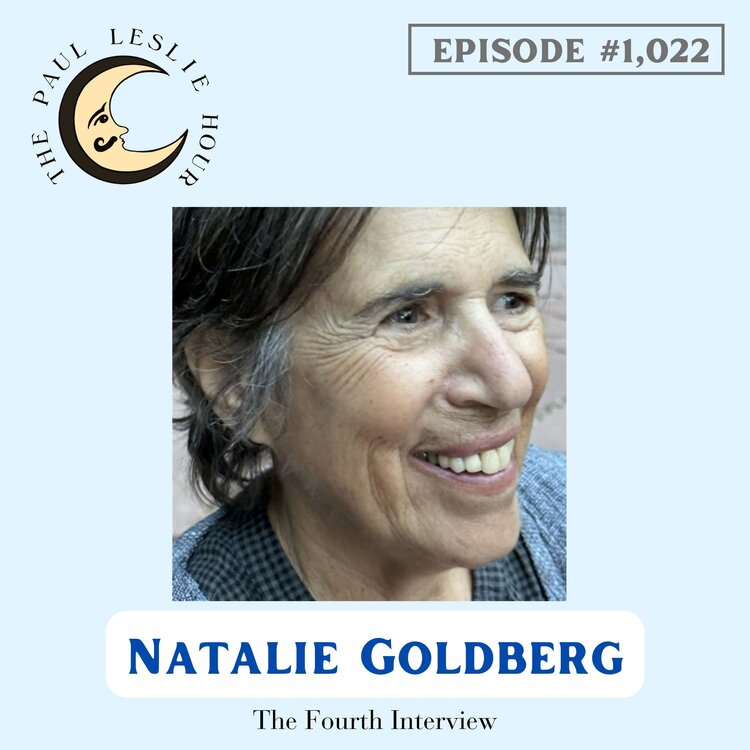
Natalie Goldberg joins The Paul Leslie Hour for a fourth interview!
Are you here? The answer could be philosophical, scientific, even metaphysical. We’ll settle for YOU being HERE, in any way that your imagination allows. We’re pleased you’re joining us on Episode number 1,022 of The Paul Leslie Hour.
We’re welcoming back writer, teacher, painter and poet Natalie Goldberg for her fourth visit on The Paul Leslie Hour.
Natalie’s newest book is entitled Writing on Empty: A Guide to Finding Your Voice, from St. Martin’s Essentials, an imprint of Macmillan, publication date July 9th, 2024.
Quickly, we’ll remind you that The Paul Leslie Hour is made possible by viewers and listeners like you. Soooo, give yourself and others the gift of stories. Just go right here, and we thank you for listening and contributing.
With that, our only thought is: who’s ready for Natalie Goldberg?
Help Support the Show Here
• Apple • Spotify • Audible • iHeartRadio •
“Are you here? Well, the answer could be philosophical, scientific, even metaphysical.”
We’ll settle for you being here in any way that your imagination allows. We’re pleased you’re joining us on episode number one thousand and twenty -two of the Paul Leslie Hour. We’re welcoming back, writer, teacher, painter, and poet Natalie Goldberg for her fourth interview on the Paul Leslie Hour.
Natalie’s newest book is entitled Writing on Empty, a guide to Finding Your Voice from St. Martin’s Essentials, an imprint of Macmillan. Publication date, July 9th, 2020.
We’ll quickly remind you that the Paul Leslie Hour is made possible by viewers and listeners like you. So, give to yourself and to others the gift of stories. Simply visit www. The Paulesley .com slash support. And we thank you for listening and for contributing.
“So with that, our only thought is, who’s ready for Natalie Goldberg?”
How are things? Good. All right. I’m glad to hear it. Tell me again where you are. Well, I am still in Charleston, South Carolina. I had moved from Atlanta, Georgia. Have you been in Atlanta to, oh, you know, that great place? I was there. What’s his name that everybody quotes from? You know, the Persian poet. Rumi? Yeah, Roomy. Have you been to Roommies? I absolutely have. It’s great, isn’t it? Yes.
Oh, it’s just like our other interviews. We tend to start off with something culinary. Oh, is that one? So last night, you know, my book just came out last night. That’s right. A publication reading. And They said, Natalie, you always talk about food. And I thought, how dare you? Of course not. And here you are saying that.
“Well, Natalie, I have to be totally up front with you.”
I was watching that Zoom. You were at Collected Works in Santa Fe, New Mexico, talking about this, writing on empty. I think this is book number 16. Is that right? Yes, it is.
My confession is, that was my question. About the cookbook. Oh, about the cookbook, yeah. Yeah, yeah, that was me. Oh, you asked it. Yes, yes. I asked that question anonymously. Oh, okay. Which I suppose was a little greedy or selfish, I guess, of me, because I have a chance to ask you some questions today in our fourth go -round. Yeah.
Well, I wanted to know, just being there long distance, because I’m a long way from Santa Fe, it could be a song lyric or something. It felt like there was a very, a very connected and communal feeling to this event. There was an energy to it that’s usually you can’t get that over Zoom, but I was really, really, I felt like I was right there, is I guess what I’m trying to say.
Yeah, you really picked it up. I haven’t been with people. Actually, this book writing on Empty is about the COVID years. And so I hadn’t been with people for my last three books. Did I write that many books during that time? But anyway, so this one, it was really fun to be with people again. And I was older. And, you know, as you can see, I’m wearing glasses. And I couldn’t see everyone everyone who’s there. And it turns out there were a lot of friends there, but way back. I mean, there were a lot of people and a few people up front who haven’t seen and they were all just eager to be together. It was that way. And many, many people I didn’t know, but it felt communal anyway because it seemed like they had read my book. So it was fun. It was really fun. I’m glad you were there. Yeah, it was a fun event.
“And I’m wondering, did you have a greatest lesson that you yourself got from writing, writing on empty?”
That’s a great question. Well, the first thing that comes to mind is, But I have more to say, I can do it. I can still do it because I didn’t know, you know, when you get older. And also, I found my way out of COVID, not out of COVID, but my way in COVID to continue being a writer. I did find that. And that was very important to me because everything had been wiped out, you know, the cafes leaving the house. I just stayed in the house, was depressed.
And like they say, when you get older, I know this woman who’s 84, who’s this my typist, and she’s fantastic, and she’s an incredible dancer. And I said, what do you do? And she said, you just keep moving. And that’s what I did. I didn’t consciously realize it, but I had to get out. And so we drove across country. We drove to Port Towns in Washington. And in that mobility and movement, I found myself again.
I took, as the reader, I took, because I’ve had this excuse that I’ve used sometimes that I’m on empty, you know. And as I was reading the book, even before I got to the, you called it a roadmap at the end, where you actually, it switches from being more about your experiences and then it becomes participatory. And I thought there is no empty, as long as I’m alive. There, You know, there’s always something to write about.
Well, that is a great thing to say, and there’s no empty, even if it’s boredom. Right. Or the, you know, the void. That’s not empty. That’s the meat of Zen. So, yeah, that’s terrific, Paul, that you realize that.
“Something that I hear from a lot of people who will contact me and there’s different stories of this and a lot of these people are writers and they have this list that’s a self -imposed list on themselves.”
that I have to write I have to maybe sit in silence or I’ve got to do my exercises I’ve got to swim I’ve got to walk and then it’s like they It’s a self -imposed judgment on themselves, and they feel like, oh, I didn’t do the list that I must do. And, you know, maybe my writing title should be revoked or something.
But sometimes I look at these lists, and I wanted to get your thoughts on this. Sometimes I’m looking at the list, and I think, well, goodness, you’re a human being. You have limitations. I mean, you can’t do everything. How do we come to terms with the fact that we are flesh and blood and bone?
It’s really hard. It’s really hard, but don’t make it harder by being critical and judgmental of yourself because you don’t do your list. And look at your list. Is it realistic? And do you want to do it? Let it come from inside something that you want.
But of course, at the beginning, like learning to play tennis with the Williams, I’m thinking of them particularly right now, the Williams girls, women, I would call them now. But when they were girls, they just kept going and they kept showing up. And I was much tougher on myself at the beginning because I wanted it bad, but I didn’t know I could do it. And I had to practice. I didn’t know how to write. And now I’m quite soft. Maybe my students wouldn’t say so, but I think I am compared to the way I was, definitely.
“I think probably one of my favorite parts of this book, writing on empty, is the introduction of your mother.”
And I think that sometimes when we write, we can find a source of compassion where maybe we thought that it wasn’t there. Can you tell us a little bit about that experience? Was there any trepidation to write about something personal?
It wasn’t trepidation in writing because I’ve trained myself, go for it. It’s afterwards, Natalie, the human being a month ago when I realized it was coming out, I thought, oh, no, because I’ve never written about my mother and I’ve had a really hard time with my mother. Let me say now she’s been dead for 15 years.
And during COVID, in that empty time is when I actually felt the first emotional compassion for her because it was so bad for me, the COVID, that I thought, wow, I feel like a 50s housewife, you know, the stereotype of that. And I suddenly realized, nah, that’s what your mother was. And this is what she dealt with. And I was flooded with compassion for her.
And then in that opening, I was able to start to tell some stories about her. I don’t know if they’re always very nice stories, but the fact that you tell a story about someone, you care. They’re in your life. They have to be someone that matters.
“You mentioned that you kind of got a feeling about what life was like for your mother because of the 50s housewife thing.”
Is there any other way that you see your mother differently now? Yes, definitely. I understand much more deeply that my grandparents ran from pogroms and Stettles in Poland and Russia way before the Holocaust. Most people only know about the Holocaust as a terrible thing that happened to Jews. But really, there’s been tremendous prejudice for a thousand years.
And before the Holocaust, my grandparents ran from pogroms, where people would get drunk, mostly men, on their horses, because this was in the 1800s and gallop through these Stettles or ghettos and kill anybody they want, you know, maul them and no consequences. So my grandparents ran from that.
And so they had a great victory. You know, they were here. They made it out. And they had a place to go to. The U .S. was good then and or at that time for them. Don’t talk to black people. But I realized my parents are first generation. And I never really realized that they’re lost. You know, that my grandparents didn’t know how to give them this country. They were just so relieved to get here. And the mores and the culture.
And so my mother mostly shopped. That’s the only thing she could think of doing and sales. She was big on sales. And as a kid, I was bored out of my mind because I had a great need for something else. But she couldn’t give it to me.
“Well, I’ve been enjoying the book and I’ve been doing some of the prompts at the end.”
Is there a great message that you hope somebody gets when they read Writing Unempty for themselves? Oh, writing on Empty. Just that we can continue. We can, and that it’s important to continue, and you have to find your way to continue, because it isn’t black and white.
Things are very complicated right now with politics, with what’s going on in the world. You have to really stay awake and make an effort to continue. I could easily have given up. That is a great message to take away. Absolutely.
“Natalie, you’ve done so many things.”
You’ve written now 16 books. You’ve had a chance to travel. You’ve had a chance to make a documentary film. There’s been all of these things. Is there anything that you want to do that you haven’t done yet?
That’s a great question. Love better. Learn to love better to be more present. There’s no great burning thing that I have to do. No. I was in love with everything I’ve done. And so I just, I kind of want to deepen it. And I really love this time where I call myself retired, though my friends say you’re not retired now.
Well, one of the things, I’m taking a group to Montgomery, Alabama in September. And we’re going to study Byron Stevenson’s work. I don’t know if you know it, Just Mercy, his book and his movie, and we’re going to study John Lewis memoir of a movement. And we’re going to go, each day we’re going to do one of Brian Stevenson’s. He’s been there for 30 years. He set up an incredible legacy museum, then a legacy monument, and just now a whole sculpture garden along the river where they slaves.
I wanted some way to work with that. I’ve always assigned people of color for 35 years of teaching. And I have a fellowship program for people of color for over 35 years. But I went into the belly of the beast. I mean, the beast is all around us. But I went to Montgomery. And I was stunned by it. If I was younger, I think I’d move there. It was back in the 50s.
I just admire what he’s been doing, that he went down there. He’s an African -American lawyer who went to Harvard and right afterwards went down to Montgomery and realized that a lot of people were in jail, not because they had done anything, but because they were black. And he worked really hard to get them out and stayed there. That’s what’s powerful. He stayed there and built equal justice initiative. And there’s probably around 300 or 200 lawyers there now working on the equal this initiative.
“And so you’ll be heading there, you said, in September?”
Yes, I’m taking a group. I have the group signed up. It’s full. Okay. Yeah. And as a matter of fact, we’re flying into Atlanta and renting cars and driving over to Montgomery, which will take about two hours. Because last time I flew to Montgomery, and if you miss a plane, it’s terrible because it’s a very small airport, and there aren’t many planes.
I’m sure there’ll be plenty to write about. Yeah, but we won’t just write. We’re going to practice. You know, behind writing is Zen practice. So we’ll be sitting and we’ll do slow walking to the places. It’s like meditation, But usually when you sit, you pay attention. You anchor your mind in your breath. When you do slow walking, you anchor your mind in the bottom of your feet. So a willingness to really take in what is there.
And it’s not easy. How do you take in such deep suffering? How do you hold it and not run from it. Quite a challenge. Yeah, but I think COVID began it in some ways. You know, suddenly the rug was pulled out from everybody’s life. We were very lucky.
Hopefully it gave us passion for what’s been going on all over the world, refugees, people that don’t have countries now, don’t have houses or apartments or any place to live, food, you know, it’s a very tough life. We’ve been sheltered. Yeah.
“I want to read this question, this question was submitted by Robert McCready.”
Oh, I know, Robert. Robert, I just got your long letter and haven’t had a chance to read it yet. Well, I’m sure he’s watching, but he says, it’s an interesting question. I thought, goodness, what’s the best way to distinguish reality from illusion?
Good old robber. That’s a great question. The best way, sit still. Sit still for an hour at a time. Just learn to sit still. And sort of like, you know, it, then It’ll clear up after a while. Your body will hurt so much that, you know, but it does help to sit down.
“This question just pops into my head just now.”
Last night watching the event in Santa Fe, it occurred to me that people can have very emotional reactions when you’re a writer. And in some ways, it’s, it’s challenging sometimes because they have some concept of you or sometimes they know you or they feel like they know you because they’ve read your work. And then they have an emotional reaction. And you don’t know them at all. And so it’s, I’m wondering, how do you handle that?
Well, I know I have emotional reactions to people, but as a writer, we need to become more sophisticated and understand, for instance, writing down the bones, I’m only one person, and two million people read the book. So I can’t know them, though I put my heart in the book. So we need to become more sophisticated as Hmm. Tell me a little more. What do you mean by that?
We need to be more. And what I mean is that, yes, they have an emotional reaction, but the reaction is their reaction. It might not even mean what I meant by writing what I wrote. And if they do, what I try to train my students, but they didn’t like this, I said to them, if someone gives a reading, don’t go up to them afterwards and tell them you’re from Brooklyn too and go on and on about your Brooklyn life. Just shut up. Say thank you. I enjoyed it. Can I get you a glass of water?
Right. Because we’re so vulnerable up there. You know, and if they understand what it is to be a human being, No one can take it in right after giving a reading or any time, really. You don’t know these people.
“Something that you mentioned the other night or last night, you were talking a little bit about rejection.”
And writers experience rejections in a lot of different ways. I mean, sometimes it’s of perceived indifference that somebody can feel to something. And then sometimes it’s actual rejection. Somebody writes you a letter to say no. What do you think is the best way to handle rejection?
Did I answer this list? I feel like I said, done it. Maybe I said it yesterday. Someone asked me, am I allowed to use the four -letter word? You can. Absolutely. Okay. Usually when I hear it, you know, when it’s written, and even and when it’s critical, I immediately put up a wall and say, fuck you. And then over time I digest what someone says. And sometimes they’re right or sometimes it’s very helpful. But I notice at first I put up a wall because, you know, it’s very vulnerable. Right, right.
Well, yesterday you mentioned about saving the rejection slips. Oh, yeah. I threw them out right away, and I’m sorry I did because for Bones, you know, I was a new writer and I had to protect myself. But what I was writing in writing down the bones was, you know, unheard of. I was saying that everyone could be a writer if they wanted to. All they had to do was right. It was, I didn’t realize it was revolutionary, and I got really mean letters from editor New York. And I wish I had kept them, but I couldn’t bear it at the time. But now I feel like, you See, I knew what I was talking about, but you don’t always know. You’re just right.
“I don’t know if you saw this interview that Jerry Seinfeld did not long ago, where he was talking about his, he didn’t call it a writing practice, but it sure seemed like it.”
He talked about how, you know, he just uses a cheap pad and he said, I use big pens. And he talked about the satisfaction of using a ballpoint pen until the very, very last drop was gone. Did you see that?
No. No, but I was going to say big pens, they’re the slowest. But he knows what he’s talking about for himself. He loves that pleasure of the last moment. And I get that. I do get that because we never use a big pen all the way down. Right. I never use a big pan, period. It does slow you down. It’s hard to write with that, you know, with that type of pen.
But Is there anything like that that you have where it’s like a, it’s a secret or not so secret, but a personal kind of pleasure? Painting is my darling pleasure. Yeah? When I paint, yeah, it’s my darling pleasure. And I don’t try to be deep or understand anything. I just enjoy color. And I enjoy weird things. Like I’m looking outside, I have an old barbecue.
You know, I think actually, I forgot his name, but he just called in about reality and… Robert. Robert McCready. I think he has a painting that I did with an old barbecue. You know, those old with force, you use briquettes and stuff. Yeah. I still have that stuff. That’s correct. I have seen that painting. Yeah, so it’s darling pleasure is just, you know, what’s ever around.
“So you know Robert McCready?”
I know Robert McCready, and It’s interesting that we met through the Natalie Goldberg interviews. Oh. He contacted me, and he said, I’ve watched these interviews over and over, and it’s occurred to me that you’re in my vicinity of the world. And he said, I could actually know you. He’s in South Carolina, right? That’s right. That’s right. And we’re in South Carolina. Right. Correct. Yeah.
And you know what? Sometimes he has bought a painting of mine that he gets it right away and buys it before anyone else has a chance. And I keep thinking, who is he? And I don’t think he has very much money. And I mean, I have And you know, and you have an idea sometimes what a person looks like, and we once saw him. I think he knows this. My partner and I saw him on something, and he was completely different. He’s very handsome and full of energy. Definitely.
And yet when he comes across in letters to me and stuff, to tell you the truth, Robert, you sound kind of like you need a little more education. Maybe that’s southern schools, I don’t know. But he isn’t like that, actually. In a brilliant question he just asked. Yeah, definitely.
“Well, is there anything you would like to say here in closing?”
Not just, I want everybody, It’s writing on empty and also go on natalie goldberg .com, but this has been a great source of enjoyment for me. I’ve really enjoyed this book. Everybody, please pick it up. But anything you’d like to say in closing for our viewers and listeners out there.
Well, I love this book. That’s all I want to say is I love it. And why do I love it. Well, I love all my books. They’re all my girls, my darlings. But I think I loved, because I started to break down from chapters. I wasn’t aware of it, but it’s part one, part two. Now, that’s not a big deal for most people, but as a writer, it’s totally breaking things down.
And the book I’m working on Now, I realize they call them sections. And part one, part two is it’s not a narrative, but more a moment. So I’m starting to really reflect my mind more, I think, in this book. Also, I didn’t think I’m 76 now. And I didn’t think it’s 76. I don’t know why. You know, we’re fed so many things that aren’t true. I thought you weren’t allowed to write at 76. You should just, I don’t know, just drink old chicken stock and rock on a chair and wait till you die. But I broke that open. Well. So I’m very happy with this book.
I can say as a reader, I mean, I’ve enjoyed the last, I’ve enjoyed, I’ve read all the last few books, but I have to say, there’s something that feels very different about this one to me. It feels like, I don’t know. I mean, it almost feels like this is a new era or something. It’s giving you me, my moments, without feeling like I have to be a teacher. And that’s why I put the map at the end of telling you something about writing. But I didn’t have to, you know, hit you over the head with it anymore. I didn’t feel the responsibility.
“One other thing that I wondered, in any way is writing on empty, is this in any way a reference to the Jackson Brown song?”
You know, everyone asked me that, but no. I’m sure we’ve heard it, and I’m sure people have heard Jackson Brown, and he’s wonderful. But no, it doesn’t refer to it. Okay.
Well, you know, you mentioned a few different songwriters in this book, including Bob Dylan, who we’re Always, Bob Dylan. Oh, yeah. Oh, yeah. By the way, quick side note, I took Robert McCready to his very first Bob Dylan concert. Where? I took him to the concert in Fayetteville, North Carolina. And he was… How long ago? Oh, it wasn’t long ago. It was just a, you know, maybe a few months back. Oh, so he was already in his 80s. Right. Different.
I’ve seen him in his 80s in Seattle. I’m actually going to write something about it. Oh. Yeah. Well, I’ll be looking forward to that. Thank you for taking Robert to that. I appreciate it. My pleasure.
“Well, Natalie Goldberg, always a pleasure to talk to you.”
I’ve enjoyed this very much, and I’ve enjoyed the new book. Thank you very much. And I was delighted when I saw that Paul Leslie was going to interview me. Oh, thank you. Thank you so much. Okay. Bye, Robert. Bye, Paul. All right. Until next time. Okay, thank you. Thank you. Bye -bye.
“We thank you and appreciate you dropping in for the Paul Leslie Hour today.”
You know, you can help the Paul Leslie Hour in our mission to provide independent media content like this by visiting www .com the Paul Leslie .com slash support. We truly thank you. This is your announcer speaking. Performance of the entertainer intro song and Corina Corina outro song courtesy of John Premarano. Well, that’s it for today. So until next time, be safe and be good.