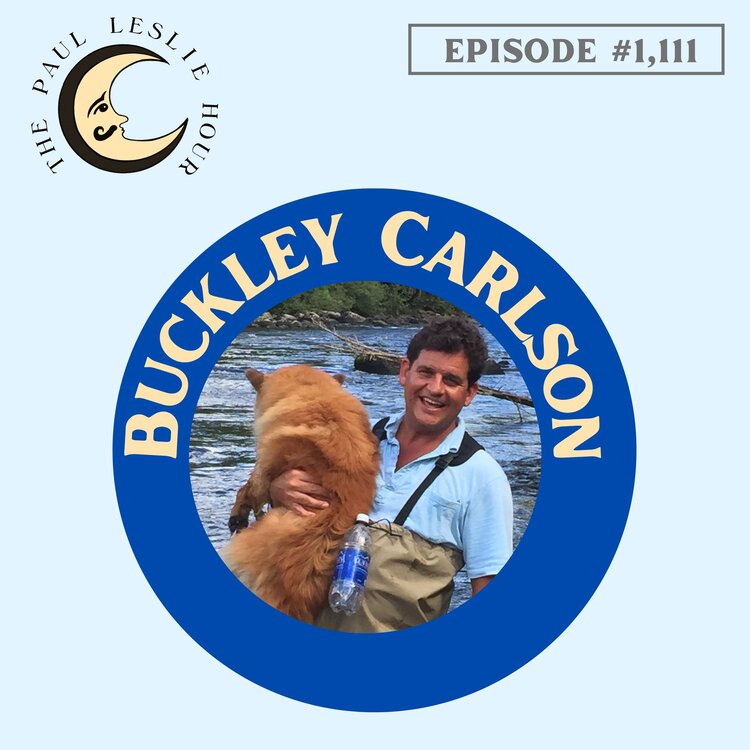
Buckley Carlson joins The Paul Leslie Hour!
Writer, communication expert, political commentator, outdoorsman and patriot Buckley Carlson joins The Paul Leslie Hour for an in-depth interview to cover:
-Growing up in California
-The influence of his father, the late Dick Carlson
-The experience of having political debate on X
-His many passions: reading, writing, music and more.
Buckley also reveals what he always wonders about people he meets.
It’s a conversation that is at times both light-hearted and serious. It’s right here on The Paul Leslie Hour. We’re so pleased to welcome… the one some call Buck.
Buckley Carlson, everybody. Follow Buckley on X: @buckleycarlson
Help Support the Show Here
Paul Leslie:
Well, this is a real pleasure. I’m so pleased to be sitting across from you. This is the first interview that I’ve done in my home, a video interview like this. Buckley Carlson is a writer. He’s a communication, what would you call it, aficionado?
Fan. No, yes, a communications specialist. Specialist.
No, I would say appreciator. I appreciate good communication, clear communication, and I strive for it. Often fail, but that’s what I aspire to do.
Has a bit of a political side at times. Is an eater, which is different than being a foodie. I’m a proud eater as well. And you have a great variety of interests. I’ve enjoyed communicating with you, but now we’re committing this to recording. Welcome, Buckley Carlson, America’s uncle.
Paul Leslie, thank you for having me here on your show. Thank you for having me in your charming house. Thank you for introducing me to your wife and your incredible dog, Nina, if I may say. That’s right. Who is right here with us and has a lovely beard, which is still quite feminine. Well, I can’t say that about too many girls.
I’m sure she appreciates that. Whenever I do a video call and there are times where there’s a dog or a cat that walks into the set and people have a tendency to be apologetic or like a kid coming in to ask for something, I always think that that’s what you’re going for.
Yes, that’s a little more color. That’s a little more life, a little more joy. In my office, I have two dog beds underneath, two dog beds on either side, and five dogs. So they have to figure out how that works. Occasionally one ends up in my lap.
Exactly. I’m for it.
Well, Buckley, I think most stories are best from the beginning. I understand you are from the late great Golden State.
Growing up in California
Yes, I am. The state of California, which used to be the best state, unrivaled state in America. It was especially in the 70s when I was growing up in the 80s. It was well run. It was clean. It was efficient. It was safe. It was the destination for people from all over the world. It was the epicenter of creativity. They used to say it starts in California and moves east. And they weren’t necessarily talking about crazy political ideas. They were normally talking about music and other forms of art and literature. People gravitated to California because it was one thoroughly beautiful, incredible diversity of climate and topography, but just naturally beautiful in so many ways. But also it was the essence of freedom and creativity. It thrived on those ideals. As I said, it was very well run. I can’t think of a single state in the country that is well run. But I can’t think of a state that’s more poorly run than California these days. And I haven’t lived there in quite some time. But I think about it often. And it annoys me to this day because the people who destroyed it were not the same people who made it. And that’s a common theme in America these days, I notice. There’s a lot of destruction and no accountability.
Well said. Yeah. Well, if we were to be like a fly on the wall, a fly that could hear and see, what would we hear or what would we see, what would we smell on a typical day in the Carlson household?
Memories of the Carlson household
When I was growing up in California, you’d see a lot of dogs. We always had a lot of dogs. And they were with us in the bedroom, in our kitchen, in our dining room. You would see a lot of meals. We ate a lot of meals. And together, no matter what we were doing, we always came back for dinner. That was a common theme in America, and it was a concrete rule in our house. We had incredible freedom, but we were always expected to come back for dinner. And we did. And dinner was an affair. And I don’t mean formal, although you had better wear decent clothes at dinner. But it was an engaging experience. Everybody was expected to and enjoyed not just eating, but talking. We spent the majority of our time actually together around the dinner table and loved it.
You would also see books because we had books everywhere at my house. But we also had the best room in the house was my father’s library, which was always the epicenter of it’s always the most comfortable room, the most interesting looking, the most cozy. And it was festooned with all sorts of interesting Carlsonalia that my father had gathered from around his travels and various jobs he had around the world and reflective of his many interests. And of course it had books, a lot of books, and every single one of which that he had purchased on his own and read and on every topic he could possibly imagine. In fact, it was my father never was in. He went to high school, had been booted from, I think, three high schools and briefly went to college. But I don’t think he learned anything in any of those settings. And I think he learned everything from the books that he read and from the experiences he had. And lastly, actually I could go on and on, but you certainly would have heard a lot of laughter in my household. It was a joyful place to be.
And you would have heard interesting stories because my father was perhaps the best storyteller I’ve ever encountered. He died last year at 84. I’ve heard his story since I was a little boy. I’ve never encountered anyone with a command for detail and narrative arc, characters, recall for both of those things, and the ability to weave it all together in a way that is not only entertaining, but also educational and fantastically fun.
Well, I’ll just tell everybody out there that Buckley’s father, Dick Carlson, he was the guest on episode number 1000. He was the 1000th guest on the show. And now it’s 1111. 1-1-1-1.
I love it.
Not planned. It just kind of happened that way. Interesting to me. But you know, he was somebody just listening to him talk. Golly, like he just seemed to, it almost seemed like, is this a real life or is this a novel? You know?
You could be excused for that. A storied life. He had such a colorful existence. And not all by design. Some of his life, of course, you can’t control your life, but he did with his life, the life that he was given. He did the best he could and far exceeded what could have been expected. He, interestingly, was orphaned as a newborn and was in, I think it still exists, he was in an orphanage in Boston called the Home for Little Wanderers. He was there as a newborn baby and was adopted by a family. At that time, they cared culturally that there was some that you were adopted by a family that had similar background that you had. My father was Swedish. He was adopted by a Swedish family that had other children. And they understood it was going to be a brief period. It was not. He was there for two and a half years. Then one day another family adopted him. And they were super nice people and they had no other children. They had a dog, which was my father’s best friend. And then his adopted father died when he was 12. And my father was on his own from that day on and was a bit of a delinquent, a colorful delinquent. Had some run-ins with the law. And then got his act together at a very early age and was self-made and successful and self-taught for his entire life. And then sort of had us, interestingly, because he was so self-sufficient and such a thinker and a deliberative person in some ways, he never considered that he would have children. It just didn’t occur to him, he told us later. But he ended up being the most naturally intuitive, involved, excellent father. In my 50s now, I’ve never encountered anybody with the relationship that my brother and I had with my father and that my father had with the two of us and with our children. It was a remarkable thing. He ended up being, went from being an orphan and an only child to being a true patriarch in every way with a big family that adored him and that was centered around him and looked to him for guidance and certainly entertainment, but wisdom. And boy, he had a lot to share.
Invaluable lessons from father
Well, in the interview that you did with your brother, Tucker, you said that he taught you so many invaluable things. I’m hoping you can tell us maybe one or two of the things that you learned from your father.
I could speak to you for hours, the things I learned from my dad. But I’ll try to break it down into some categories. I mean, he was Swedish genetically. He was a northeastern wasp by upbringing. And so he was naturally, I mean, it was important to him. Work ethic, obviously, was huge. He was incredibly hard worker and thought everybody should have a job. Everybody in my family needed a job to support themselves, but that a man got his value through his job. And he was big on personal responsibility and independence and self-sufficiency, not whining, not complaining. He was incredibly compassionate and warm and loving, but he put a premium on being tough, straightforward, loyal, independent. And so he taught us all of those principles, of course. He was probably the most important rule in his life, the guiding principle in his life, was to do something interesting, to lead an adventurous life. And boy, did he. And he encouraged us to do the same. And he always said from a young age, grasp the nettle, which to him meant don’t pass up a single opportunity. If there’s an opportunity presented, take it. You’ll never regret that. There’s a limited amount of time here. He was always quite cognizant that life was short. His own life, I think, was a pretty big accomplishment to make it to 84. And every bit of that life was used to its fullest.
Some of the interesting things he taught us, every practical talent that I can think of from a very young age, he taught us how to shoot guns. He taught us how to fight properly. He taught us how to defend ourselves, how to win a fight quickly, how to survive a fire, how to start a fire, how to flip a cigarette backwards, a lit cigarette backwards and hold it in your mouth. How to turn a cigarette into poison, which you can do. How to field strip a cigarette so no one would know that you had been smoking. How to darn your socks. How to repair your clothes. How to, I mean, it was trying to think of all of the practical things that he did. But he also, he was also very clear about the way that you treat other people, for sure. He put a huge premium on loyalty, personal dignity, honor, courage, of course. But he also said, trust yourself, that you have an innate radar within you. And he called it dog radar. He said he had a great affinity for animals and they for him. And he said, you have within you dog radar and it’s on at all times. And God gave it to you for a reason. And listen to it. Pay attention to it. Respect it. If you get a weird feeling about someone or something, pay attention to it. And it’s interesting because he, there’s no one I’ve ever known who’s been more attuned to other people and the vibes that they give off, the unspoken communication that everybody is telegraphing. And so it made him, he was an incredible storyteller, as I said, but he was also an incredible listener and an incredible conversationalist. And he would pick up on details that other people would miss. But he also was tapped in, like dogs, to a communications channel that most people are not even aware exists. May I give you an example or two? Please. Absolutely. Several times in his life, he had dreams later in life where he would be visited or he would have a conversation with an old friend that he hadn’t seen in 30 years. Only to wake up and discover that that person had died throughout the night. Really? Yes. That happened multiple times. He once, another interesting example, he once saved my life while asleep from 600 miles away.
Wow.
Yeah, it’s a shocking story. Actually, may I tell you the story really quickly? I’ll try to condense it quickly. In the 90s, I was working for a presidential candidate, a Republican presidential candidate who was a long shot and he was running. He was a great guy. He’d been former governor of a southern state. And he was competing for the Republican nomination. And I’m sure you know how important the New Hampshire primary is. So I was up in New Hampshire the week before the primary, sleepless time. I was a press officer. It worked for three or four days. We fared very well in the primary in New Hampshire, which gave additional life to the campaign and money, of course, and media attention. So our campaign lasted for—it looked like it was a viable chance to get the nomination. So all of a sudden, this new avenue of interesting things opened up, and the campaign tasked me with driving from New Hampshire to Atlanta, Georgia, where I was going to drop a car off and meet the campaign plane at like dawn in two days. So I had two days, no sleep for the past two days. I drive down. It was pre-cell phones, of course. I drive from New Hampshire to Atlanta, stopped in D.C., saw my girlfriend another sleepless night, drove to Atlanta. On the way to Atlanta, I had been awake for, I think, three hours. Three days. And I could not stay awake. And it was one of those things where I couldn’t pull over because I had to catch this plane at 6.30 in the morning. So I did everything you do when you’re driving and you’re falling asleep. I turned on horrible music really loud. I was chain smoking. I had the windows down. It was in the middle of the winter. I had the windows down, bad music, slapping my face, pinching my leg, chain smoking. I could not stay awake. So at some point, I fell asleep multiple times and keep nodding off. And at some point, I fell asleep deeply. And I woke up and I was in the center lane of this big highway between Atlanta and Richmond, Richmond and Atlanta. And I was going like 85 miles an hour in the median strip towards a concrete abutment. And I woke up. Someone had hit the back of my seat and was yelling at me. Holy smokes. And I woke up and I veered back onto the highway and my adrenaline was spiked so hard that I went the next two hours wide awake and I was fine. But it was actually a terrifying experience. Meet the campaign plane, do a series of campaign events the entire day, have a great day, come back to, I think we were in Houston that night with the entire campaign. We’re having cocktails. I thought, gosh. It would be kind of nice and considerate if I called and let my mom know that I made it to the campaign plane because she, like all moms, had exhibited quite a bit of trepidation that her son was driving this long distance, sleepless, whatever. So I thought, yeah, I’ll call them and let them know. So I go to a pay phone in the bar and I call her. She answers the phone. How are you? Oh, I had a great day. We went to Dallas, went to Houston. We’re back in, I think, in Atlanta at this point. It was great. How was the drive? I said, oh, my God. Oh my gosh, I had this unbelievable experience. And she said, what do you mean? And I said, well, I actually fell asleep multiple times, but at one point I fell asleep and I was deeply asleep and someone woke me up in my car. She interrupted me at that point and started yelling for the other extension, Dick, Dick, pick up the phone. So my father picked up another extension and turned out my dad, who was about the deepest sleeper you’ll ever meet, was asleep the night before, woke up, he was asleep. In his sleep, he was sleeping in the back of a truck and in the center seat. And he moved around to get more comfortable and he opened his eyes and he could see the back seat of the driver’s seat. And he could see that the driver was asleep with his head against the window. He didn’t know who the driver was. And he freaked out and started hitting the back of the chair of the driver, which was me. And he woke me up in his sleep while I was sleeping 600 miles away and driving. He woke up screaming, actually, which is also not a characteristic of my father, who I only saw cry when dogs died. And I’ve never seen my father exhibit physical or psychological fear about anything in the 55 years I was with him. Yes, he was clued in and connected to a communication stream that, again, most people don’t see and aren’t aware of. And he was very much a part of that. And it made him a super sensitive person in that regard, that he was attuned to other people and currents.
Amazing.
An egalitarian worldview
There is a word that came up in your interview, and it’s a word that also showed up in the biography, Tucker, written by Chadwick Moore. The word is egalitarian. And I think that that’s the ultimate thing that somebody can aspire to. Tell me a little bit about that as it relates to not just your father, but you and your brother.
We treat all people as individuals. Every single person we meet. We were raised that way. We’re that way naturally. My father was that way. My father had, we had, I’ll answer it this way. We had interesting people in our house. My father was married. Our natural mother was a lunatic. And she left early on. He was embroiled in this terrible divorce battle in California for several years. Didn’t really even need to be because she didn’t show up in court in the final court trial. They were in this divorce battle for several years. He raised us during that period. He raised us as a single father while he was working and busy, but always around and always with us. So we had people live. We had housemen or a housegirl. We had various people help out around the house when we were growing up because my father was actually on TV at the time. We had an incredibly welcoming household with a disparate group of characters in and out and around. And my father interacted with all of them and treated them like family.
He also was, it was a different time in America. You probably remember where meritocracy, actually getting ahead on your own and your own merits, your own accomplishments was something that was not only common, but expected, and it was everywhere. People didn’t have, it was also such a different time economically, which ties in because it was such a, it was a thoroughly middle class, majority middle class country, and the experiences that I had with other, and we had a very comfortable economic life, but it was no different from friends of ours who maybe didn’t have the same economics. It didn’t matter. I mean, we were all in the same boat. It was a very unified country economically that way, but attitudinally also. So he believed in a meritocracy. He believed he was an egalitarian thoroughly in that he treated each person as an individual who had value and interest and he would find it. And he would, the reason I mentioned the people who lived in our house and were around us is that they eventually, they worked for us initially, but then eventually they became family members. And that was his attitude about everyone. So we always had a full Thanksgiving table of our very small biological family, me and my brother and my dad, and eventually my lovely, wonderful, blessed stepmother, who was my mother for the majority of my life and was a wonderful influence and a wonderful person. And then we’d have like 10 or 12 others, always. I mean, meals at the Carlson household were the central theme when I was a little boy. Growing up, just me and my brother and my father, much of those were spent in all-night diners. Denny’s, when you could go to Denny’s, like talk about a different America. It was like everybody went to Denny’s. Everybody waited in line at the same time. There were no special dispensation for the super rich. There were no $100 million houses, for instance. There was no, it was a better country. Yes, I wish we would get back to that in America. It’s a healthier place to be. People are individuals and everybody does have something to contribute and everybody should be able to rise above their economic circumstances. We do not have a caste system in this country. We didn’t. We seem to now. It’s destabilizing. It’s dispiriting. It’s disgusting, actually, I think.
Yeah. Well, I’ll tell you on the egalitarian thing. Even when your brother was on television, he and I have written back. He’s one of the biggest media personalities ever. And he’s always taken time to communicate. That’s very special, I think.
I believe that. My father was the same. My father was a great letter writer. We have an enormous archive of my father’s letters. My father used to write us letters every day for years. In fact, we were the only people in our elementary school and later in boarding school who would get these fantastic letters from my dad, who would handwrite them and then eventually dictate them. But, for many years, we would go every day in elementary school, open up our bagged lunch that our father had made us, and there would be a limerick or a story or just a simple joke or a simple, I love you son kind of letter. Extensive letter, actually. Yeah. Tucker’s like that for sure. My father was very much like that. He loved people. My brother loves people. I love people. I mean, what a blessing it is to talk to people and to listen to their stories. I’ve had quite a rewarding text exchange with you over these last couple weeks, and I’m really grateful for it. They’ve been very entertaining to write to you.
A writer’s journey
Now, I did some digging, and I read quite a few of your pieces. Buckley, you are a fine writer. Very good. Very entertaining. You have a voice. I kind of imagine to try to describe, and people can check out, they can find some of these articles you’ve written. You’re kind of like a chipper Hunter S. Thompson.
Sober, too. Yeah, yeah. There’s a kind of joy that you convey in your writing.
What about your influences as a writer?
Reading, probably. I’ve been a writer professionally for over 35 years, corporate writing mostly. Political writing, speech writing, op-eds. Op-eds and speeches are the two things I get paid to write and really enjoy writing. I enjoy making a detailed argument. I enjoy learning about things I knew nothing about before and tasked with communicating about something in a clear and compelling fashion, even if I don’t have a deep knowledge about it. So that’s joyful to me. That also has been remunerative. I’d much rather write about dogs and food. And so I do. I actually used to write a column occasionally for the Charleston Mercury, which is, I think, one of the oldest continuously published papers in the country, if I’m not mistaken. I’d like to do much more of that writing. There’s too much going on in the world politically, and we’re under attack. I’d really like to help save this country in my own very small way. I don’t know how, but so a lot of my writing has been focused on that.
Well, you know, you and I both spend a decent amount of time on Twitter or X. It can be a kind of addictive place. What has the experience of being a public person on X. By the way, everybody, it’s at Buckley Carlson.
You know, it’s interesting. I was on X for years, for a decade and a half just as a reader. Right. And you can obviously learn so much on X. But now we’ve gotten to a point where it seems like you can only learn on X. Obviously, there’s tons of probably nonproductive pursuits you could have on there. The volume of information that’s on there and the accuracy of it, it’s mostly unfiltered. I think that’s what we thought of until recently. It’s obviously very suppressed on certain topics that we are not allowed to discuss, sadly. But generally, it’s an open forum of an enormous amount of information and opinions and creativity. So if you’re not on X, you’re really not getting the full scope of information. I used to read, I heard your interview with Ann Coulter and you asked if she did things habitually and she said she habitually watched MSNBC and read the New York Times. I used to be a habitually New York Times reader up until like eight years ago because it’s just too infuriating and it’s too many lies, obviously. And I could never subject myself to MSNBC, but Ann Coulter has to do that to get her perspective and she’s a great warrior. Anyway, so you have to be on X, obviously, if you’re interested in what’s going on. I didn’t used to write anything on it because I’m not a public figure. I don’t want to be a public figure. I had never aspired to be a public figure. Obviously, because I’m related to my brother, I have to be more careful, I guess. I had to have been when he was on Fox.
I say that out of experience because I once—I’m not sure if you’re aware of this since it’s a very small story, but I’ll tell it quickly. I’m sure you’ve given friends grief for the reply-all email mistake.
This is a legendary story, by the way.
Okay, well, I—okay, so you know the story. Go ahead.
Pretty funny. I was in the middle of writing. I was in California on vacation. I think it was around Christmastime. And I was writing a speech for someone, for a client, and my young son and I were going to go to a shooting range and I was writing and he came in, he was like eight years old. He would come into the guest room that I was in and writing and check, dad, are you ready? I said, son, I just need like another half an hour. I’m almost done. So it was really under the gun on this deadline for a client. And up on my screen pops and several emails came up and I ignored all of them. And then an email came up from my brother. And he had put me, I guess he hasn’t done this since, but he’s not even on email anymore. But at the time he was, and he had BCC’d me in email correspondence, which was fascinating. He was running the Daily Caller at the time, and the mouthpiece for Bill de Blasio, who was the mayor of New York at the time, was complaining in a persistent and whiny fashion about the treatment that her boss had gotten in a news story that the Daily Caller had run that day. So I suddenly was clued into an email exchange that had been going on through various people, editors, publishers, eventually up to my brother. And the girl’s tone, the spokesgirl, young girl who worked for de Blasio, was so rude and aggressive. And she’d been treated actually courteously throughout it. And then it reached my brother and he was also courteous to her, but kind of curt. And entertaining. He wrote this thing back to her. So I read it very quickly because I was under the gun and I wrote what I thought was a private note to my brother. And it was actually very crude. But it was pretty funny, actually. And I hit send. And as soon as I did up on my screen, the little notice came that I had sent it to multiple people. And I’m on like a little MacBook sitting in my lap. Such a dummy that I, like, unplugged it from the wall, thinking, oh, get in the way and prevent it from going out. I didn’t, obviously, because I was on wireless. And I closed my door. My son walks in. Dad, you ready to go to the shooting range? I said, yes, I am. Just give me a moment. And I walked outside. And I called my brother, who was apparently with his wife somewhere on the beach in Florida and didn’t answer my call. And so I called my father. And my father answered and I was hyperventilating because my brother was at Fox at the time. And I knew that what I had written, while perfectly acceptable, would probably become a news story solely so people could bash my brother over the head with it. So I called my father and he said, calm down. It’s OK. What did you write? So I read it to him and he started laughing. And he said, don’t worry, you’ll survive this. And I said, OK, thank you. Long story short, my son said, are you ready to go? I said, hold on, let me just go back. So I opened up my computer. It had been like eight minutes. Within eight minutes, I got an email from a reporter from, I think, Mediaite saying, would you care to comment on this email that you sent to this professional young lady? She’s very offended. Of course, she had gotten the email, was obviously rejoiceful about it and immediately sent it to this media reporter. She wasn’t offended at all. She was excited that she could use this to hurt my brother. Well, a lot of other people got the same idea and they rewrote this story in every, as I recall, in most papers around the country. And it was an opportunity to attack my brother as some horrible. Of course, they called him a racist. Race had nothing to do with it. Of course, they called him a misogynist. Misogyny had nothing to do with it. I mean, it was all this standard slanders. But it really burned me. It really embarrassed me. And I felt terrible for my brother that one, you know, just accidental reply all could somehow affect his business. There was a lot at the time. It seemed like a big deal. And there were a lot of people who were advocating for his firing at Fox simply because of this private communication that I had with my brother that was no longer private. So, yeah, that was great. But it burned me enough that I never wanted to say anything in public again because I don’t like having guardrails. I don’t really care what anybody else thinks about me beyond my son. My future stepdaughter, the woman I’m in love with, my parents, my nieces and nephews. Exactly. Like very small group of people, all of whom know exactly who I am. And I really love other people. I got a lot of friends, but I actually could care less what some reporter thinks of me or some stranger thinks of me. I mean, I’m a well-meaning good guy. So I’ve got some flaws, a lot of flaws. That’s fine. But no, I simply didn’t want to do anything. So I never responded. Long answer to your question. I never was writing on X because I didn’t want to be constrained. I don’t want to think about it. It’s not a contrived exercise for me at all. I don’t do it for I do it because I have opinions and now I’m free to have those opinions. And I think we’re we have an existential threat against our country. And obviously, free speech is sacred for that exact reason, making arguments that are going to rally people behind a certain position. That is traditionally how change has happened. And I’m perfectly happy to participate in that process. And boy, have I met some super impressive, very smart people, very articulate people. And some these days courageous people on X who are, I mean, there are people that write things from the heart and they mean it and they love this country and they love their families and they’re trying to make a difference and they’re getting burned as a result. You may have noticed my brother’s under attack a lot for this reason and I’m pretty personally annoyed about it.
How does it feel when you’re on X and you see people saying stuff about your brother?
Well, most people who say it either don’t know anything about him and they’re just repeating, parroting a line. A lot of those people obviously are, I mean, there is a very well-funded effort having to do with, you know, larger political struggle to attack my brother and to undermine people around him and people that he supports, but also the ideas that he espouses. But they never actually take on the idea, you’ll notice. It’s always a personal attack. He’s crazy. He’s a misogynist. He’s a racist. He’s an anti-Semite. Which I think just makes them look foolish. I think those kind of slanders these days have really lost their sting. And that’s a big departure from what’s been going on in this country in my whole lifetime because that discussion about Israel was a third rail that no one touched, and if they did, they were crushed. I mean, Pat Buchanan is obviously a great example, but there are many others, which is obscene. We’re Americans, and we should have the right to exercise our opinions about anything, anything, but certainly about how our government is run in our names. I mean, we are shareholders of this government. That was certainly a well-acknowledged concept when I was growing up, that as individual Americans, we aren’t just part of this country. This country is responsible to us for its actions, and that has not been a theme that our government has embraced in the last 20 years. I mean, you see all of the disastrous policies from the Iraq war to the COVID suppression to all of the lying election of 2020. I mean, go on and on. The January 6th hoax, whatever. The Russia hoax, everything. No one has ever held accountable for any of the decisions they make in our name. And yet we are held accountable for it in our pocketbooks and in the perception that people around the world have of Americans and in our health and our happiness. So I’m sorry that needs to come to an end. But my brother’s a big boy. He defends himself better than anybody else can defend him. He is. And he’s certainly cheerful doing it. I really admire his strength and I admire his ability to express himself and his courage for doing it. Certainly in the face of people who not only want to destroy him financially and reputationally, but would like to jail him and in some instances kill him. So personally pretty offended by that last.
Yeah. Yeah.
Does that mean I can get some Nina love, too? Nina, you sweet girl.
She’s wondering, why isn’t anyone paying attention to me.
Those lights are really bright, aren’t they? Yes, you’re such a good girl. I am so in love with your dog. I mean, wow. She’s in love with you. You’re such a good girl. You are such a good girl. Sorry, I don’t want to molest your child. I hope you know it so. Dogs. Yeah. You know, the older I get, it’s been like this for a while, but that’s like the first question I ask someone when I meet them. Do you have dogs? Do you like dogs? Don’t you feel like it’s like the one question that actually answers so many other questions?
I’m wondering about people. Like, you know, if I’m reaching out to somebody to do an interview, I wonder, like, do they have a dog?
Yeah, me too. Me too. In fact, I cannot have more than a 30-second conversation with a stranger without asking that question. Yeah. Did you have dogs growing up?
Yeah. Oh, yeah. Do you have siblings? I have three sisters.
Wow. Good for you. Yeah. I’ve got a nephew who’s in that position. And I think it’s really, you’ve got a leg up over a lot of other men. You probably understand women really well.
Yeah. I think there are things I maybe, you know, they say that men don’t understand women. No matter what.
But I’ve noticed the eternal quandary. Yeah. I’m trying. Yeah. I’m trying. I feel like I did get like a little boost. Yes. Because I have two older sisters and one younger.
You know, my brother has, so my brother has that exact same thing. And he, I mean, he just, he understands people well anyway. He’s always, always had that talent since he was a little kid. Yeah. Which is like a remarkable wisdom about people. And also about ulterior motives. Like, he’s very good at noticing that. But having three daughters has made him a much wiser, softer, in the right way. I could believe that. Yeah. Yeah. I don’t think you could survive it unless you either become, like, a violent alcoholic or you become a much better, wiser person.
Yeah.
Private person stepping into the spotlight
You know, something that I noticed that I think is interesting, you’ve, as you said, you’re a private person. You could have enjoyed total anonymity if you wanted. Your brother asked you to do an interview. You do a recent interview. And really, it was just such an interesting talk. I watched it twice. Really? Yeah, yeah. Was there any hesitation because of this fact that you’re a private person? And here, you’re doing it again. Any part of you that says, you know, maybe I shouldn’t do this?
I had a ton of trepidation about doing it. It was not just trepidation. I was uninterested in doing it. It’s not my forum. I always think people should stay in their lane. I’m very comfortable communicating with people one-on-one in my personal life, in real life. I’m very comfortable corresponding with people, very comfortable with the written word. But I never, never aspired to have a video platform to do interviews. I take it as a compliment that people have asked me. Tucker asked me multiple times to do it. I’m very close with his staff. He’s got like the most talented, awesome people around him that he’s had for years. I’m close friends with a number of them, with most of them. And I have great respect for them. They’re personal friends of mine. They’re hilarious. They’re super charming and fun to chat with, as is my brother. So he asked me, yes, he asked me multiple times. And so did the people around him. And I resisted it and said, I don’t think I’m, you know, not really interested. I’m flattered. Thank you. But he roped me into it. I love talking to my brother. I talk to my brother every day. He’s my best friend. I have so much fun chatting with my brother. So I did it and I had a hilarious time doing it. We had like a two and a half hour conversation. You saw it. We’re going to do it again. Actually, we’re going to do it on a semi-regular or a regular basis, probably once a month. We’re going to do it again in a couple of weeks. Subsequent to that and also when I started being active on X, I got a lot of also very kind invitations from people to do podcasts and other things. And I’ve just demurred. And tried to be a gentleman about it. I’m just—my whole life I’ve sought just to have a private life. I like having a private life. But I also love talking to people. So I’m really darn glad I’m here. And the reason I’m here with you in particular is that you were—you’re not only a really good guy. I’m not pandering to you, but I really like you. And I’ve gotten to know you as we’ve corresponded via email and text. And I thought you were smart and interesting. Thank you. Well, enormous fun to communicate with. I mean, our text exchange this morning about food and dogs was hilarious and really fun. So if you would have me back, I would come back here anytime. And also, I feel like I was completing the circle that my father had been on this show with you and had high regard for you.
Well, I feel like it is, like the circle being completed. There’s that feeling that I have. You know, one of the number one comments, if anybody goes on Tucker Carlson’s YouTube channel, on your interview is people saying, more of this. Can Buckley be a recurring guest? You know, and that’s interesting that you guys are going to be doing it again.
Looking forward to it. I’ve gotten a lot of that feedback personally, too. And also it’s heartening because a lot of the comments I’ve seen have been, you don’t need to talk about the political world and what’s going on at the moment, which is true. You’re not going to get better political analysis or wisdom than from my brother. That’s my perspective. He’s really an interesting thinker and a fantastic communicator, so I’m not going to improve upon that. But we do have a really strong relationship over our entire lifetimes, and we have interesting and fun conversations about all sorts of things. And people have expressed interest in hearing it. So as long as people are willing to hear it and get those comments most days. So looking forward to doing it.
Thoughts on media and X
Well, while we’re on the subject of X, you know, in the interview that I did with Ann Coulter, I thought this is so interesting. I asked her, you know, is there anybody out there that you follow that you, you know, the media personalities, whether new media or old, it’s so interesting to me that Anne, right away, she was like, well, never television. I mean, come on, not TV people. And I talked to a fair amount of young conservatives in their 20s and whatnot. And I really, like, I’ll ask them, have you heard of this person? I’ve talked about this on X. And they’re like, you name anybody from Fox News, and they’re like, I don’t know who you’re talking about. I’ve never, really, I’ve never heard of these people. Television is becoming increasingly like it’s not a player in the political discussion. Yes. But who are the people, new media or the traditional, that you especially like or that you follow?
There’s a long list, actually. There are a ton of people in my feed. There are people that I go to directly. I think Ian Carroll is very talented and very smart and has a lot of interesting things to say. Another Ian is Ian Malcolm, who I don’t know if you’ve come across, but is also very smart and capable of connecting dots that most people aren’t. He makes compelling arguments. Daryl Cooper, Martyr Made. I do actually, I mean, of course, I try to watch Tucker’s podcast. He doesn’t host a lot. Who else? Let me see. Republicus, open the JFK files, is one of my all-time favorites. Cassandra McDonald. Who else? Marissa Hansen. He was a great investigative reporter out of Texas. I always drop in on Candace Owens’ page because it’s usually pretty combative and interesting. I confess that I also look and see what Nick Fuentes says on occasion. I don’t listen to his rumble, but I do see some of his updates. I look at the opposition. I also drop in on some of the people that are clearly lying, but you generally just have to tap into one or two of them, and they’re saying exactly the same thing. It’s been quite revealing over this past six months, certainly leading up to the war, after Charlie Kirk’s death, how many people have been revealed to be part of a coordinated campaign. I find an ex for some reason, I guess because they’re just not that creative and they say the same things you’ll come across. You’ll hit one person’s page and you’ll see them saying something that you disagree with and then you go to someone else’s and you’re like, wait, they’re saying exactly the same thing. Verbatim. Verbatim. It reminds me of that famous TV compilation from where they’ve got all the local broadcasters using exactly the same phrases and it comes out and suddenly you’ve got 300 people saying exactly the same thing about safe and effective. Right. White supremacy. White supremacy. Exactly. Part of the problem I have noticed, and I’m sure a lot of people have this when you follow, I try to get outside of the following category. I go through that first. People I’m following, which is about a thousand people. So I get into a lot of the same content. But I try to dive into small accounts because you’ll find things, people who don’t have big following, but a lot of interesting things to say. If I notice someone has, I do this a lot, actually. If I write something or I’m reading someone else’s post that’s interesting, I’ll quickly skim through the comments. In one second, you’ll come across some particularly interesting perspective. I go to that person’s account. Oh, they only have 300 followers. I don’t care. They’ve got something interesting to say. And I’ll quickly scan their page, find something and retweet it. Because I think, you know, it’s a collective effort here. And there are a lot of people on the platform that don’t get the kind of visibility they deserve. There are a lot of low follow accounts that haven’t had the proper exposure or they’ve been exposed in the past and their account has been nuked and they’ve had to open up a new account. That’s something I come across a lot. There’s also a lot, I’m sure you’ve also noticed this, there’s a lot of suppression on certain topics.
Yeah. Yeah. Well, Elon and his team, they’ve been talking about new efforts to get a lot of the, you know, the suppression cleaned up, I hope. I’m optimistic. And also incentivizing these smaller accounts because you’re absolutely right. There’s a lot of these small accounts that have direct reportage or, you know, really interesting statements. I commend you for looking at the small accounts.
I love it. I mean, there are some. Yes. Like mine. Yeah. I look at yours a lot now. I’ve seen several of your interviews, which I was impressed by. I would say also. You know, there are some big accounts, which I’m reluctant to mention, but there are other smaller accounts of Joel Webin. I mean, look, there’s been a huge Zionism, for instance. Obviously, the whole concept, the whole argument about it has been obviously dishonest, but vehement. And there are learned scholar, you know, actual Christians who can speak to it in a couple I’ve encountered lately. Joel Webin, J.D. J.D. Hall is one of the best writers on the internet. I don’t know if you’ve encountered him. I think it’s J.D. Little Hats. It’s J.D. Hall. Anyway, he’s a Christian minister who writes these lengthy pieces. He’s got a substack. That’s the other thing that’s great is discover some pretty quality writing. Really quality writing. That’s part of the problem. I just don’t have enough time. So I end up going through and I get these vitriolic responses to me and then I end up responding and get sucked into my own little bubble and not actually experiencing enough of the outside world. Lord Bebo is another great, interesting account. Adam with an E on the A-D-A-M-E, Adame, I guess, is also someone who’s frequently. We have a conduit of interesting information. Gosh, there are so many.
Musical passions and memories
Well, I want to talk a little bit about music. You and I have been sharing stuff, talking about the things that we like. And you have, it sounds like, a good taste in music. Tell me about some of the stuff you like to listen to.
I was listening to Van Morrison this morning in my car, which I haven’t done in quite some time. I need to do more of that. I was listening. I’ve got pretty varied tastes, but I would say most of the music that I’ve listened to my entire life was 60s and 70s. A lot of Grateful Dead, been to a lot of Grateful Dead shows, a lot of Rolling Stones, Allman Brothers. I really do like Bob Dylan, listened a lot growing up. But I also, and even Elvis and Aretha Franklin, I love, Ray Charles. And then I listened to a lot of earlier stuff, probably from my father, Edith Piaf, for instance. Yeah. So I listen. I like blues. I like jazz. I like early rock and roll. Some country I’ve been exposed to. My son has exposed me to some great country talent. But it was mostly confined to 60s and 70s and some 50s, some 40s even. But I have recently been exposed to some newer stuff. I think I learned from you today that Van Morrison is still putting out new music. At 80. At 80, which is shocking. And Oteil, I’ve started listening to Rooster twice today. I loved it.
Oteil Burbridge.
Yes. Tell me some of the – what’s some of the newer music? Do you like some of the music like Billy Strings?
Billy Strings is good. I mean, new music. I’ll tell you, there’s some singer-songwriters that I really like. It was just somebody had DM’d me, Nick E. Fingers, who I think follows you also. He said, Paul, what are the female singer-songwriters you like? I love like a random question like this. And I said, and here’s some names, Amanda Colleen Williams, Sonny Sweeney is very good. And then there’s a young woman named Erin Enderlin that’s really good. Ooh. So those are some names to look up. But, I mean, I’m listening to, I like, I’m kind of like Othiel in that I like old stuff. Yes. I mean, I’ve been going back and listening to, you know, people like Skip James. Oh, yeah.
Blues guys like that. Yes. Howlin’ Wolf. But, you know, I love, I know you asked about new people, but I love Sinatra.
Me too. Yeah. I listened to Sinatra yesterday. Yeah.
The Grateful Dead is one of these bands that, you know, sometimes people at their first listen, they don’t know because there’s a lot of stuff going on. Yes. You’ve seen them a number of times. What was the best show you saw of The Grateful Dead?
Probably one of the earliest shows I saw with my brother in San Francisco in like 1982, maybe. And actually, that’s not true. Probably the best show I ever saw was Jerry Garcia Band. In 1986, maybe, in New York. I really like, I love acoustic. And I like the banjo. And he played both. And I like kind of smaller venues. Yeah. My favorite part of a dead show was the parking lot. Yeah. I loved the part. Well, you just, the nicest, most interesting people. And I was a little more, I don’t do drugs or drink. It’s been a long time since I have. But definitely smoked some weed and ate some mushrooms in a dead show parking lot when I was much, much, much, much younger. Wouldn’t advocate doing that now even though it’s legal in some states. But no, the kindest people, interesting, kind people at dead shows.
There’s an oft-circulated photo of you and your brother, one of your pals. And the late, great Jerry Garcia. Yes. Tell me about how that picture came to be.
Through my father, who was an investigative reporter in San Francisco in the early and mid-60s, and knew all those characters, and they had Ashbury, and was friendly with Jerry and Phil and Bobby. And they came through Washington, D.C. in 1986, I believe. I believe with Bob Dylan, actually. And met my father for lunch. And so he divulged that to me and my brother and little opportunists that we were. We obviously raced down to his office and met Jerry. And we already had plans to go see him in all the shows around D.C. RFK Stadium was still around at that time. And then I think they played Meadowood. We went to both of those. And actually, I remember seeing them at RFK with Bob Dylan, who I’d always really admired as a songwriter. I thought his voice was kind of annoying. I got used to it. But he was so shit-faced that he could not even sit on his stool. And I remember feeling kind of sad about it. You know, everybody has demons. Quite a few so but it was an entertaining show it was a great show actually so i have yes i have that picture in my kitchen i saw today i was cooking up some bacon and jerry and my you know 17 year old brother were watching over us approvingly me and my three-legged dog as we made some bacon.
So were you in awe to be around someone like Jerry Garcia?
I mean, I think, yeah. I mean, he was such a talent and I tried to suppress it. I mean, I didn’t, you know, beyond shaking his hand, you know, I didn’t rub his fur or anything. I did wash my hands later. But yes, I was. And I don’t think I had an extensive conversation with him by any means. I don’t recall him being really that verbal with me, at least. He had just had lunch with my father, so I’m assuming that it was, yes, it was a pretty great experience. Yeah. I’ll stop pretending.
Adventures as a blackjack dealer
Something that was just briefly, you know, you guys just mentioned it as an aside in the interview you did with your brother. When I heard it, I immediately started to laugh. You were a blackjack dealer on the Mississippi River?
Yes, I was for a very brief time. So I was originally when I did go to college. I went to two different colleges. Yes, I had been very focused about what I wanted to do, and originally I wanted to fly in the military. And I went in pursuit of that. I’d been a pilot since I was 15. I still fly to this day. Not enough. But I don’t have a plane, sadly. Someday I hope to have one. But I was very focused on being a pilot in the military. I really wanted to serve and I really wanted to be in the Marine Corps and fly F-14s. So I applied and got into the best flight school in the country. Embry-Riddle Aeronautical University was an aeronautical science major. Flew there for several years and then was in just a catastrophic boat accident. Broke my neck. My aspirations to fly in the military were dashed. I mean, I was applying to the military. I had taken the ASVAB. I’d been almost just, I was on the verge of going to the military. And I had this boat accident. And it changed my life. And there was a weird period there. And I was, what am I going to do? And I went back to college. I went to the University of Mississippi, to Ole Miss. Great and interesting place. And which I loved socially, but I was not at all, you know, I was 20, 21 at that point. And I thought, wasting my time, like how much can you drink and party in college? So even though I did drink for a number of years after that, I was at least well enough aware to know that I was wasting my time and I was eager to get to move on and do something interesting with my life. So I had. I had several ideas. I wanted to be a cop in New Orleans. I thought that would be interesting. It’s a long story there. I didn’t do it. And then I was like, what else am I going to do? And then right nearby, they had just legalized gambling. I’m not really a huge pro-gambling guy, but they had just legalized gambling. I think it was the first place in the middle of America that had, certainly in the South. And they opened a casino right around the time I was at Ole Miss. And I thought, how interesting would that be to go? Be a blackjack dealer at a casino in Mississippi and then write a book about it. It’s got to be colorful at least. So I did. I went. I enrolled. I lived in some depressing little motel for a couple of weeks while I went to blackjack school, got paid for it. And then there was a devastating all across the South ice storm that destroyed the South. I think it was 1993. Shut down the entire South from much like the one that happened a couple months ago, actually. Yeah. But it closed down the casino, closed down everything. And so I thought, oh, got to close down the casino. So I had to leave. And then I got a political job on a campaign. This is my first campaign I worked on and I worked on. It was a presidential campaign and I worked on it for the next two and a half years. Fantastic relationships with people. I’m still very close to the people I met on that campaign. Didn’t win. But the candidate was a great judge of character and assembled an amazing team, a lot of whom I’m still very close to. One of my son’s godfathers is from that campaign in 1993 to 1996. So it was a short-lived blackjack career. And I didn’t write a book about my experience, even though it was like two and a half, three weeks. But there was enough color in those two and a half, three weeks I probably could have. All of it dark. None of it wholesome. Yeah. But interesting.
I bet.
What Buckley Carlson admires most in others
What do you admire the most in another person?
Passion, interest, people who my favorite people, my closest friends all have. One, embracing the talent that you have, which I think is God-given. Two, pursuing your interests. Everybody I know and love has not just one, but a multitude of interests. Most of my close friends and people I admire are good parents, have dogs, are kind. But what I really admire is people who are unbound by convention and who seek out adventure and experiences with a unifying purpose, not just adventure for adventure’s sake, but turning it into something, telling stories about it, writing about it. And I admire physical courage and intellectual courage, inquisitiveness, people who look at stuff or hear things. Bless you, Nina. God bless you, you wonderful dog. Sneezing dog here. I’m very familiar with that. God bless you, Nina.
Nina.
And people who embrace life, people who are happy to be alive, whatever their circumstances, and they bring enthusiasm to it, and people who are considerate of others and interested in others. That’s what I admire in people.
Advice to younger self
If you could go back in time, and I always like to say put your hands on the shoulders of yourself and say, Buckley, this is what you need to know. From when you were just starting out in life, a young man, let’s say, if you could tell him anything, what would you tell the young Buckley Carlson?
First, I would say drinking is a waste of time. Drugs are a waste of time. It’s been a long time since I’ve done either. And I don’t think I’ve suffered from either in the last 22 years. But it derailed me when I was young. I was just not focused enough. I guess I would tell myself that. Yeah, don’t waste your time drinking. Don’t waste your time. Whatever I’m saying, I didn’t do a lot of drugs. But I did a lot of drinking from a young age, and it’s a waste of time. So I would say don’t do that. I would also say take every moment as seriously as you possibly can because, my gosh, it really does go by fast. That may be a cliche, but it’s just, and the older you get, the faster time moves. Have no fear about anything because you have very little control. Again, I wasn’t wracked with fear, but there are really no guardrails to what you can accomplish with faith and determination and just like dedicated perseverance. One regret is I wasn’t writing books from an early age. I wish I hadn’t made myself do that. I wish I was less self-indulgent. I’ve been a reader my whole life since I was a little boy. I read a ton of books. I consume an enormous amount of reading material, some for my job. I have to be apprised of what’s going on. I have to read a lot of research for the stuff that I write about. But I’m definitely too self-indulgent on the nonfiction side. I shouldn’t read too much nonfiction. I’ve gotten much better about that over the years. But that’s like one of my great relaxation things. But it takes up a lot of time. The other thing I would say is read the Bible early and often. I know people who’ve read the Bible religiously every day of their life and still get stuff out of it after 60, 70 years. I’ve only been reading, I’ve read the Bible in my life as part of biblical courses that I was compelled to take and as part of Bible studies. Select individual quotes and stuff may be valuable for other people. I’ve recently, in the last couple of years, started just reading it straightforwardly, straight through as a book, you know, linearly. I find that to be incredibly valuable, and I hadn’t done it in the early part of my life. The other, can I keep going? Yeah. I couldn’t, for various reasons, have more children. And I couldn’t be more proud or closer to my son and my girl. But I would say have as many children as you possibly can. And even if you’re afraid of how to afford it, you’ll make a way. I wish I had a lot of children. Probably not applicable now, and I tried. Serve your country. I wish I had served. I wanted to. I tried and I couldn’t. What else? What I tell myself. Keep a daily log. Write it down. Make yourself at the end of every day, even if it’s in shorthand. Because, I don’t know, I have interesting conversations every day with people. I do a lot of travel. I’m compelled by my job, by my life. I’m with interesting people all the time and have interesting conversations. And I have fairly decent recall about it. But if I had been disciplined about writing that all down, I would have a lot of books under my belt. And that’s the other thing. Maybe I already said this, but I always wanted to be a book writer. I have actually ghostwritten for other people two books. And I should have been writing books on my own since I was 15. I should have, you know, a James Michener level catalog of books. And that’s a real regret. And it’s never too late to start. So I may have to go home tonight and write a book. Seriously. Yeah. I mean, seriously. I don’t know who will read them. I mean, I think I’ve got some interesting, valuable stories. We’ll see. What else would I tell myself? Pay attention to really listen to your elders. Not everybody deserves your attention. But I’ve come across a lot of older wise people that I didn’t give short shrift to, but for circumstances in my life, busy or distracted, didn’t actually absorb enough from those people who’d actually lived an interesting long life. And I should have made myself do that. I didn’t miss that opportunity with my father. I missed that opportunity in some regard with my mother because my adopted mother, but I call her my mom. She’s my mom most of my whole life. Extraordinary woman and extraordinary faith. And she wanted to talk to me more about God. And I was always very polite about it. But I should have just sat down and thought about it more. Because God’s been in my life my whole life. Answer those questions and have a better relationship, a stronger, deeper relationship. And I think you could spend your whole life aspiring to that and you’ll never get enough.
The best thing about being Buckley Carlson
What is the best thing about being Buckley Carlson?
The loves in my life. I have the strongest relationships with the people in my family, with old friends, with my dogs. I have real physical romantic love. I have really rewarding love and an amazing relationship with my son and with my brother and with my sister-in-law and with all of my nieces and nephews, even some of my cousins because we, interestingly, weren’t raised really. We had a very small family for a lot of reasons. We had a very small family. And it’s gotten much, much bigger. And it’s so rewarding. Also, just recognition that life can be pretty fucking tough, obviously. Excuse my language. But, you know, life is painful and life is hard. And this life on Earth is governed by, you know, some pretty dark forces. And it’s a brief way station on the way to eternity. So, you know, embrace as much of it as you can now. There will be a final exam. Two questions on it I heard someone say this recently I was like what did you do with the talents God gave you and what did you do with your relationship with my son Jesus Christ so I’m thinking about that a lot more but back to your question I just have I was always born with a love of people a happy constitution and disposition and really blessed with the family that I have and the relationships that I have within it and with the longstanding friendships that I have. And I’m not looking for new friends because my life is busy. But, man, do I find new friends everywhere. Everywhere. Everywhere with my interactions with people. I really actually love people. And I interact with a lot of people all the time. That is true reward. Constantly learning new things. And also. I know this is a run-on answer. No, it’s good. It’s great to wake up every morning and be like, are you an expert in anything? No, not. Not an expert in anything. And I can learn so much more. And I learn from so many people all the time, from brief interactions to lengthy meals with people. Life is wonderful and life is rewarding. And this physical world that we’re in is so damn beautiful. And I’m so glad to be around water and animals. And yeah, I’m grateful, really.
We just never know who’s watching or who’s listening. It can be amazing sometimes when you find those things out. I always like to let the last word go to my guest. It’s an impossibly open-ended question, but what would you say in closing?
I would say thank you. I don’t do many interviews. I haven’t done any interviews. I’ve spent my life on the other side. I’ve advised people how to do interviews. I’ve given them a strategy for being better, more effective communicators. I’m not sure if I was, but I thoroughly enjoyed myself. Enjoy talking to you. I could go on much longer. I hope we have a meal after this. I hope so. I may have to steal your dog. I don’t think I’ll make it out of here with your dog. You have a great dog and a great wife and a really cool job. Thank you. Really. And I like your questions and I like your general attitude.
Thank you.
Thank you. Thank you. I really enjoyed it. Thank you, Paul. We’ll have to do it again. Please. I hope we will. All right. Thank you. We’ll leave it there. Can we have some nicotine?