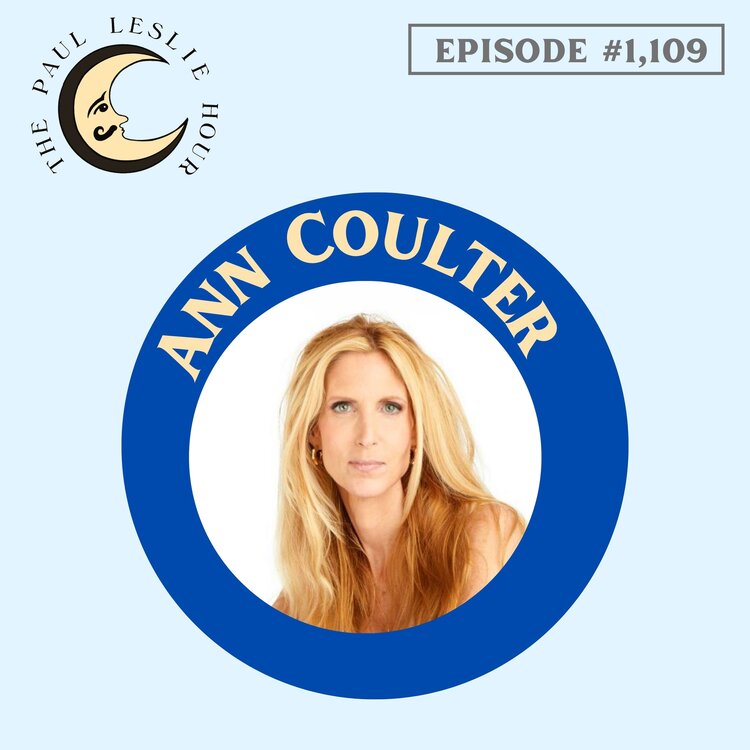
Bestselling author, commentator and political powerhouse Ann Coulter joins The Paul Leslie Hour for an in-depth interview to cover:
-The state of America today
-The new media landscape
-Immigration
-Donald Trump
She also reveals the surprising TV show she would most like to appear on.
It’s a captivating, fresh, uplifting conversation on The Paul Leslie Hour. We’re so pleased to present… Ann. Coulter
Help Support the Show Here
The Official Ann Coulter Transcript
This interview was conducted February 27, 2026.
The state of the American spirit
Paul Leslie: It is my great pleasure to welcome a tremendous and electric, nonstop, exhilarating force in our media and political landscape. Ann Coulter is the author of 13 bestselling books, New York Times bestselling. The host of a very, very top shelf podcast, Unsafe, and has her own Substack as well, which you can follow along at AnnCoulter.Substack.com. Ladies and gentlemen, Ann Coulter, thank you so much for making time to talk to me.
Ann Coulter: Absolutely. Thank you for having me.
So you’re ready to do this. I’m extremely excited.
Me too.
Is it a good time to be an American, Ann? I realize that’s as much an emotional question as a mental one.
Good question. Sorry for the hesitation, different directions I could go in. For one thing, where else? I mean, as I often say to people when they’re not happy with this or that candidate, it’s on my side. You know, it’s a binary choice. What other country would you prefer to be a citizen of? So I think, yeah, pretty much from the beginning of time, of our time, of America’s time, it’s been the best country to be a part of.
I think we’ve fallen on some hard times in the last roughly half century. But yeah, Trump gives me a lot of hope when I see Democrats refusing to stand for absolutely basic principles—no trick question—that it’s the first duty of the government to protect American citizens from the crimes of illegal aliens and not one Democrat can stand for that. Or that children shouldn’t be taken away from their parents to be poisoned and mutilated and transgender and not one Democrat stands. That does make me a little bit nervous.
They used to call this during the nuclear freeze era, which we now know was entirely pushed by the Soviet Union because they couldn’t keep up with our nukes. But be that as it may, we know that the Democratic Party and liberals, they’ve always been dupes for foreign propaganda and things that make America worse. It used to be called the zero infinity problem, where the chance of a nuclear reactor blowing up is almost zero, but if it does, the consequences are infinite. And that’s how I feel with the Democratic Party. They’re taking positions that, gosh, I would think that would not help them at the polls. And we have President Trump there now. We have his Vice President, J.D. Vance, and great senators like Eric Schmitt. So there’s a lot coming up to take over. So I’m more optimistic than I was certainly during the Biden era.
Reactions to the State of the Union
Yeah, well, I wondered how long it would be until we mentioned that State of the Union address. And I’ll confess, while I was watching it, I thought about you for a moment. I thought, what is Ann Coulter thinking at this moment when Trump says, go ahead, stand up? Are you for Americans first or are you for illegal immigrants? I don’t remember his exact words, but they would not stand up. What were you thinking in that moment as you were watching it?
I thought it was brilliant and exactly what I was thinking was, my gosh, Stephen Miller definitely wrote this speech. It was a very good speech. It was very clever. And Stephen Miller, I think like Trump—I will give them both credit for this—I think to their bones, they are deeply patriotic Americans and love this country and love the things that make America a lovable and wonderful country. And I mean, I think it was obviously spontaneous when Trump said when they wouldn’t stand for things like that and he’d say, “these people are crazy.” My gosh, that was my favorite moment of the speech. It was just so obviously from the heart and what I think any normal person would say.
Are they crazy?
Or are they evil? One of those dilemmas. We can debate it for how many angels can dance on the head of a pen. I think both political parties in this sense, what they want is power. I mean, I always say to people when they’ll point out all of the really, really, really bad Republicans—and oh my gosh, there are a lot of them, Paul. Well, for one thing, I assure them, there are a lot of bad Republicans, there are no good Democrats. Keep that aphorism in mind.
But a lot of people who are elected, I’ll start with the Republicans, who are elected as Republicans, they run as Republicans just because they happen to have been born and live in a district that’s Republican. But it’s not like they have any principles of governance or what this country should look like or ideas for laws that would make people safer and healthier and richer. It’s not like they have ideas on that. They just want to run for office and, I guess I’m living in a congressional district. Those guys you can spot from a mile away.
With Democrats, I think they have been hoist on their own petard. I mean, as I describe in Adios America, they absolutely have been bragging for 20, 30 years about how Teddy Kennedy’s Immigration Act, by bringing in all of these third-worlders who are block voting for the Democrats, was going to give Democrats just a few more election cycles and we’ll have total hegemony in this country. Roy Teixeira in Texas wrote a big article about it. I forget it was some other Democrat. He called Obama’s election, George McGovern’s revenge. He said Obama’s election is the result of—you look at who voted for Obama. It is overwhelmingly foreigners plus the usual Democrats’ base of college professors, bitter divorcees, and obviously, black people block vote for the Democrats. Roy Teixiera has kind of changed his mind about that.
There was also another big Democratic consultant years and years ago, decades ago, who said Teddy Kennedy’s immigration gift was the Kennedy family’s greatest gift to the Democratic party. They have been laughing and bragging about this. They know that most Republicans, especially the ones I just described, are so terrified of being called a racist. They will do anything. They will vote for anything. Just please don’t call us a racist. So they’re very easy to, as Tawana Brawley said, manipsinate. And that’s what the Democratic Party relied on.
But I say they’re being hoist on their own petard now because now they’re all being voted out of office by these various ethnic blocs they brought in, like in Minnesota. I mean, it’s hilarious that that ridiculous Mayor Frey technically lost a primary. I mean, they ended up doing technicalities and some of you voted illegally or something. But he lost to a Somali. And it’s happening in all these congressional districts around New York City. I was recording—it was either at Adios America or in Trump We Trust—in New York City, when that guy, Tom something, long, long, long time Democrat was taken out by, I don’t know, I think it was AOC, might’ve been Hakeem Jeffries, but whomever it was, it was shocking to the Democratic Party in New York.
And I’m sorry, I don’t remember, I don’t tend to pay attention to House members, but it was shocking because this was a Democrat who was so big in the Democratic Party in New York. It was in Queens or something, Brooklyn, one of the boroughs, which I’m also not very familiar with. And I had just read through the section about how this was going to happen to the Democratic Party and I came in like the conquering hero the next day laughing at my Democrat—at least one of the producers was a Democrat—saying, “Ha ha ha, you guys are SOL now. That’s the end of white people in the Democratic Party. You’re just watching a slow motion plane crash.”
The effectiveness of Stephen Miller
Yeah, that’s a pretty accurate assessment. I want to go back to, you were talking about Stephen Miller at the beginning there. Now, you could kind of say in some ways that somebody that’s a Democrat is kind of despised by the right when they’re ineffective. And then a lot of times somebody is despised that’s on the right, like Stephen Miller, because they’re effective. You know, the Southern Poverty Law Center puts him as one of the top bigots. What about Stephen Miller? Tell me, what do you feel his greatest contribution is?
He’s magnificent, seriously. I’m depressed, I fantasize about Stephen Miller being president. I’ve known him for a long time because we were two of the very few—I mean, you could probably count it on one hand until Trump came along. The Republican Party was pedal to the metal for basically open borders and mass immigration. That was the position of the entire Rupert Murdoch, and remains the position of the entire Rupert Murdoch enterprise. The Wall Street Journal had been pushing it forever.
I just saw on Twitter recently a blast from the past. Pat Buchanan, I think it was in his book against mass immigration, he said, which just seems like such an obvious simple aphorism, something Stephen Miller might come up with: “Who would it be easier to assimilate? A million Englishmen or a million Zulus?” And the Wall Street Journal‘s Paul Gigot responded, “The Zulus would probably work harder.”
That was the Republican Party. I wrote about it in Trump We Trust. Sorry, I am getting back around to Stephen Miller because this is part of his—what I consider his brilliance and foundational nature of Stephen Miller. In that Republican primary in 2015 to 2016, I read through all the transcripts of the Republican debates and highlighted, and it was just hilarious how the rest of the—Trump was running against 16 or 17 other people. It was just required. You have to talk about how you’re like Reagan. That was a long time ago, guys. It was a different world. Can we move on? Talk about your immigrant relatives. Talk about the way the Democrats now, “of course we need to secure the border.” And then they would spend the rest of that little answer saying how nothing will work. “Of course walls don’t work. No, we’ll put drones. We can at least watch them running across.”
And Trump was the only one who would come out and say, “I will build a beautiful wall, a big, beautiful wall.” And of course he won more votes than any Republican in primary history. Before Trump came along, it was Stephen Miller, me, a few other people who were in our circle. Joyce Kaufman here in Florida, that magnificent KABC host—what’s his name? Tom McIntyre in LA, I so salute him. Immigration was so big for him, he voted against John McCain because McCain had pushed amnesty and my hat goes off to him.
So this is from the bones with Stephen Miller and I think it is not totally surprising. He grew up in Los Angeles and it kind of drives me crazy that these people from—one of my favorite congressmen, except he’s bad on immigration, he’s bad on drugs, is Thomas Massie from Kentucky. I had him on first in my Substack just because I think he’s really smart, really great MIT inventor, made all this money from his inventions. And then I had him on just to talk about the stuff we disagree about. And I look up his district and it’s like America in the 1950s. They probably still have Blockbusters. It’s 90% white, 10% black. Well, that was America for the first four hundred years.
So I always say I refuse to listen to anyone talk about immigration until they’ve lived in Los Angeles for two months. And then you will see it is not the rosy colored picture that’s being painted. And that isn’t to say—I mean, we’re getting the vast majority of both legal and illegal immigrants are Latin Americans. And yeah, a whole lot of them—who knows if it’s most of them? Nobody knows, but I’m supposed to say most of them—are lovely people, are hard workers. I wish the best for them. But as Trump says, if you’re gonna have a country, you gotta have a border.
Well, Stephen Miller grew up in that milieu. He then, of course, was at Duke and was one of the few to recognize that whole Duke Lacrosse fraud was a fraud. Incidentally, the lying stripper was released from prison—she later killed her boyfriend. She got released recently. And Miller, he eats, breathes and sleeps smart arguments. He obviously has a high IQ, but the main point is a lot of people with high IQs do stupid things, do terrible things. I assume George Soros has a high IQ and now there we got evil. I don’t know about crazy, but boy. People with high IQs can be dangerous on the other side. Well, Stephen Miller is our dangerous person for their side.
Hypothetical deportations
On that note, this just popped into my head. If you could deport any person, whatever you say, it goes. Who would that be, Ann Coulter?
Alejandro Mayorkas.
Gone.
Well, I’d give them life in prison, possibly the death penalty, for knowingly bringing in murderers, rapists, people who went on to commit—to come in and murder Americans. I mean, I wrote some sort of tongue-in-cheek columns about this thing that in Texas, there are guys on death row for having participated in a robbery murder that they had less to do with. They were just the lookout guy. And here you have the head of Homeland who was openly violating federal law written on the books. Illegals, even if they’re legit applying for asylum, they’re supposed to be detained. They’re not supposed to be given iPhones and put on a bus and “what city would you like to go to? Here’s a plane ticket.” And so he was knowingly dragging in millions, millions of illegal aliens, knowing that a fair percentage of them would go on and kill Americans.
What America means to Ann
You make a strong case, that’s for sure. Michael Savage, he famously puts it down to borders, language, culture. You can’t—if you don’t have those, you don’t have a country. It’s a question that Frank Sinatra asked again and again in the chorus of a song, “The House I Live In.” I know the guy who wrote it was a communist, but he asks, what is America to me? You’re a native American, Ann Coulter. What is America to you?
That’s a very good question. Part of it is—and I only start with this because there’s so much anger whenever you say it—but I mean, in a normal world, this would be like my fifth point. And that is that it is culturally British Protestant. That, I mean, there’s a reason King George called the American Revolution that Presbyterian War. Only one signer of the declaration was even Catholic. Incidentally, in colonial times, pre-revolution, Jewish people could vote before Catholics could because the British were worried they didn’t want people who had allegiance to a foreign pope.
As Samuel Huntington, the Harvard professor, puts it in a book called Who Are We?, he says as Catholics in the United States became more American Catholic and less Roman Catholic, they came to be fully accepted and obviously they’re a crucial part of our beautiful mosaic. But there is that—I mean, a lot of people have written about this—is that cultural, that is also—you don’t have to be British, you don’t have to be a Protestant, but those ways, those customs, that common law, for example. The stiff upper lip, the decorum, the not wailing at funerals, the not committing child rape, cannibalism, not walking around in jihad.
And read Alexis de Tocqueville’s On America, that tells you what the culture is. And contrary to what these crazy feminists say, one of the things de Tocqueville noticed about early America is how rape was taken so, so seriously. So seriously you could get the death penalty for rape. More seriously than in continental Europe. And you know, now we’re bringing in immigrants where rape, the girl gets punished. Maybe even stoned to death. It’s certainly not taken very seriously. Entire families—I mean, I write about this in Adios America and—sorry, I don’t mean to step on any toes. I’m not saying all Latin Americans are child rapists. Don’t worry. But there is a part of that culture that is accepting of child rape, where the whole family is participating.
Now, that is changing the nature of our country, who we bring in, who the people are. I’m not saying it’s genetic, but it is cultural and a thousand years of culture does create people with certain prejudices—and I mean that in a good way, prejudices, expectations, a foundational belief in free speech, a foundational belief that you have a right to bear arms and protect yourself. And the reason I start with that—I mean, can get into the other stuff by starting with that—is that there is just such a pushback with this idea that America is a propositional nation and anyone—the Zulu—can be a better American than you or I.
Yes, some can. And I know many immigrants whom I think are absolutely rock solid, the most waspy, patriotic, British law loving Americans you could imagine. Yes, of course that can happen, but that doesn’t make it just an idea, America. It is a people that created the country, that wrote the Declaration of Independence, that fought the Civil War, that conquered the frontier. I mean, one of the things de Tocqueville said about American women, he was admiring how strong they were. And he said it’s probably because back in England, and actually all the continental salons, women were at home getting the vapors, being waited on, having their servants zip them up, going to balls. Read some of the classics, Jane Austen, to see how they all lived. While American women were on stagecoaches conquering the West, being attacked by Indians, they weren’t sitting home fainting and eating bonbons. And that’s why de Tocqueville said American women were so strong. So the history that you all went through does create a culture and a people. And so that is what’s most important. But in that culture, I think the most important things are freedom. Freedom. We’re the freest country in the world. And any immigrant we bring in makes us less free.
Habits and daily routines
Hmm. Now that’s interesting. Now, Ann Coulter, would you say you’re a creature of habit?
That’s a good question. Well, I habitually watch MSNBC. I habitually read the New York Times. I don’t know what kinds of habits?
Like do you have when you get up, do you have a morning routine? Would you say a lot of days are the same or is each day a little different or a lot different?
I see what you mean. A little of both. I mean, obviously I’m starting with coffee. And if I get up in time—the hour of my arising can vary quite a bit, especially because I go back and forth on the coast. I would say that most people may not see this as being very different—I mean, they’re different in other ways too—but when you’re a reader and a writer, every day it’s something new. You’re researching. It’s maybe not every day, but maybe every week. Totally new issues can be thrown at you.
That’s one of the things I liked when I left—well, many things about leaving the practice of law. But you know, when you get a case, even if it was a really interesting case and the law was interesting and the client was interesting and everything starts off so sunny, but then you’re stuck with the same case for month after month and year after year. And as you go through the courts, you’re arguing the same thing. You know what’s coming. It’s just the same arguments, the same thing. And that’s not even including things like document production.
Whereas in my current life, I like looking at certain legal issues, but when there’s an interesting legal issue, I can spend a little time researching. I can figure out the answer, write it up or commit it to memory. Sometimes I don’t write it up and then just move on, leave it behind. So in that sense, a life of—I mean, this sounds pretentious—but a life of the mind. But when you’re living in your head, yeah, every day is different because you’re always investigating, researching, thinking about something new.
The work and pleasure of writing
Sometimes when I’m reading your work, like for example, the If Democrats Had Any Brains book, I get this feeling, and it could be my imagination more than anything, I think Ann Coulter really had fun writing this paragraph. And sometimes that’s evident—you read all of your audiobooks yourself so people can find those. I get that feeling, but that might be more judgment on my part. Is writing more work or is it more pleasure for you?
Pleasure. And I usually did like writing those paragraphs. When it flows easily, when you’re laughing at your own jokes—I shouldn’t say no, I’m just formulae, I’m a craftsman. No, I’m laughing at my own jokes. That’s when it’s the easiest thing. Sometimes—you know when it’s like pulling teeth for me? I’m not a—is that how I describe—I’m not a travel writer. So sometimes you have to give people the setup. You have to explain what happened before you go into your analysis. If I’m writing an argument, defined broadly, then it just flows. When I’m trying to describe the scenery, so to speak—describe the setup—that’s literally just writing what happened and not trying to be persuasive. So it’s not as fun for me.
Future plans for a mystery novel
You really are the queen of quips. There’s these moments where you read a certain line and it’s like, that’s my—you’re very welcome. Well, this is a submitted question. This is from a Presbyterian, a writer, Robert McCready. He says, “I want to know if she’s really ever going to write a mystery or if she’s tongue in cheek when she says it.” Second part, “Does she have a pseudonym?”
That’s a good question. First of all, on “am I ever going to write a mystery?” Thank you for asking me that. I hope people still keep pushing me to do that. One of my friends told me—one of my rich friends—you know, all these people out in California are always threatening, “if this Republican wins, I’m leaving the country.” And he said, “you either say it or you do it. And if you’re gonna do it, you don’t go around announcing ‘I’ll leave the country’.” And I’m starting to feel like, my gosh, that’s what I’ve done with this mystery thing. I keep saying I’m gonna do it and then I never actually do it. I don’t write a single line.
And actually I would like to. My Substack, I really like it, but it’s taking up so much time. I do a column a week, a video a week, and good interviews—I think they’re very good interviews because I actually read the books of people I’m interviewing, as you obviously do; many interviewers do not. I don’t just interview someone to get an interview out there; there are always people I think are interesting and I think people need to hear from. And then I do a podcast at the end of the week with five stories you might have missed this week. Sometimes they’re not stories you missed, but I just have something to say that I think no one else is saying. And it’s fun, but it takes time.
As you know, Paul, I think my position always was over the years, people were always trying to—various people in various TV shows—tried to give me a radio show or a TV show. And I always took the position that for every day you have a nightly show, you lose a point of your IQ because you don’t have time to just sit around reading and thinking and then reading again. So in answer to the question, I really want to. Maybe I just need to take a month off in the summer. I think I could do it quickly because I at least love reading mysteries. And what was the other question that was attached to that?
Does she have a pseudonym?
Not yet. I’m not sure if I’d use one. On one hand, I’d like to because I wouldn’t want—I don’t want to write a mystery that’s like, you know, a conservative mystery. But, I don’t know, I’ve never tried to publish fiction. Maybe I never will. But it seems to me it would be easier to get a publisher if I used my own name. Maybe I could get the publisher and then change the name on the book. But that’s the only reason I’d use a pseudonym, so that I wouldn’t be off-putting to liberals.
Choosing a news network appearance
I have a great pseudonym, but I won’t mention it publicly because who knows, you might use it. Well, this question comes from Wyatt Torosian, who says that he met you one time and the advice you gave him was life-changing. But here’s Wyatt’s question: “Ann, you may be the only person banned from all three major cable news networks: CNN, Fox, and whatever they’re calling MSNBC now. If all three of them called you up to appear right now, which network and show would you pick and why?”
Brilliant question. MSNBC. Definitely MSNBC.
Why?
CNN is like, I think, the poor man’s MSNBC—both left-wing lunatics. But with MSNBC, I mean, once in a while on CNN, you’ll get a conservative. Actually, it’s weird that Scott Jennings came up from MSN—or rather CNN—because usually the acceptable conservatives are the ones who must sign an agreement: “I will lose all arguments, I promise.” Whereas MSNBC is just—it’s an absolutely soundproof chamber. And they build these arguments, this house of cards where the premise is not only false, but laughably false. A 10-year-old Republican could tell them, “Wait, you’re starting with something—yeah, that would be great if it were true, but no, Trump did not kill a nun.” And then they go on and on for days. And I just think it would be fun to pull out that card from their carefully constructed arguments on the foundation of—it’s not even sand, it’s like fairy dust.
Well there you have it, if you’re a producer from MSNBC, Ann Coulter might be available. I like what the late Scott—
They would never, ever have me on.
No, because they wouldn’t be able to keep up with you. No way. You would annihilate them.
Well, you know, Rachel Maddow isn’t stupid. She’s just a zealot. And I’ve been offering to go on her show. I mean, I meet people—this is years ago—nobody really watches cable news anymore. I need to do more podcasts is what I need to do. That’s what all the young people are listening to. But I used to meet all these people, you know, just out at lunch with media people in New York. And they’d say, as if I’m the one who’s going to say no, “Would you ever do Rachel Maddow?” And I’d say, “Yes, yes, I’ll do it tonight.” And they’d call her producers. I mean, I guess it’s unfair for me to say this because she’s not here to defend herself, but it does kind of look like cowardice. And I do think she’s not stupid. I think she’s a zealot.
Well, you’ve paid her a compliment here. We’ll see what happens. But I think that’s fair. I think, come on, why wouldn’t she have you on? Imagine how entertaining that would be.
Well, apparently, that’s not what MSNBC viewers want. I gather they are, to borrow a phrase from JD Vance, a lot of cat ladies and they just want to hear the same thing over and over and over again, which is kind of weird. I mean, just to engage in a little bit of sexism, I’ve always thought that men—and I don’t mean this in an insulting way, there’s no creature I love more than dogs—
Media consumption and the “comedy” of MSNBC
Yeah.
But men are kind of like dogs where they can do the same thing, you know, play catch, for example, the same thing over and over and over. They listen to the same Rolling Stones song. Anyway, I think they’re less bothered by repetition. But boy, not MSNBC viewers. It’s MSNBC, it’s whatever those alleged comedy shows are, you know, Colbert and the rest of them. And it’s just the same thing 24/7. I mean, the good thing about MSNBC being my go-to TV network is I listen to like 10 minutes in the morning as I’m making my coffee, and I know everything they’re gonna be saying all day.
All day. Yeah. I like what the late Scott Adams always said. He said, MSNBC, once you understand that it’s comedy, it’s great.
Fair point. Definitely not intended as comedy, but that’s the way I watch it.
Yeah, well you mentioned Maddow. Is there anyone out there in the media that you can’t not pay attention to? Both new media like X and podcasts and what have you, and still on television or still on radio.
Definitely not television. I don’t think so. I can’t think of someone, but definitely 100% not television. That would be the last place you would go to get news.
The greatness of Mark Simone
Well, there’s somebody I do want to get your take on. Now this gentleman, he has a weekday talk radio show. He’s got an amazing voice. You’re a frequent call-in guest. I’m talking about the great Mark Simone on 710 WOR. What makes Mark Simone great?
He’s very good. Wow, a lot of things make him great. He’s very well read. He has an amazing radio voice. He knows a lot in that noggin of his—both politics and heavily the cultural stuff. You know, we became friends just me doing his radio show a lot. But for a long time in New York, Geraldo had a show on Fox on Saturday night at 9:00 p.m., but Simone was on radio doing cultural stuff. He’d be interviewing like Jethro from the Beverly Hillbillies. He’s seen every Columbo episode. He ran into Peter Falk one time and they went to a diner and just talked about Columbo for six hours. He knows a lot about music.
So his was a cultural show. Anyway, I’d invite all my friends to come wait in the green room at Geraldo and then we’d go out to dinner with Mark Simone. It was like a regular Saturday night date we had at 10:00 p.m. Luckily it was New York City where restaurants used to just be getting started then. So the cultural stuff—I don’t think he even talks about it that much now on his WOR program, which is huge and totally crushing it—but it’s there and it’s important. And if you follow him on Twitter, you see he has a lot of very clever takes. I do think he has good guests, but I don’t mean that just to be self-flattering. He’s great at getting his guests. He’s probably the best interviewer I can think of. He provokes guests to give their best answers and then kind of pokes them with zero acrimony, just getting them to give you their best.
That man knows everything there is to know about Sinatra. Everything. Yeah, it’s pretty amazing. What goes through your head when I mention the name Tucker Carlson? What do you think?
My very first thought is—I don’t mean to be insulting—but oh good grief, please don’t make me get involved in this conservative circular firing squad. I can’t pay attention to all this. I mean, the six degrees of separation that Tucker interviewed Fuentes and Fuentes was friends with Kanye and then the head of Heritage said I’m not going to write off Tucker and now people are taking positions on whether various foundations are friends with Heritage… I can’t pay attention to it. I can’t and you can’t make me. I mean some of his stuff is great, some stuff not so great.
It’s dizzying, isn’t it? Yeah.
Health and exercise routines
Well, this next question—if I asked this to you directly, people would say, “Oh, he’s hitting on her.” But this actually comes from my wife. We were watching you on Triggernometry, and she said, “How does Ann do it? She looks fantastic. What’s her exercise routine? How does she eat?” So that question comes from my wife.
I love your wife. Tell her thank you, thank you, thank you. Well, I read the New York Times. That makes me so angry. Pacing around burns up a lot of energy just reading it. They said what? I try to exercise like everybody. I like to bike. I love to bike. I like to ski. That’s been a little bit missing from my routine this winter because there isn’t much snow out west.
The possibility of a new book
Is there any book on the horizon with you?
Oh, writing a book? Well, go back to your first question. If I were to write another book… you know, a friend of mine kept getting mad at me when I’d say, “I’ve said it all. I got nothing more to say.” And he said, “You’ve got to stop saying that.” That’s partially actually true, though. I mean, my books have really covered the gamut. My longtime bodyguard used to say to me after every book—at least after Treason—so it was High Crimes and Misdemeanors, Slander, Treason. And after Treason, every book I wrote, I’d say, “Well, that’s it. I got nothing else in me. It’s everything I ever wanted to say.”
And then something would come along and I’d investigate it. I’ve had ideas for books that I thought would be good ideas. One was going to be, for example, on Envy. But then I read a lot of books on envy. Before I start writing, I want to see if there’s a book there. And I just realized, I don’t see it. I don’t see a book coming out of this. So for a long time, I did come up with new things. It would just hit me—I suddenly understand something; I need to investigate this, research and write about it.
I’ve covered so much that is directly topical right now. I would recommend Guilty, for example. That’s about the victim culture in America. Everybody wants to be a victim. What they do—the fake victims—are actually the powerful ones. And they scream that they’re victims as they’re hitting you over the head. One of the classic examples in that—people yelled and screamed about it, but I’m right, Paul—was single mothers. It actually bothered me; it was my minister who got me on this. Whenever he was reaching for an example of a sainted person on earth, he’d always say, “Think of a single mother.” And that just kept getting under my skin.
So I wrote at least one solid chapter about how single mothers are the classic example of people who are utterly narcissistic, doing an enormous amount of damage not only to their own children, but to society. And yet they’re constantly throwing themselves in front of us as, “I’m such a victim, you must help me. We need a shelter. We need diapers.” And “the dear single mother, the girl’s doing it on her own.” And by the way, when I say single mother, I mean a woman who by choice is a single mother. We’re not talking about a divorcee. We’re not talking about a widow. How do we know that? Because we have words for divorcees and widows: divorcee and widow. But someone who would by her own choice… you know, there is adoption. Okay, you get pregnant by accident. Kids who are adopted turn out fine, but kids do need a mother and a father and the stats overwhelmingly prove this.
So anyway, that was one of the examples of Guilty. I have many examples. Demonic is about mobs and groupthink. The main thing is the contrast between the American Revolution and the French Revolution, which could not be more different. The French Revolution led to Pol Pot and the Soviet Union and Cuba. The leaders of the French Revolution all end up getting guillotined themselves, dying at a young age, whereas all of our founding fathers died in their sleep. They created an actual and the greatest country in the world. They actually did it. And it was heavily a religious and well-planned, well-thought-out effort. They weren’t just like the French Revolution—fishmongers’ wives running around, chopping off heads, running through the streets. That’s Antifa versus our country. You vote to change things. These attacks on ICE—as JD Vance said, you want to change the law, we have a system for that. You put up people to run for office, you get them in Congress. We’ve done that for our entire existence, and these are the immigration laws they wrote. Republicans, Democrats, banged it out, debated, came up with compromises, and presidents signed them into law. And now liberals just think like the French revolutionaries: “Well, if we just throw a fit, stamp our feet, create a mob…”
Also, Demonic I think is very interesting for the psychology of mobs. Things that you cannot get a man to do on his own—his conscience would stop him—in a group, the conscience goes away. It does not work. So those are a few. Of course, I love Slander about the media and Treason, redeeming Joe McCarthy and pointing out how liberals in the Democratic Party have always rooted for our enemies in foreign policy. And In Trump We Trust is important now. Resistance is Futileis about how they hate him so much they’re hurting themselves and helping him. Even when I was maddest at Trump during his first term when he was sucking up to the New York Times and not building the wall, they’d attack him for something and it was so unfair they’d force me into defending him.
And of course, Adios America, which Trump read and I think led to the Trump revolution. Adios America, I think everyone needs to read. It’s funny watching everybody repeat it, including Elon Musk—the arguments from that book that were shocking at the time, that even Regnery didn’t want to publish. They went around telling people they were trying to save Ann from herself. And now I think you’d be hard-pressed to find a line in there that people would say is outrageous, because so many people are repeating the arguments. And the other reason I don’t write as many books is I don’t think people read books anymore. I think they listen to podcasts. Maybe they’ll listen to an audible book. But I think fiction mysteries, for example, are much more popular.
It does seem from Elon Musk’s tweets that he did read Adios America.
It seems like it to me. But who knows? Enough other people have read it. You may just hear other people using those arguments, but they weren’t well-known at the time.
Right. Now, not necessarily your favorite, but would you say that there is a book of yours that—if you could only present one to the masses, the American masses, let’s say—what would that book be? I wrote down what I think you’re going to say, but go ahead.
Until we’ve saved our country, still Adios America. If JD and or Eric Schmitt or my favorite choice for president, Stephen Miller—if the Trump revolution continues and we save our country—what would my next choice be? Maybe Godless or Demonic.
Misconceptions and being “nice”
Hmm. There are some wonderful books in there. I recommend people get a hold of them. Read it. Do you think there’s a biggest misconception about Ann Coulter?
The one that I don’t understand why liberals find this comforting. The big one they were always telling themselves is, “Oh, she doesn’t even believe it!” Which, I don’t know why you find that comforting, liberals, but I don’t think anyone would say, “I know the road to riches and fame and popularity—first I’m going to attack the entire media, then all of the universities and Hollywood, and I’ll be a millionaire by noon.” This is just a path anyone would have chosen? What am I getting out of this? Being literally attacked and rhetorically attacked everywhere I go.
Turns out there is a silent majority, so good for Ann. Mickey Kaus would tell you that I’m very nice, and that is a misconception. He enjoys introducing me to liberals to surprise them.
Hmm. There was another person that told me the same thing about you. They said, “Ann is far, far nicer than the critics. People don’t have any idea how nice she is.”
You see, I think I’m perfectly nice in argument on TV. The stereotype image of a lot of the TV or radio shows—back when they’d have debate, now nobody wants to hear both sides—was that I’m angry and yelling and frowning. Go back and watch. I think I’m always sitting innocently smiling and making my point, but if you don’t back down as a conservative, they take that as a personal affront. Well, no, I’m just perfectly nice on set, but I don’t agree with you.
Right, yeah, you’ve always been pleasant. What is the best thing about being Ann Coulter?
Finding conservatives wherever I go. So you go to the most liberal areas in New York City, or a cocktail party. It used to be for normal conservatives, you do this thing that gays used to do in Hollywood where each person will be a little more conservative in their comments, and it takes 45 minutes for you to realize, “We’re both right wingers, yay!” and then you throw your arms around one another. Well, no—being me, right wingers will come bounding across the street and no time is wasted on small talk.
The podcast and dream guests
Yeah, that’s funny. You’ve done some just—I think they’re marvelous. You’re a great interviewer. When you interviewed the producer of Jerry Springer—what a great interview. Who would you like to get on Unsafe that you haven’t yet?
Yes, that was so much fun. Well, this isn’t gonna set the world on fire, but personally—and it kind of annoys me because I’ve now met him and he won’t do it—Trump’s trade guy, Robert Lighthizer. I was calling around to all the people I thought might know him. And then like a month later, I’m having dinner with a friend of mine and he said, “Well, I was having lunch the other day with my friend, Robert Lighthizer.” So now I’ve had lunch with him, but he doesn’t want to talk about tariffs. And the other one’s a Harvard professor whose stuff I’ve read on tariffs—I think he’s Professor Goldsmith. Anyway, he’s said some interesting stuff, but he keeps coming up with what I consider very flimsy excuses, like grading student papers.
Trump 2.0 and personal interactions
Do you think that with all the stuff that Trump has been doing in this Trump 2.0, in your eyes, has he redeemed himself?
Yes. Yes. I mean, I still have quibbles. And part of what drives you crazy about Trump is he’s so what this country needs. Watching the State of the Union—what I’ve always liked about Trump, even though he’ll turn around and do some douche thing and tick me off—is that from the heart, he loves this country. He is a common sense patriot. He says things that I almost feel like that generation is going—that the next generations have been so brainwashed into “diversity is a strength.” But Trump, I feel like, really loves Americans and loves America.
And because he’s so great and because he pushed the immigration issue and changed the world forever, that’s part of the reason it’s so enraging when he does something stupid. Like, do you have to rename the Kennedy Center the Trump Kennedy Center? It’s not that important. You’re gonna go down in history—we’ll put you on Rushmore if you accomplish your immigration promises and save the country.
I mean, during the 2016 campaign—I like this one because at some point I had to just start laughing—no Republican supported him. I supported him a few weeks after he announced just because I was sitting back thinking, “I’ve been waiting for someone to say these things my whole life.” So a lot of talk radio hosts used to ask, “Wait, you’re not supporting Trump, are you?” and I said, “Yes, I’ve been waiting my whole life for someone to push these issues.” And there weren’t a lot of people advising him. So I was in pretty regular contact with him from almost right after he announced through the first year. But during the campaign—and I wouldn’t have mentioned this to anyone, but it’s so old—one of the things I used to browbeat him about was after the debates and his speeches, if he could stop coming out on stage and selling Trump water and Trump steaks. Sir! And it got to the point that I just started laughing when he’d do it. There’s no training that man.
So some of it’s funny and some of it I just feel—well, okay, the Iran thing. That’s serious and it’s annoying me. That isn’t making America great. Please get back to this country. I wish you would talk about attacking the Mexican drug cartels. I loved the attack on Venezuela. Okay, get it back to our hemisphere. Get it back to people who are killing 100,000 Americans every year, because no Iranians are doing that.
Good point, solid point. But you would call him back now.
He didn’t totally though. Technically during that time—my friends think this is hilarious—if I was in Florida, I’d show up and wait for him at Mar-a-Lago when he was getting back from a debate and yell at him if he needed yelling at. So one time, maybe the first time he did this, I began by saying, “I’m the only person losing money trying to put you in the White House. You’re going to listen to me.” And you know, classic Trump—he calls over his head of operations at Mar-a-Lago and says, “You’re losing money? I’m going to give you $200,000 right now.” That’s apparently all it was to join Mar-a-Lago. And he tells his main guy, “This woman—see her? Lifetime membership.” So I always tell my friends, yeah, technically I got a lifetime membership. I’d probably get shot if I tried showing up.
Now that could be a viral moment—somebody filming you as you walk up, but “I have a lifetime membership! What are you talking about? Let me in here!”
The Grateful Dead and Bob Dylan
Well, we’re coming up on the hour here and I have just two final questions. One of these—to a lot of people they would think, well, that’s silly that he’s asking this—but I really want to know. You put on your podcast, Unsafe, one of the great descriptions of why you like the Grateful Dead, about what an American band they are. Do you have any reaction to the live album, Dylan and the Dead?
I love it. It’s like chocolate and peanut butter. Those two should have—who would have thought? It reminds me of those commercials for Reese’s—I don’t know if you’re old enough to remember this—but they’d have one guy dressed up as a piece of chocolate and another guy as a can of peanut butter, and they’d run into one another, and oh my gosh, it’s so perfect. That’s always how I felt about Dylan and the Dead. Why didn’t anybody think of this before?
Final thoughts and the message of redemption
Yeah, it’s a great underrated live album for sure. So everybody out there, I highly, highly recommend finding the Ann Coulter Substack at AnnCoulter.Substack.com. AnnCoulter.com is the website and you’re gonna want to follow her on X. And my last question—it’s very open-ended. You can go anywhere with this. What would you say to anybody who’s listening in?
Maybe it’s just because you remind me of it, but I’d say listen to a sermon on Redeemer.com. They’re free; there are thousands of them. Tim Keller—it changed my life. It’ll change your life when you realize the big thing’s taken care of. And now we’re just put here to do your best. The Old Testament was always utterly mysterious to me, and one of the great things about Keller’s sermons is he’ll take some crazy story from the Old Testament and he will connect it to its mirror in the New Testament, and suddenly the Old Testament makes sense to you. Anyway, I think it’s like your best college professor ever—45 minutes in and out.
Well, I’ll just say this on that note. I was hoping you’d say something along those lines. Something you said on Unsafe that I have returned to in my mind again and again: you said one time, “There are times I have hard days, I have bad days, just like everybody. And then there’s a moment where I remember redemption—to be one of God’s children, a Christian.” It touched me so much when I heard it and I think about that a lot.
It makes everything in your life easier. I mean, I can’t say I always live it when somebody takes my parking spot. But big things, little things—everything should roll off your back if you remember that the big thing, eternal life, is taken care of. I mean, you try not to think about it, but everybody’s afraid of death. You never die this way, and that’s a big thing.
Wow. Well, we’ll leave it there. Ann Coulter, thank you so much. I appreciate this a great deal.
Thank you and regards to your wonderful wife. Thanks, Paul.
You got it.
Frequently asked questions about Ann Coulter
What are Ann Coulter’s current views on Donald Trump?
In her appearance on The Paul Leslie Hour, Ann Coulter provided a candid assessment of the former president and the current political landscape. Coulter, who was an early and influential supporter during the 2016 cycle, discussed the evolution of the “Trump revolution.” While acknowledging his impact, she noted that many of the core arguments that defined his rise—specifically regarding immigration and national sovereignty—have now moved from the fringe to the mainstream of political discourse. She observed that arguments once considered “outrageous” are now being repeated by major figures like Elon Musk, though she remains a sharp critic of the follow-through on those initial promises.
Does Ann Coulter believe books still influence American politics?
During the interview, Coulter expressed a notably skeptical view of the traditional book publishing landscape, stating plainly that “people don’t read books anymore.” She observed a massive cultural shift toward digital and audio consumption, noting, “I think they listen to podcasts.” While she believes political non-fiction faces an uphill battle in this new environment, she mentioned that fiction mysteries remain a highly popular genre. In fact, Coulter revealed her own interest in writing a mystery novel, though she noted her current commitment to her Substack (which includes a weekly column and podcast) leaves little time for such a project.
Which major cable news network does Ann Coulter most want to appear on?
While Ann Coulter is a familiar face across the media spectrum, she shared a surprising preference during her conversation with Paul Leslie. When discussing the current state of cable news, Coulter revealed that if she could choose to appear on any of the major networks (CNN, Fox, or MSNBC), she would pick MSNBC to ideally appear on Rachel Maddow’s show. Despite being a staunch conservative, she admitted to being a habitual viewer of the network and a regular reader of The New York Times to keep a pulse on the opposing side’s narratives.