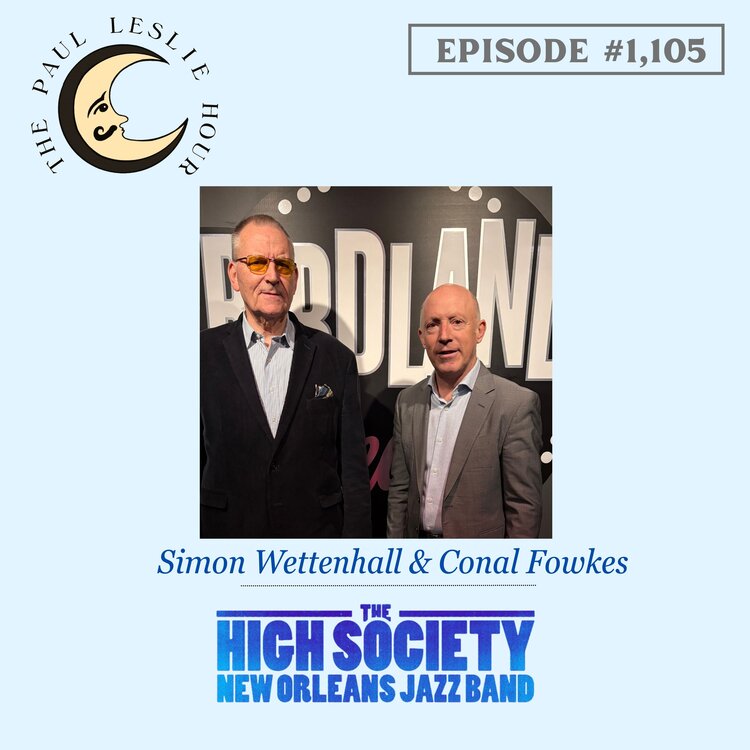
Keeping the Spirit of New Orleans Alive: A Conversation with Simon Wettenhall & Conal Fowkes
The Story behind the Music
What does it take to capture the raw, “hot” ensemble sound of early 1900s New Orleans in the heart of modern-day Manhattan? In this episode of The Paul Leslie Hour, Paul sits down with the driving forces behind the High Society New Orleans Jazz Band: trumpeter Simon Wettenhall and pianist/vocalist Conal Fowkes.
The duo discusses their recent live album—a recording that captures the high-energy, improvisational fire that defined the genre’s birth. From their legendary residency at Birdland Jazz Club to their decades-long collaboration as members of Woody Allen’s jazz band, Simon and Conal share insights into a life dedicated to musical preservation and performance.
In This Interview, We Discuss:
- The Authentic Sound: The technical and emotional challenge of recreating 100-year-old ensemble jazz.
- Birdland Memories: Stories from the stage of one of the world’s most famous jazz venues.
- The Woody Allen Connection: Lessons learned from years of touring and performing together.
- The New Live Album: How they chose the setlist, and what listeners can expect.
About the Guests
Simon Wettenhall is a world-renowned trumpeter known for his soulful, driving lead. Conal Fowkes is a versatile pianist and vocalist whose expertise spans from early jazz to Latin styles. Together, they represent the gold standard of traditional New Orleans jazz in New York City.
Help Support the Show Here
Live at Birdland: The mission and the music
Folks, thank you so much for joining us on another episode of the Paul Leslie Hour. Our guests today, Conal Fowkes and Simon Wettenhall of the High Society New Orleans Jazz Band, are both returning guests. Now, Simon was last on in 2008—I don’t know how many years ago that was—but Conal, however, is the most recurring guest on this show. You all have this new album out, Live at Birdland. Is there a mission when you begin one of these gigs? Is there a thing you’re trying to create aside from just “we’re doing music here”?
Simon Wettenhall: Well, definitely. We have a band that’s pretty much in agreement about what the mission is, which is kind of really rare. I think we all agree that we’re looking to create an ensemble sound rather than a collection of soloists and virtuosos.
We’re pretty much dedicated to a specific type of ensemble sound. And that is the ensemble sound of the early New Orleans jazz bands, some of whom obviously we know migrated to Chicago. That’s the general aim, I would say.
Conal Fowkes: Yeah, absolutely. I’m totally with Simon on that one. Along with that, our aim is also to play our hearts out and give the folks a good time—to entertain and put on a good set of music.
Simon and I spend a lot of time prior to these gigs choosing the repertoire and a setlist that will flow and represent those diverse elements of classic New Orleans style. There’s a lot of work behind it, so on game day, the hope is to deliver all of that. Hopefully, the audience just sits back and has a joyous experience.
Seasonal sets and thematic waltzes
You were discussing the repertoire—can something outside the show affect what you play? For instance, it’s a cold one up there in the Empire State today. Can the weather or the date have a bearing on the show at Birdland?
Conal Fowkes: We do often have little thematic things going on week to week. It might be because it’s an anniversary of a famous composer, or a particular holiday like Christmas or Easter. There are certain songs we might throw in just because it’s that time of year. Weather-wise, it might influence the choice slightly, but not greatly.
Simon Wettenhall: One of the things we always try to do is play a waltz in the style of an early New Orleans jazz band. There are a bunch of waltzes that are specific to the season, like “In the Good Old Summertime.”
These are really beautiful songs that people know intimately, or they are just very familiar melodies. People grew up with them; their grandparents grew up with them. So yes, it’s definitely seasonal and thematic. We might even do a few other tunes by that same composer on that night to create a sub-theme.
The audience at Birdland
Admittedly, you all are playing old songs. Bob Dylan once said there are more old songs than new ones, so he plays them. I’m curious about the people who come out to see you. Would you say those folks have some kind of commonality?
Simon Wettenhall: I would put them into three different categories. We have locals who come to Birdland anyway because they know they’re going to hear good music. They often haven’t heard us before and they have a great time.
Then there are the tourists. Birdland is a very well-known club, so tourists come from everywhere, some of whom have never heard music like this before. And of course, there’s the classic jazz fan. Some make a definite trip just to hear the band because they’ve seen something about it.
Conal Fowkes: Literally everyone and anyone comes there. We have children, retired elderly people, and everybody in between. We get people from every country in the world who are visiting New York and want to catch a “New York jazz experience.” The mix is huge.
Capturing the live energy
How did the idea to put this down on a recording come about? And was it difficult to choose the setlist knowing it was being recorded?
Simon Wettenhall: Scott Asen, who runs the Turtle Bay outfit, heard about the band and came along one night to hear us. He really enjoyed it and, right then and there, proposed the idea of doing a live recording. That was the starting point.
Conal Fowkes: It was very difficult because we have a vast repertoire and you want to represent all these various elements. Simon and I painstakingly spent a lot of time on it. We eventually came up with two nights’ worth of material.
We recorded two consecutive Thursdays, a total of 18 pieces. We thought there might be some disasters or mistakes, but in the end, everything was usable. There wasn’t a bad take—no edits, no nothing. We ended up with way more material than we could use, which created the even worse problem of deciding what to leave on the cutting room floor.
Future projects: Blues and waltzes
So is there talk of a second CD or a studio recording?
Simon Wettenhall: There were a couple of issues initially regarding a vinyl release because our tracks were too long—most run between five and seven minutes. There is talk of doing another recording, though we haven’t figured out if it will use the existing tracks or new ones.
Conal Fowkes: Turtle Bay owns all that material now, so it’s up to them, but there has been talk about a studio recording. That brings new challenges and the opportunity for redos, though you lose the atmosphere of a room full of people.
Simon Wettenhall: I think Turtle Bay might have an interest in a certain type of project now. For instance, we didn’t get a waltz on the live recording; we could do a whole album of waltzes. Or we could do an album of Jelly Roll Morton blues or his “Spanish tinge” tunes. There are ideas there that nobody else has really tackled.
Forming the High Society New Orleans Jazz Band
You have a long history of playing together, but how did this particular incarnation come about?
Simon Wettenhall: We’ve all known each other for years, playing together in thousands of bar jobs, jazz festivals, and with other bands. After the pandemic, when the Carlyle closed for a bit and that gig was no more, we wanted to keep the vibe of that music going. We decided to form a band of our own to explore that area.
Conal Fowkes: I’d like to mention the guys because they are integral. Brian Nalepka is our double bassist; he goes way back with the Bunk Project. Kevin Dorn is our drummer. Josh Dunn is on acoustic guitar and banjo—he’s a fantastic guy from Tasmania.
Harvey Tibbs is on trombone; he’s a New York staple. And on clarinet, we have Tom Abbott, who is a spectacular, deep, bluesy player. We lost a few members during the pandemic, but these spaces have been filled with the best possible guys. We all think the same way, so it’s a natural fit.
Fact-checking 1974 and the “Divine” piano
I have a fact-check for Simon. Someone wrote in saying they saw you in a bebop group in Pasadena in 1974 and that you and your friends used to listen to Charlie Parker and say “shut up Miles” because Davis was an “immature soloist.” Do you admit to this?
Simon Wettenhall: It’s all true except for the bebop part! I wouldn’t call it that. I was studying music with Warne Marsh in Pasadena and put a group together to play standards. Regarding Miles, I’ll be honest: there was a point where I wasn’t a fan of early Miles, and now I am. I like pretty much everything the early Charlie Parker bands did. All this music comes from New Orleans, no matter what they call it.
And a serious question for Conal from a listener: Does playing the piano feel connected to the divine or anything spiritual for you?
Conal Fowkes: Playing any instrument is open to moments of transcendence. I’ve played my entire life—thousands and thousands of hours. There have been rare moments where something else is going on. It feels like the piano is playing itself.
Those moments are enriching and uplifting. I’m not religious, so I don’t think it’s “God-sent,” but it is otherworldly. It transcends the mundane. It’s certainly a reason I keep doing it—I keep trying to have that feeling again.
The transition from the Carlyle to Birdland
You played at the Carlyle for so long. Was it difficult to transition to Birdland?
Simon Wettenhall: For me, it wasn’t difficult at all. The measure of a place is how people are listening. I’ve never played anywhere as comfortable as Birdland. In a club, if the management is behind the idea of listening, it’s fantastic. The Carlyle, as great as it was, attracts a different kind of “society” audience.
Conal Fowkes: I agree. Birdland is perfect. They know what they’re doing—the piano is beautiful, it’s never out of tune, and the sound is always right. It’s a luxury. It’s a listening room where people are quiet. The Carlyle was wonderful, but Birdland is a step up. It was a very comfortable, easy transition.
Playing with Woody Allen: The unadvertised gig
And what are the days you play at Birdland for everybody out there who is planning to go into New York City?
Simon Wettenhall: We play there every Thursday and we do two shows—one at 5:30 and one at 8:30. The shows last for 75 minutes.
Back when I was interviewing you all, at that time it was the Eddy Davis New Orleans Jazz Band. Whenever I called it the Woody Allen Jazz Band, nobody ever corrected me except for Woody Allen. He said, “It’s actually Eddy Davis.” It almost seemed like you all were not advertising the gig much—it was a “if you know, you know” kind of thing. Was that intentional?
Conal Fowkes: That’s true, and that was at Woody’s request. For his own reasons, he did not want publicity. He never liked to be announced, and he doesn’t want to see his name plastered everywhere. He knew full well that word travels fast and you’re still going to have a full room, so they didn’t push his name. That was Woody’s request, not the Carlyle’s.
In all those years of playing with Woody Allen, was there a surprising thing you learned about his relationship with the clarinet and music as a whole?
Simon Wettenhall: That’s a deep one. I was always fascinated by his relationship to the instrument because it’s not immediately apparent. In some ways, he doesn’t really want to be identified as a musician—I don’t know that he wants to be identified as anything in particular! But his relationship to music is always evolving. You have to be prepared for that. Even when you work with someone a lot and become comfortable, he still provides surprises you don’t expect.
Conal Fowkes: He has an interesting relationship with the instrument. He uses an unusual reed and has had alterations done to his clarinets. But regarding the music, I discovered a long time ago that he holds musicians like Bud Powell and Thelonious Monk in the highest regard.
You might not think that if you only follow the New Orleans style he plays, but he knows guys like Bud Powell inside out. He loves Charlie Parker and John Coltrane. It’s an interesting tidbit you pick up along the way—he really knows the modern greats.
Live at Birdland: The album experience
Tell people a bit more about the album. I know Conal has it there—hold it up again. If people order two from Turtle Bay, it helps with the shipping costs!
Conal Fowkes: This is it: The High Society New Orleans Jazz Band, Live at Birdland. The record label is Turtle Bay, a New York label. You can find them at turtlebay.com or on streaming outlets like Spotify and Bandcamp.
It contains a beautiful booklet with color photos and the history of the band, written by Ricky Riccardi. If your listeners don’t know him, Ricky is the curator of the Louis Armstrong House and Museum and a Grammy Award-winning liner note writer. What you hear on the album is absolutely uncut. No editing, no fixes—just how it came out of our horns on the day.
I always say: give yourself the gift of listening. Listen from beginning to end. You’ll hear the different vocalists, the instrumentation, and the applause. It’s a wonderful experience.
Taking the show on the road
Is there any desire to take this show beyond New York City—maybe to Spain or even Asia?
Simon Wettenhall: Totally. We’d love to do that. We’ve done many tours in Europe in the major concert halls, and we’d love to get this group out to Latin America or wherever there’s an opportunity. The band has a strong communicative spirit; people really get into it.
Conal Fowkes: I could see us going to new lands. This band has never played in Asia. I’d love to go down there. I don’t think Woody wants to fly that far, but we certainly would! Japan, specifically, has always eluded me, even though there is a small but very strong audience for this music there. They have a famous Japanese band that plays in the style of George Lewis and Bunk Johnson, so they might be very open to us.
The last word: Supporting an American phenomenon
Last question: Do either of you have a policy against an audience member buying you a drink? And what would you like to say in closing to the jazz fans tuned in around the world?
Simon Wettenhall: I never oppose the offer of a drink! I don’t drink anything heavy, but I love a beer or an ale. I’m very grateful to anyone who offers.
As for closing, I encourage everyone to read about the history of jazz and the people who made it. Listen and read at the same time. I’m convinced it is the major contribution of the United States to global culture. It’s fundamentally important to us as human beings and it could too easily disappear if we don’t explore it.
Conal Fowkes: I will rarely ever decline the offer of a drink! If I have to play afterward, it might just be one, but I’ll happily accept.
I’d just encourage anyone listening to support live music. Go and listen to the greats that inspire us. It’s all on YouTube now—you don’t have to dig for old 78s like we used to. Listen to Jelly Roll Morton, King Oliver, or Armand J. Piron. Dim the lights, cut off distractions, and just listen. You’ll find something beautiful or “hot” that you relate to.
Ken Burns said the three great things America gave the world were baseball, the Constitution, and jazz. There’s a reason he picked jazz. It’s a rich, vitally important American phenomenon. Spend a little time on it; you won’t be disappointed.
Simon Wettenhall: Thank you, Paul. It was great to be here and see you in person.
Conal Fowkes: Always a pleasure, Paul. Come down to Birdland anytime.
Simon Wettenhall: But you gotta buy me a drink!