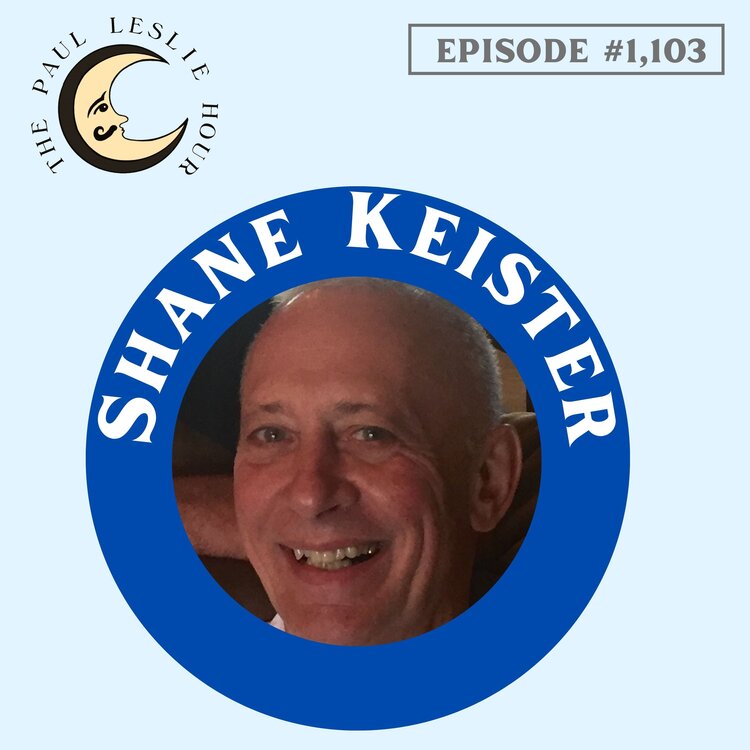
Are you here? We have to ask, even though we already know. You are plugged into episode number 1,103 of The Paul Leslie Hour—the place where the long-form story meets the front porch.
It is the first interview of the new year, and we are starting 2026 with a true titan of the studio—a man who played for Elvis, McCartney, and Jimmy Buffett. This is the Shane Keister interview.
Prepare for a soulful conversation. It starts now.
Help Support the Show Here
Support the Show
Subscribe to Paul Leslie’s YouTube
Shane Keister Interview
The purpose of the art
Paul Leslie: Hey, it’s me. Hello, ladies and gentlemen, and welcome to the year 2026. I am so pleased to welcome our special guest, Shane Keister. And to tell you a little bit about him, I’ve said often that somebody works with, I’ve said often that somebody worked with everybody. With Shane Keister, that is not an exaggeration. He has one of the most diverse, one of the most
Shane Keister: to go.
expansive and rich histories as a recording studio musician and he’s also a composer and performing and recording artist. He’s worked with everyone from Elvis Presley to Paul McCartney, Jimmy Buffett, Willie Nelson, Amy Grant, Rita Coolidge, Roberta Flack, Johnny Cash, Emmylou Harris, Jerry Jeff Walker. I could keep on listing, but no exaggeration, I would be here for probably 30 minutes. So what do you say we get into it?
Certainly.
Thank you so much for joining us, Shane.
Thank you for calling me. I appreciate it.
It’s a pleasure. Shane, what has always been the purpose of the art you create?
Actually, the creation, the art is the creation of it to me. The ability to come into a studio and hear a song for the first time and play it and add something tasteful to it. and just kind of know what to do. That’s the beauty of it to me.
Now you’re joining us from your studio in the volunteer state, correct? You’re there in Tennessee. Shane, where are you the happiest and what are you doing?
Correct.
I guess I’m the happiest doing orchestration and production and playing. I thank God I can still play because I’ve got Parkinson’s. It took a lot of my ability away, but I’m very careful how I play and I can do it. I play live with some, I guess I’m happiest doing music either in the studio or live.
Do you have a preference when it comes to live versus studio work?
No, I love playing organ. I’ve got a Hammond organ, a C3, and I love playing organ live just for some reason. I’ve done piano live I’ve done piano work a lot live. I like that. A synthesizer. Anything with keys on it.
Yeah.
Yeah, it’s pretty safe to say you will play any keyed instrument, right?
Yeah, I’ll try to.
Early days in the recording studio
Well, I’m hoping you can tell us about maybe the first time that you walked into a recording studio. Can you remember what you were feeling and what you were thinking then?
I was really excited because I was in Texas. Excuse me, in Tyler. Tyler, Texas. I was 17 and was going in there with two other guys and drummer and bass player and I’ve never been in the studio. The people and the manager and the band, of course, we were all talking about going to a studio. I remember looking at the console and being fascinated by that and the fact that the piano, was an upright piano, but it was a very good piano. It sounded like a grand. I saw how they mic’d it. I was fascinated and I was excited.
Working on A White Sport Coat and a Pink Crustacean
You have played on so many sessions. I mean, it’s just an incredible number of them and many, many very, very iconic recordings. For people who are fans of Jimmy Buffett, everybody knows about the album, A White Sport Coat and a Pink Crustacean. This is like, I guess, the holy grail of Buffett records because it’s where he moved away from a kind of folk rock sound and he developed this kind of coastal persona and this coastal sound. And for people who have that vinyl, they will see the name Shane Keister. You played on that album. Do you have any memories of that session?
Yeah.
Yes, I remember Jimmy was fun to work with and Don Gant, his producer, was a really good guy. I don’t know, I worked for Don a couple of three times, but I remember I was working on a sound. can’t remember what the sound was, but I had kind of been tweaking it for a few minutes. And Jimmy said, Shane, that’s really great. Can you get it more to sound like a bear in a cave? I don’t know what a bear in a cave sound like, but I made a couple of tweaks and he said, that’s it, that’s it. He was fun to work with. And very talented guy.
What did you make of him, Jimmy Buffett the person?
Very free, very free spirit. Unhindered, great writer. He just, he would rise to the moment, I guess. He kept us all excited.
And what about Don Gant? Don Gant passed away in the 80s, but he produced that album and a few others for Buffett. What are your memories of him?
Yeah. He was he was from a group. I can’t remember the group he was from, but he was a very musical guy and a really nice guy. Yeah, he died from, think, a blood clot. He had broken his ankle and he drove from Florida where he broke his ankle to Nashville. And I think he died from a blood clot. I always enjoyed working with him. I didn’t work a lot with Don. I know a lot of people that did work and everybody says he was fun to work with and a great guy, a real pro in the studio.
That title, A Pink Crustacean, did you find yourself craving seafood during the process?
Actually, yeah, and they had a huge amount of seafood delivery. I mean, was a styrofoam container the size of a refrigerator. And it was full of lobsters, clams, oysters, everything on ice. It was just amazing. A feast.
I’m curious, Mike Utley, who also played on that album, did you have many encounters or sessions with him?
Just a couple Mike’s a good player and a good guy. I don’t remember what we worked on together with one of the songs here. I just remember good vibes. He was fun to work with.
Influences and mentors
Well, speaking of piano players, who would you say are the piano players, the keys players that have had the biggest influence on you?
Gosh, when I was young, Ramsey Lewis, Herbie Hancock, Chick Corea, Oscar Peterson for sure, but I’m not a jazzer. I was mesmerized by his ability and art. But I think I was influenced more in the studio world by David Briggs, who was a great piano player and an arranger up here. passed away not long ago. And Tommy Cogwell.
Yeah, that’s right.
was a great bass player and guitar player. He kind of tutored me in the world of session. Chip Young did too. But none of the those guys were all guitar players, they weren’t piano players. But they were very talented studio musicians and they tutored me.
Tell us about maybe some of the engineers and producers that you’ve worked with that impressed you the most.
I think Stan Kessler was, Chip Moman’s engineer, Chip’s was a good engineer too, but Stan taught me the concept of signal flow. Gene Eichelberger was a brilliant engineer. He was at Quadraphonic. He had the first digital EQ I’ve ever seen. Chuck Ainlay, there’s actually been so many guys in Nashville that were so influential. And in New York, Alan Silverman, was a brilliant, brilliant engineer. I’ve been blessed to work with so many talented people. That’s all I can think of right now, but I’ll catch up in a minute.
Recording with David Allan Coe and Johnny Paycheck
Well, that’s an impressive list, to say the least. What impresses me about so many of the sessions is when I look through individual songs, there are so many influential tracks where I think like, my gosh, I’ve heard this song hundreds and hundreds of times. You played on the David Allan Coe album, Once Upon a Rhyme.
and that has one of his most famous songs, Steve Goodman penned, You Never Even Called Me By My Name. What are your memories of working with David Allan Coe?
Yeah. Yeah.
We recorded a session at Pete Drake’s studio, which is no longer there. I remember working there and we had a pretty big rhythm section. It was not a big studio. But I remember when he came into the vocal booth, I can’t remember what he said, but we all kind of came to attention. And we thought, this guy is either going to kill us all or we’re going to make a right great record. He wasn’t out of control, but he was, let’s just say, having a great time. And it was fun to work with, actually, when it came time to do that song, when we all heard what it was, we were like, yeah, we get this. It’ll be fun.
Was he an intimidating presence?
Somewhat, yeah. And the whole studio was kind of, well, we were all kind of gearing to what he wanted to do because he was pretty specific about what he did and did not want. I remember that. So we tried to do what he wanted and he liked it.
Yeah.
I know those albums are, they credited the producer as Ron Bledsoe.
Yeah, but but go ahead, I’m sure.
Pete Drake was there also, but I don’t know if he was producing. I think he was just playing.
How much of Coe do you think was him kind of playing a character versus being himself?
I would say it’s probably 50-50 because he didn’t ever change. He relaxed it sometimes, but he was basically the same vibe the whole time. Just a lot of energy and someone intimidating.
Yeah, yeah. Well, kind of speaking of David Allan Coe because he wrote the song, you also played on the Johnny Paycheck session for a very famous track, Take This Job and Shove It.
Yeah. The two famous bar songs. I remember the two famous bar songs. Yeah.
Repeat that, sorry.
yeah, exactly. Two famous bar songs you played on both of them, arguably the most famous of all time. Do you have any memories of that session with Paycheck?
Yeah, we did that at the Quonset Hut and Henry Strzelecki played bass on that. Henry’s gone from the earth now, but he was a wonderful bass player. I rememeber we talked about how funny the song was. We said, yeah, let’s just kick it off and slam it. We kind of looked at each other. Somebody counted off and we dug into it and played it.
What did you make of Paycheck?
Oh, he was cool. I like Johnny. He was a very attentive, I guess, artist because he listened very carefully to what we were doing and he would constructively criticize us. Yeah, he was good. He was a good guy.
Yeah.
I think of Paycheck as one of those artists when they mention the great country vocalists. He maybe gets left out, but what a voice that guy had.
Oh yeah, amazing. Yeah, he was wonderful. I have a great George Jones story. That’s my dog, Maddie. I don’t need you, thank you. Appreciate it. So I had a two o’clock session in Berry Hill, Paul. you know where Berry Hill is here.
The George Jones police escort
Well, on the note of voices, what about George Jones? Do you have any George Jones story?
I had also a six o’clock session downbeat with George at Quonset Hut on Music Row. Well, the two o’clock session was supposed to end at five, but went over to about 25 after. Now I was in a hurry, because I didn’t want to be late for this. So I jumped in my car, and I tore through Berry Hill. I look up, there’s a cop all lit up behind me, pulling me over. He’s a great big guy, with mirrored sunglasses. I mean, just like out of a movie. He walks up and he says, “boy. You’re going fast through here. Where are you going so fast? What are you in a hurry?” I said, I told him the truth. said, sir, I’m a studio musician. I’ve got a six o’clock downbeat with George Jones at the Quonset Hut. I don’t want to be late. He said, I’ll tell you what. Boy I know where that is. I’m going give you an escort there and I want to go in that studio with you. And if there ain’t no George Jones, you’re going to jail. I said, yes, sir. He got me there about three minutes to six. We walked in the back door through the alley. And here I come walked in with a uniformed officer. Unannounced. Bob’s putting his pot away because he looks up. Everybody’s, everybody’s tidying up. George is trying to hide his liquor. Thank God it wasn’t a no show. He was there. Or I would have been in jail.
that’s a great story.
I’ve got so many stories that I can tell you, but time is money.
Right, we’d be here for two hours. What about George to work with in the studio? What was he like?
yeah.
He was pretty easy, actually. He never got any bad attitude. I remember the one thing that he was trying to learn apart. He knew the song, but he didn’t really know it. And he kept going over and over one part of the song. I think it was the chorus until he was happy with it. I would play with him. So I would play with it. And then we just do it. He was OK to work with it. He wasn’t he wasn’t crazy or anything. And as soon as he opens his mouth and you hear one note, you go, oh, yeah You know the voice.
Hmm.
Touring and recording with Elvis Presley
Well, Shane, you’ve worked with the best of the best, and that would include the king of rock and roll, Elvis Presley. Can you tell everybody out there about the first time you looked eyeball to eyeball with Elvis Presley?
Yeah.
Yeah, we’ve been Larry Linden. went out with him for the first time and Larry is a drummer and the fluid system Memphis and said when you guys are going to rehearse and learn the show and we all this will be on the third day. So we were pretty hard for two days in a row. James was there teaching us Jerry chef, the bass player. They were kind of like teaching us to show. So we learned the show. Help us came in the third morning pretty early, but. I don’t know, maybe 8:30 or nine And we were all kind of nervous. He said, all right, boys, he just picked up the mic. And as soon he picked up the mic, he looked at me like, yeah, I got this, problem. And then he called three or four titles and a couple of medleys. And we worked, I guess, for about 20 minutes with him. He said, that’s great. These guys are great. Let’s do it. And we were like, are we done? He said, yeah. We did how many shows? I think eight or nine shows. It was fabulous. It was wonderful.
Som memories to last a lifetime. Was it ever intimidating? mean, he was after all Elvis Presley.
Oh yeah
Yeah, he was very friendly to me. And the most embarrassing moment of my life happened with him at Riverfront Stadium. A sold out performance, of course, 50,000 people. And we would do several medleys in the show, but one of the medleys, I think, started with Heartbreak Hotel and ended. And then he talked to the audience and do some punches and some kicks. And when he threw his right hand out in a strike. I would catch it and do teddy bears. Da da da da da da da da. Easy, right? As long as I could see Elvis, it was easy. That night, Charlie backed up way to the piano and I couldn’t see anything because I’m sitting down. Well, about two or three times I said, Charlie, move, Charlie, move. Finally, he moved to his left. I could see Elvis and Elvis was staring at me with knives coming out of his eyes. I found out later he had thrown three punches and I didn’t come in. So finally, he looks at me and he turns back to me says, excuse us, ladies and gentlemen. We got a new idiot playing piano back here. Can’t seem to follow what’s going on. 50,000 people laughed at me. But after that it was kind of funny because in the middle of another song he just threw his fist down and I go, dada. Yep, I’m watching. It got to be a game with us.
Now, were you able to tell Elvis later what had happened?
Yeah, and Charlie got Charlie got a bunch of trouble. I got my revenge through Elvis.
okay.
Very good. Well, I was looking through different credits and correct me if I’m wrong. I think you played on one of my favorite songs of his and that’s Moody Blue. Did you play on that?
I played on a version of that. I don’t know if it was the one that you know. I think the original was done several years before I did. I played on his last album. I played synthesizer and I played clavinet and I something else organ. I don’t think I played on that Paul, but I know the record.
Yeah, okay. When you realized you were going to be on an Elvis Presley recording, how did that strike you? How did that feel?
Amazing, because I knew anything the guy did was going to be timeless. And the fact that I could be part of a record like that was just, I was kind of stunned to tell you the truth. And Chip Young and Felton Jarvis were producing it. And they were both good friends, so they were a calming factor. But yeah, I was honored.
When you were traveling with Elvis Presley and the other musicians, did you travel with him or how did that work?
Yeah, we traveled in the Lisa Marie plane. We flew almost everywhere. We traveled by bus one time between, I think, East Tennessee and Savannah, and the rest of the time we flew on the plane. It was wonderful.
Choking in the studio with Paul McCartney
What about Paul McCartney? I know you did a session with him. How did he become aware of you?
The secretary for the Sound Shop, that’s where the recording was, called me at, I don’t know, at 2 o’clock or 2.30 in the afternoon and said, Shane, are you working at 6? I said, no. She said, I got a session for you with Paul McCartney. I said, no, you’re kidding. She said, no, I knew he was in town. She said, can you be here at 6 o’clock? I said, yes, I will. so Monty was really responsible for it. And she called me because I was kind of new in town. was a new guy and she liked me. I liked her. She was a good friend. And all of the sudden I’m in the studio with Paul McCartney and Paul. That’s the only time I ever choked in a studio. We were taking this all. We’d run it down and talked about it. we’d run down to chart and we were playing it and looking through the lid of the piano like this in the studio is I’m in the control room and there’s Paul McCartney with his face looking at me.
Yeah.
And I’m playing this, oh my God, it’s Paul McCarty. I stopped playing. I kind of hiccuped and stopped playing. And in the studio, I mean in the control room later, said, man, said, I’m a bloke just like you. He said, don’t be afraid, don’t worry, just hang in. Have a good time. He reassured me and we did it again. Did the take again and it was fun. That’s the only time I ever choked though.
But he was able to put you at ease.
Now, what did you think listening back to that song?
I remember thinking that’s me on piano and that’s Paul McCartney singing Gosh! and Buddy Emmons was playing too. But we were looking at each other like, yeah, this is the big time.
Producing Don Francisco and He’s Alive
There’s another album that you played on that’s pretty renowned, especially it’s something that resurfaces every Easter. I’m talking about the Don Francisco album, Forgiven.
Yeah. Yeah. Yeah. Don was a great writer. He’s the first. The first and actually the second album I ever tried to produce, I co-produced that with John Thompson and He’s Alive came off that record. He’s Alive was, I think it ran 93 or 96 weeks at number one. It’s still, I think it’s still the longest-running Christian record. And Don gosh, Don didn’t get the recognition, I think, that he deserved that. But he’s just a talented and such a nice guy.
Pretty astonishing stories here. What did you think of that particular song, He’s Alive? Did you feel like it had a particular something to it when you heard it?
Yes, and it was very long, of course. And we talked about, well, can we shorten it? No, we can’t because the lyric is so important. We’ve to keep the storyline. So we said, well, we had to try to make it interesting. So I remember that’s the first time we realized that we were going to have to cut the acoustic guitar first because of the dynamics. And we did the whole song from front to back with acoustic guitar, I think in bass or something, just a little kind of a skeleton template. And then we filled it in with
Right.
with drums and piano and bass and everything. And I remember getting at the end when that “he’s alive,” chorus happens over and over. It just makes the hair stand up on my head. He’s such a great writer.
Absolutely.
Ahmet Ertegun and the art of listening
There’s no doubt, no doubt. You also had a relationship with the late, great Ahmet Ertegun, one of the most renowned names in the record business, really. How did you come to know him?
Yes.
Yeah, yeah. He came to Nashville with an act from Nashville and I was playing piano on it and leading the session. And then he asked me to do some arrangements on that same project. I did some charts, some string charts, and he liked it. He said, look, I’ve got a project in New York in a couple of weeks. Can you come up for that? And I guess I went to New York half a dozen times and then he asked me to sign. He signed me as a staff producer with a two five year contract back to back. So I was busy living between New York and Nashville for over a decade. I did a lot of records with Ahmet, he was a brilliant man.
How would you say that the studio scene was different in New York?
Well, the first thing I noticed being a player was the headphones weren’t important. They weren’t as important. In Nashville, the first thing that you do is get your head engineers to do, you get the headphone mixer where we can all hear each other. Because we’re talking about the song and discussing intros and endings and things like that. So we got to be able to play and hear ourselves and each other. then the mix of the headphones has got to sound really good. We got to be able to hear everything. Those two things weren’t primary in New York. That’s the only difference. Engineers were just as good, musicians just as good, but for a long time the headphone situation wasn’t addressed, I don’t think, correctly. Now it is, because we realize we can’t work if we can’t hear.
Did you spend time with Ahmet Ertegun outside of music business stuff?
Yes, a bit. We went to New Orleans one time together. But that was part of a business. Let me think. No. Oh, yeah. There were lots of Atlantic Records functions that I went to. Black tie things. And he was a brilliant man. He taught me the art of listening, Paul because as a musician, I listen differently than you. And I hear things that I hear all kinds of crazy details. And if I’m listening to a song, I better listen to the song and not the peripheral fluffiness, the lace as you listen to the middle of it. And that’s what he taught me. He was very instinctive, very instinctive.
Tell us a little more about that. He taught you the art of listening. How did that come about? How did that particular lesson come to you?
We were working on a project on a group called Devonsquare. We were doing vocals on them. And we already had the track cut, And did a couple of passes on the vocalists. And we said, let’s listen to the last two or three takes. And we listened to each take one by one. And he looked at me and said, which one do you like? And I told him, he said, why do you like it? I told him, he said, yeah, but listen to number two and number three. We listened and it was it was different. It felt different and it was intended, but it felt different. He said, listen to the feel of it. And I listened to it. I think I understood what he meant. I said, yeah, you’re right. It’s better. It’s a it’s a it’s a better record with this vocal. He was he was very into it.
Interesting.
Paul Leslie: You shared a producing credit with him on an album, a very, very excellent album, Music Is My Life by Diane Schuur. Can you tell us about working with her?
Shane Keister: Oh, she’s she’s she’s wonderful. She’s probably the best vocalist I’ve ever worked with, Paul. She had like a five-octave range, something crazy. Her pitch center and her time are amazing. She she may she may be the best vocalist in the world, you know, that ever lived, or in the top five. But working with her was a joy.
She’d sing something, then she’d say, “What do you think about that?” and Ahmet and I would go, “Yeah, what about this?” She’d make a suggestion. She’d do that, and then she’d ornament it. She was amazing. She is amazing.
Yeah, she definitely is amazing. Let’s hope that you two work together sometime soon. Yeah. Well, thinking about that album, it makes me wonder, what does a guy like you, Shane Keister—what do you think about the Great American Songbook, those great classic songs?
They are just that; they are the great classic songs. Those songs are all timeless. I can’t think of any of them that aren’t. They’re going to be around for as long as there’s music, I think.
Benchmarks of songwriting excellence
There’s no doubt, no doubt. Well, I’d like to get from you, what would you consider a kind of a benchmark, an exceptional song—any song at any time in history?
One that I worked on or one just in general?
Just a song in general that you think is a high-quality song.
Well, “He’s Alive” would be my first reaction because of what the song is and what it did and the time it was written. It was very revolutionary. I think songs like “God Bless the U.S.A.”—that’s a timeless song.
I worked on a song called “100 Years” by Five for Fighting and John Ondrasik, the artist and writer; he’s a great guy. That song means so much to me. I remember playing it. I was crying when I was playing it and they saw me and said, “What’s the matter?” I said, “You wrote this song about me,” because I listened to all of the lyrics. It was just like I was living the song. Let me think of other songs.
Well, those are some good ones. I saw that you are credited on the song “God Bless the U.S.A.,” the Lee Greenwood song.
Soon.
Yeah, you know, we cut that at the old Mercury Studio and I remember the “Proud to be an American,” and I remember and I’ll and then “I will stand up,” right at that break. We tried that break as two beats and three beats and four beats. I can’t remember why we decided what it was, but we tried it a dozen times and Jerry would say, “Now shorten it a beat,” and then “Add a beat.” And finally, whatever we ended up with was what we did. But I remember thinking this song is going to be around a while.
Future collaborations and missed opportunities
And you were right. It’s just amazing. I mean, I can’t help but express a bit of awe that all of these very, very famous songs, you were there. You were contributing to that sound.
I was very blessed. I’ve been very blessed my whole life.
Well, is there anybody that you have not worked with that’s still around that could happen, that you would really like to work with?
Yeah, let me think. Pink. I love her voice and her records. Let me think. No, he’s gone, sorry. I just thought of someone. Pink; I’d like to make a record with Pink.
Interesting.
Yeah, she’s she’s she’s powerful. I love her music and her artistry.
Who were you thinking of that had passed on?
Michael Johnson. Yeah, I loved working with him. I’d love to work with him again, but he’s he’s… He was such a wonderful player and such a wonderful spirit and wonderful singer.
Michael Johnson.
Yeah.
The composition of melody and the Bach challenge
Well, in addition to all of your instrument playing, your session work and live performances, you also are a songwriter. Are you primarily a composer of melody?
Melody and music, yeah.
Yeah.
Gosh, I’ve been blessed to write with great writers and great artists. And I think of all the songs that I’ve written, there’s one in particular that I remember that so many things happened from—a song called “Pirate” that my ex-wife and I wrote together, Alice. She’s a brilliant lyricist. It was on an album by Florence Warner. I don’t know if you know that name. We did it; Norbert Putnam produced it.
Quincy Jones heard the record after it came out and he called me. I came home from the studio and here’s Quincy Jones’ voice on my Codaphone. “Hey Shane, this is Quincy Jones. I heard this song called ‘Pirate’.” He called me like, this is a joke. This isn’t right. It’s a 213 number, so I knew that it was L.A. I called the number and here’s Quincy. His office.
And he said, “Man,” he said, “I love what you did on that song, ‘Pirate.’ You composed that?” I said, “Yeah.” He said, “Did you orchestrate it?” I said, “Yeah.” He said, “Well,” he said, “I’m doing an album on Frank Sinatra and Lena Horne in about six or eight months.” He said, “I want you to do a couple of charts.” I said, “Man, are you sure you got the right guy?” He laughed. He said, “Yeah.” He said, “When are you coming to L.A.?” I was supposed to go out there for something in a couple of weeks. So I did. He was working on Michael Jackson at the time. So we went to the studio and hung out with him for a couple of days.
And then gosh, I went back in about three months, maybe four months. You might know the name Don Costa. Don was a brilliant, brilliant writer and composer and great pianist. And Frank would not go in the studio without him, and Don died and the album got canceled. Frank wouldn’t go to the studio without Don. So, I never got to do that one.
Yeah.
That’s so sad. I’m so sorry.
Me too.
Yeah, there’s gotta be when you have such an extensive list of credits like you, there has to have been a few, you know, missed calls or something. Yeah. Well, I’m curious about some of the songs that you’ve written that you are the most proud of. I was listening not long ago to “So Beautiful,” which I was really surprised—I thought, wow, there’s Shane’s name again. You co-wrote that with Twila Paris.
Yeah.
Yeah, Twila’s brilliant. Yeah, I love her artistry. We wrote that in—I think we were in Arkansas when we did that record. She had a great studio down there. Yeah, I think we wrote that in the studio. Let me think. There’s a song by Amy Grant that she started with called “Sing Your Praise to the Lord.” I think it was her first hit.
And I didn’t write that, but I played piano on it in the front of the record. The first 40 seconds or so is a Bach—I think it’s “Toccata and Fugue.” It’s a Bach piece and I played it in college, so I was familiar with it. But I had to play it a minor third below. I had to transpose it. And it was hard. I think that’s the hardest thing I’ve ever tried to do in a studio because the fingering was so hard. It was all messed up. Bach isn’t easy. But when you transpose it, you get it away from its original key, it gets crazy. But anyhow, that was the hardest thing I ever did and one of the best things I ever did. I’m very proud of that. Amy—I think it was one of Amy’s first records. She’s an amazing person.
Advice for the young Shane Keister
Amazing. The number of experiences that you’ve had. If you could give the young Shane Keister, who was embarking on a career in music, any piece of advice—if you could put your hands on his shoulder and say, “Shane, listen to me. This is the Shane from 2026. I’m giving you some advice.” What would you say to him?
The…
I would say listen to those people around you that you respect. Because if you respect them, they must be doing something right. And don’t be afraid to take chances with your music. But don’t take chances with addiction. Because all of us, people that are so talented, we all kind of have that potential for addiction. Whether it’s dope or sex or whatever, we got to be careful of that. That just kind of comes with the… listening to people and listening to people that we respect. That’s the most important thing, I think.
Excellent. Has there been a compliment that you have received through the years that means the most to you?
Yeah, I’ll tell you a funny story about a compliment. And I’m not going to use the artist’s name and the producer’s name, but this artist is from New Jersey and she was a folk artist and not selling any records. And her producer called me one day and said, “Shane, I’m bringing her down to Nashville.” He told me about her. He said, “She’s a folk artist and I want to cut a country record on her.” I said, “Great.” So I booked a country band: Kenny Malone, Joe Allen, and Stu Basore, Weldon Myrick. Jimmy Capps—I think, yeah, Jimmy played on it. Anyhow, a real country band.
And the first day in the studio, she gets out of her car and she plays the song. We write our recording charts down. And we kind of talked about how to run it down. So we do this, and on the first take it was a great take. It was the record, in fact. We got to the end of it and the producer pulled the fader down and pressed the talkback and said, “Hey, what’d you guys think about that?” And she paused for a second. She said, “I’ll tell you what, that’s the hickiest, corniest, countryist, hillbilliest thing I’ve ever heard in my life.” We all paused for a second, the bass player leaned in and he said, “Well boys, I don’t know about you, that’s the nicest compliment I’ve had in weeks.” Totally broke the ice, and she became a major country star.
But you can’t tell us her name. We might be able to figure it out, who knows? Probably, but I respect that. Well, what about what you’re working on now? What’s on the horizon for Shane Keister?
Not yet. Yeah, you can…
Well, I’ve got a couple of projects. One I’m working on that I’m really excited about: there’s a song from Ernest Goes to Camp called “Gee, I’m Glad It’s Raining,” that I wrote with my ex-wife for the movie. And it’s really—it turned out to be a good song. And I want to cut that as a single for somebody. I’m really excited about that. And I got an orchestration project to do at the end of this month. I’m excited about that because I love to write. Other than that, just kind of same old same old.
Well, I want to call to the attention of the listeners out there: you have an absolutely excellent Christmas album. I know Christmas is over, but the thing about Christmas, there’s always another one coming. Check out this album from Shane Keister. If you want to dig up a copy, you can, but it’s also on Apple Music, which is how I heard it. It kind of has a bit of a New Age sound to it. But it’s absolutely beautiful.
Thank you. Thank you. Some wonderful, talented players worked on that. Teddy Irwin played guitar on that and he’s gone from the earth. He was a wonderful guitar player. I can’t remember—I used several other musicians, but I played most of it myself because that’s what it took. But thank you. I appreciate the compliment. That’s a wonderful record. I’m very proud of that record.
The human factor in music
Yeah, it’s really, really very, very nice. I hope everybody checks it out. Now, I always like to give credit where credit is due. You appeared on a podcast—it’s called the Stage Left Podcast, people can still find it. It’s a very good interview that you did with this guy, but you said something in it that really struck me. You said, in some cases, music, if it’s perfect, that’s not good. And it made me think of something that Bob Dylan said one time. He was talking about a piece of music and he said, “I like this; it’s got some dirt on it.” And there’s something about music, I think, when it sounds human. I’m just hoping you can tell us a little bit about that.
Yeah. Yeah. The human factor is exactly what it is. The way I can describe that is a computer can make things perfect in the sense of time, notes playing together, notes playing consistently—sixteenth notes in exactly the sixteenth… things like that. But, you know, we made so many of those records in the ’80s and the music becomes almost stagnant after a while. It’s because it’s perfect. There’s no space for, I don’t know, not electronic errors, but not even errors. It’s just things that don’t exactly happen together when they’re supposed to. They’re sometimes beautiful. And something that’s too perfect is boring. It doesn’t have any life to me. People—we can’t do what machines do and machines can’t do what we do. People make it what it is, I think.
Very well spoken. Well, do you think, Shane, that there’s really something that you can’t put a finger on that a musician gets when they’re in the same room as the other musicians and you’re all kind of looking eye to eye with each other? You think you get something from that?
Yeah. Oh yeah, yeah, there’s a communication. It’s kind of unspoken that happens when four or five guys start playing. It’s a—it’s not telepathic, but it’s intuitive, I guess. You find yourself or I find myself listening to other players and what they’re doing more than what I’m doing. And the simplest thing is usually the best thing I’ve found recording. Because if you play simply, you leave room for everything to happen. If you play too much, there’s no room.
At heart: a little kid having musical fun
Very interesting. Now not just limited to music, but what is the best thing about being Shane Keister?
Gosh, my life, Paul. I guess I’ve had a blessed life. I’ve worked with wonderful, wonderfully talented people and just been living the dream, I guess. Music has taken me over most of the world. I’ve traveled a lot, and I’ve been part of some great recordings. If I had to do it again, I wouldn’t change a thing. I don’t think.
Hmm. I had all these different labels that I put on you at the beginning—that you’re a studio musician, a performing and concert recording artist, a composer, all these different things. Who is Shane Keister at heart? Who do you say you are?
Gosh, a little kid, I guess. I just love having fun with music. I love having fun period. But I love having musical fun. I worked a long time with Lynda Carter on the road. She had a great band of studio musicians. That was—gosh, Paul, that was the most wonderful band. Paul Leim, Kerry Marx, Lou Marini.
Ha ha.
A great band of studio musicians and her music was very fun to play. And gosh, at that point in my life I think I was about 65 when I first started working with her. Gosh, working with her and that band—that was the best band I’ve ever been in.
Wow. Now did you all make any recordings?
We made one record. I don’t think it did much; for her fans, it was great. She sold a lot of records because it was her.
Okay. I’ll have to check that out. Interesting stuff. I always like to let my guest basically take the stage, so to speak, where you can just say whatever you want. It’s totally open-ended. You can go in any direction, not limited to music, but it could be about music. What would you say to anybody who’s tuned in with us?
Gosh, the variety of music in the world is amazing. And the people that make it are amazing.
I’ll tell you a funny story when I was working for Ahmet in Atlantic Records. This is kind of typical of the way the music business worked. It was pretty early in the morning. I was at the office at about 8:15 or 8:30. We had to make some copies and send them out. And I was waiting in the waiting room. And all of a sudden, here comes Henry Kissinger walking through. And Henry walks into Ahmet’s office. And he was friendly, just kind of nodded. And of course, he didn’t know me; I nodded.
And then I ran out there, I grabbed a subway, ran to my studio, which was about 20 blocks, 30 blocks away. I made the copies and got back in about 45 minutes or an hour. And out of Ahmet’s office walked Mick Jagger. I thought, there’s no way that Henry Kissinger turned into Mick Jagger, but it’s possible, I guess. Ahmet’s friends were so diverse. The part of the music business that he showed me in New York was just amazing. And the history was amazing. Gosh, the Atlantic studio—that was, I think that’s one of the best studios I’ve ever worked in. All that’s changed and time goes on.
Well, Shane Keister, I can say that you have one of the most incredible stories that I’ve ever heard from anybody in the music business. You’ve worked with the best of the best. You’ve made beautiful recordings. You’ve shared those with people. And thank you for doing this interview. It’s been such a pleasure.
Thank you for calling me Paul, my honor. I appreciate your interest.
My honor and on behalf of all of the listeners, thank you for the tunes.
Thank you.
Alright, until next time my friend… Okay.
Yes.