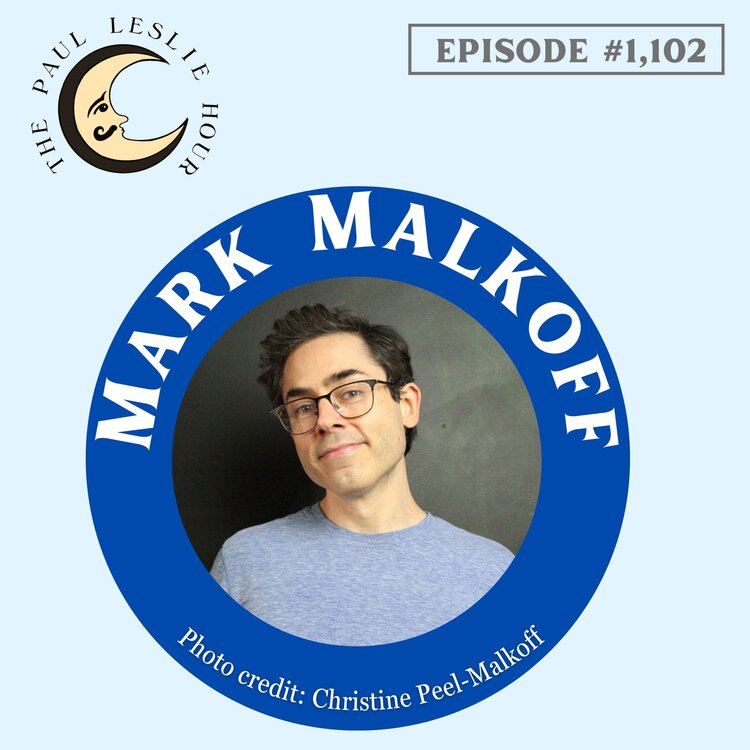
Mark Malkoff returns to The Paul Leslie Hour.
It’s The Paul Leslie Hour, episode number 1,102. We’re delighted to welcome back the hilarious and insightful Mark Malkoff, who’s here to share stories from his new book, “Love Johnny Carson.” Join Mark and Paul for a lively conversation about the ultimate late-night legend, the enduring magic of The Tonight Show, and the many entertainment icons that made up Johnny Carson’s world.
Stay with us!
Help Support the Show Here
Support the Show
Subscribe to Paul Leslie’s YouTube
The Genius Behind the Legend: A Conversation with Mark Malkoff
In this episode of The Paul Leslie Hour, Paul sits down with podcasting veteran and Carson expert Mark Malkoff. Following the success of his legendary Carson Podcast, Malkoff has penned a new book, “Love Johnny Carson: One Obsessive Fan’s Journey to Find the Genius Behind the Legend.” The two discuss the process of humanizing an American icon, the “inner circle” that knew the real Johnny, and the musical legacy of The Tonight Show.
Key Takeaways
- The Myth of the “Cold” Carson: Contrary to media portrayals of Carson as aloof, his closest friends describe him as being the same person on and off camera—a disciplined, witty Midwesterner who demanded excellence.
- The Sinatra Connection: Frank Sinatra once saved Carson’s life during a drinking-related altercation in 1971, a debt of gratitude that later led Johnny to host the Reagan inaugural at Sinatra’s request.
- The Ultimate Gift: Malkoff notes that for the millions who loved Carson, the book serves as a definitive look at his 30-year reign, making it a perfect gift for the parents and grandparents who grew up with him.
The Mark Malkoff Returns Interview Official Transcript
Welcome to Mark Malkoff Returns here on the Paul Leslie Hour and I am very excited to talk to Mark yet again. Now the last time we couldn’t see each other but we are now in this era where everybody sees each other all the time and I first of all I want to congratulate you on your new book it’s entitled Love Johnny Carson: One obsessive fan’s journey to find the genius behind the legend.
Thank you. It’s been a while. Thank you for having me.
Absolutely, my pleasure. I went back and listened to the last time we were on, and immediately I felt completely relaxed because you have this communication style, and I think it’s as a result of you have interviewed so many people. But also, probably from watching so much late night television, which both you and I have done, we’ve developed a sense of pacing, I think.
I think so for sure. I agree. Right back at you. Thank you.
So do you think that you, as a result of the many, many episodes of the Carson podcast, which is one of the greatest podcasts of all time, and as a result of writing this book, do you feel that you’ve gotten any closer to discovering the genius of Johnny Carson?
Wow, thank you. I think so. I mean, it’s hard to really define exactly what it is. I think it’s a bunch of different things. But I think from talking to his friends and the people that knew him that had never talked before, I think the genius really is, and this goes against the media who made him out to be cold and aloof and he was not that guy behind the desk.
The people closest to him consistently said he was almost the same person on and off camera, which I just don’t think you can fool the American public for 30 years and not be yourself there. And that went against everything I thought. I think the genius was is that, you know, it was a small group of people that he trusted that he was friends with for years that he could be himself like that. But I think the genius was that he was himself. He was Nebraska.
He expected excellence of himself and from everybody. He put everything into his career, his social life with his wives and the kids suffered for sure. But just a student of comedy. I mean, in 1971, he had four TVs going on in his apartment in New York City. And he was watching at 11:30 his own show, The Competition, Dick Cavett, David Frost, and either Joey Bishop or Merv Griffin. In terms of competition, being competitive, being driven as part of his genius and just being a student of comedy, Jack Benny, and since he was 14 performing. So there’s a lot of things that I think that go into the genius. He was very witty, really fun, funny, but I just think part of the genius is knowing his audience, really listening and being curious, I think are two other things with him. And he knew his strengths and he played to them, I think.
Hmm very very well put. Sometimes I ask the hardest question first so that you know you just know that it’s smooth sailing from here. Well, as I said, you know, you’ve interviewed so many different people and I just want to read a list of some people I selected: Mel Brooks, Dick Cavett, Tina Sinatra, Elizabeth Ashley, Larry King, Carol Burnett, Chevy Chase, Jay Leno, Tim Reid, I mean, holy smokes, I could keep on going. I’ve done certain interviews where I feel like this certain person revealed the most about another person because people tend to be more informative about other people than they are like a person themselves.
You could get more information about certain people about Johnny Carson than you probably could if you got a chance to talk to Johnny Carson himself. Who has been that person? The gold Johnny Carson source of information.
Of the people that I talked to, I think the people that really informed who he was that I talked to, I’d say his friend Howard Smith, who was good friends for years with Carson in Malibu, people like David Steinberg, who was friends with Carson and Chevy Chase that played in the poker game with him, like Barry Diller that really, for years just knew him as just their friend and really funny and again, they said the same thing. He was almost the same guy on and off camera. Danny Robinson, whose parents, Bud and Cece Robinson opened up for Johnny and he was friends with Johnny up until he passed away. People like that, I think, to get the inside story of who Carson was, that inner circle. It was a small inner circle and obviously Carson, not obviously, but Carson demanded loyalty and he gave loyalty and they basically said if you were his friend he would do anything for you.
Now, when we spoke last time, you were just about to hit 200 episodes of the Carson podcast, and I kept kind of poking about Doc Severinsen, and I was telling you, it’s got to happen. And then it did. What was your impression of the great Doc Severinsen?
I was very happy to get Doc. That was huge. We got him twice. My impression is that he misses Johnny to this day, thinks about him every day and just, you know, they were friends, but at the same time, just really wanted to be excellent like Johnny was. Johnny demanded a lot of himself and Doc, I wish, certain performers have a really hard time enjoying the process and Doc was just always walking on eggshells, just really kind of nervous that he might let Johnny down. So there was always this anxiety that he wanted to please Johnny.
But they were magic in terms of the chemistry back and forth when Doc would fill in for Ed McMahon. Doc just really read Johnny well. For example, Johnny hated to be corrected even if he was wrong. So it comes back from a commercial and Johnny’s like, Doc, that song that you just played, that was great, and gives the wrong title. And Doc doesn’t correct him. Wisely says, yes, that’s what I just played. And yes, I appreciate that you like him. So Doc knew how to handle Johnny and, you know, they were friends. They vacationed together and the whole dressing flashy was just a complete accident. And Johnny just very wisely was like, you’re going to do this every night. And Doc played the part very, very well. But I mean, talk about being driven with Doc. Even on his honeymoon, he was practicing the trumpet every day. His wife, Emily Marshall, was telling me. I mean, the guy in terms of his discipline and his work ethic was unbelievable.
Did you ever see Doc in concert?
I never did. I wish I could have seen him, it never worked out. I’ve talked to him on the phone subsequently a bunch of times, but I’ve never seen him play. It’s amazing, just, yeah, he retired like a year ago from touring. I’m sure he still practices here and there. I haven’t talked to him in a while, but what a life, what a career.
Absolutely. He’s great live, by the way. Now, you have gotten some amazing, amazing scores, including people that, like, you know, in the Sinatra world, Tina Sinatra is kind of known for being like the one that’s hard to get. And, you know, there were some iconic Frank Sinatra moments on The Carson Show. Can you tell us a little bit about her and that aspect of Johnny Carson?
I think the reason Ms. Sinatra agreed to talk to me probably is because it was Johnny Carson and Carson was so, such a special person to Frank Sinatra and vice versa. Carson worshiped Sinatra, would sing Sinatra in the office, play Sinatra. One of his assistants in New York said the soundtrack to Johnny in the sixties in New York was Sinatra because he was always, always playing. They met really, they really got to know each other in St. Louis when Johnny filled in MCing with the Rat Pack and then they flew back to New York together and I think they either went to Jilly’s or Patsy’s one of the two and at Patsy’s Sinatra and Carson had their own side exit so they could kind of sneak in and out without the public.
They really were wonderful together; they enjoyed each other’s company. Johnny I think was always in awe and then Johnny—we talk about on the Tonight Show, he struggled with drinking. He was not a good drinker. He’d have one drink too many and he would turn into Attila the Hun. Johnny would go the opposite and want to fight everybody. So Sinatra intervened on an occasion in 1971 and saved Johnny’s life. And Johnny always was in debt to Sinatra. So when Sinatra asked Johnny to do the Reagan inaugural, to host it, Johnny said yes because it was Sinatra and Sinatra saved his life. Johnny at that point just didn’t want to be do anything political. It worked out very well. Inaugural was really fun in terms of Johnny. He revered Sinatra and surprisingly so. Sinatra only appeared on Johnny’s show once scheduled and then another time he made a cameo. Tina Sinatra told me her dad was so nervous. Johnny did make that look easy and I just, it’s hard to think about Frank Sinatra being nervous.
Yeah, you definitely don’t think about that. You know, when I think about sometimes all-time great performances that I’ve seen from a musical standpoint, so many of them were from the Carson show. You know, I can recall seeing just Jimmy Buffett doing an incredible rendition of actually a Sinatra song, Stars Fell on Alabama, on Carson. Can you tell us a little bit about, from your experience as a Carson lover and as a person who interviewed so many of these people who were musical—tell us about the musical contribution and the musical side of Johnny Carson himself.
Carson definitely liked the big band jazz, the Tonight Show was all about excellence. If somebody was excellent at what they did musically, they got booked. There were definitely the rock acts, the hard rock didn’t really happen too much. It was a novelty. Like ZZ Top had never done live TV and they had sold 30 million records. So Carson put them on as kind of a one-off. And then, it was more about the beard. Cut to Johnny with the ZZ Top beard and sunglasses. It was more about that. And Alice Cooper bringing on a snake and that was pretty revolutionary.
But for the most part, he liked the big band. He liked singers like Joe Williams. He loved Tony Bennett. He wishes that he had the talent of Steve Lawrence that could sing. Steve Lawrence called Johnny a frustrated singer. He loved Buddy Rich drumming. Ed Shaughnessy, Johnny’s drummer in the band and Shaughnessy had a famous drum off together. But yeah, anybody that was talented from opera to Beverly Sills, to Roy Clark, who Johnny had guest host a lot, and Willie Nelson. If somebody was talented, they’d go on the show, but people definitely saw their careers as a boost from the music. I know Mac Davis told me he got his own variety show, and he just said Johnny did that for him. And then, this is in the book, KD Lang, I think it was her second time on Carson, the producer saw her and that’s what got her really her big break. And Carson loved KD Lang, loved her music so much so that KD Lang in an interview said, “I think Johnny Carson’s in love with me.”
Now, the first place to broadcast my interviews was Jimmy Buffett’s Radio Margaritaville. And you got him on the Carson podcast and that was a great interview. And he commented how neat, he was like, it’s so cool that you’re doing this, a Carson themed show. Do you have any recollection of the late Jimmy Buffett in that interview?
I couldn’t believe that he said yes. I reached out to somebody that works with him and I emphasized that Mr. Buffett would want to do this because it was such a big part of his career and I don’t think he’s ever talked about it. When I did speak to him finally, he’s like, Mark, I’m excited because you’re the first one that’s ever asked me about going on Johnny Carson. It was the biggest break of my career that and opening up for the Eagles. He couldn’t really get booked on TV pre Johnny Carson. And yeah, it was really great. Jimmy Buffett sat down with Johnny on the couch. So yeah, I think he just got a kick out of the fact that he could tell his story for the first time with Carson and just really appreciated what Johnny did for him. But just really nice, gentle guy.
Well done, Mark. Now, when I think about moments from Johnny Carson’s show that really resonate with me, I seem to like the people that are kind of a little harder to classify. Paul Williams was on your podcast. He’s been a favorite of mine—he’s an actor, singer, songwriter, recovery advocate, and a recurring guest. Many, many appearances on Carson.
That’s right. He was as funny as a stand up comedian. He got huge laughs. He was naturally funny, naturally witty. He came up with the idea because he was filming Planet of the Apes to show up in the ape makeup and sang Johnny’s favorite song, Here’s That Rainy Day, and it was hilarious. He had a really great sense of humor. He was self-deprecating, which Johnny appreciated because Johnny was kind of the same way. But Paul Williams told me at one point, I watched the episode, it was one of the most uncomfortable things I’ve ever seen. It was George Peppard from the A-Team and Breakfast at Tiffany’s, the actor. He was drunk. He had an alcohol problem. He was drunk on the Tonight Show and I was watching this and he called Paul Williams a midget and Paul Williams got up ready to fight George Peppard. It really got ugly. Paul Williams was such a rock star on that show on Carson, but just to hear those stories of him starting in New York on the show and just the number, sheer number of appearances—I’m guessing 50, 60 appearances.
Pretty incredible. Now, I’m an accentuate the positive kind of guy, but there has to have been people that you just never could get to. Who would you say really, really, you’re just like, man.
I think it’s always good to ask because you never know because there were people that said yes that I was shocked that they did say yes. I mean, it really would have been great to talk to Dave Letterman, Bette Midler, Burt Reynolds would have been great. Rickles, Newhart would have been fun. In terms of the people that were public figures, those are probably the big ones. I was really happy to get Bob Uecker. He gave me an hour and I know he very rarely was doing interviews. That was a treat. I think Steve Martin maybe, because he was in the poker game. Those are just a few people looking back that I think I would have loved. Steve Lawrence as well. But for the most part, see, I started the Carson podcast because I wanted my questions answered. I feel like I did get my questions answered and that’s what I set out to do.
So for somebody who is reading the book, Love, Johnny Carson, your book, what is it that you ultimately want them to get out of that experience aside from just of course the entertainment factor? Is there anything you want them to take away from it?
I think a few things. First of all, it’s the most definitive book on Johnny’s Tonight Show from 62 to 92. And just to realize the cultural significance of this man who for 30 years dominated American television and popular culture and just the influence he had on just fashion and music launching careers. And just, I wanted people to know, at least from his friend’s point of view, who this guy was, because unlike a lot of the other Johnny Carson books and what the media said cold and aloof, I wanted to show, tell the stories of the people I talked to, which it was this completely different Johnny Carson. And I really wanted to set out on setting the record straight on certain things like Carson never publicly talked about Joan Rivers, what actually happened. And for me, this was a chance to be like, this is why Johnny was upset. There’s way more to the story.
I thought it was important also to show his struggles. I mean, he talked on The Tonight Show about his alcohol issue, which I include in the book, him being overly competitive. You know, he put all his energy in the Tonight Show, something was gonna suffer and that was his marriages and his being a father as kids. And I put that in as well. I just thought it was important just to show that this guy had a lot of great stuff going from philanthropy. I mean, $180 million he left. That foundation still pays out millions of dollars every year. It’s unbelievable what he did.
Well, I want to remind everybody Christmas is coming up if you know that person who loves Johnny Carson—how could they not?—you’ll remember that the book is just called Love Johnny Carson by Mark Malkoff. And also I want to plug real quick. You did a tremendous interview with the We Think It’s Funny podcast. You did a great job there.
Thank you very much. Yeah, Mark Schiff went on Carson a bunch of times. He was fun. I love, I’ve known Danny for a long time. They get really solid guests. I was happy to talk to them for sure. And they both are Johnny Carson admirers. And the reason the book is called Love Johnny Carson is because so many people I talked to said I love Johnny Carson. So that to me is what the title means.
Well, I think that writing can be very self-informing. We learn things when we put pen to paper. Mark, this might sound like a cheesy question, but did you learn anything about yourself as a result of writing this book?
I realized, I learned the fact that I just, I have a really tough time enjoying the process. It was a lot of panic where I am not proud of the fact that I really maybe should have been a little bit level headed. It was like one thing after another. How am I going to have enough time to pull this off? I just felt such a responsibility to the people that were going to be buying this book just to get the story right. You know, I make such I make some big claims. So it was important to me to do those citations. It’s like 40 pages of citations, which was a lot of work. So yeah, it was definitely, if I have to do this over again, I just think I would try to enjoy the process more.
And yeah, it was a huge victory that I didn’t think I could do was write a book. I did reach out to six very successful authors. And David Ritz, who I did not know, he was amazing. I mean, David did books one-on-one with Ray Charles, Don Rickles. David really, because I got overwhelmed and he was really amazing to kind of talk me through things. Having David there—on certain sections like the Joan Rivers section and some of the others, I mean, it was just, they were so long. David was really good on pulling the pulling back a little bit. I think maybe next time around, just trying to be level headed and trust the process and maybe trust myself a little bit more.
Well folks, check it out. Love Johnny Carson, One Obsessive Fan’s Journey to Find the Genius Behind the Legend by our guest Mark Malkoff. I always like to leave the last word to the guest. Is there anything you would like to say to all the people who are tuned in?
I think if you ever had any questions on Johnny Carson, that tonight show, or any curiosity and what went on behind the scenes starting from Johnny’s very first show. I talked to Mel Brooks—it was Johnny’s on Johnny’s first show October 1st, 1962. And what Johnny was like in retirement and basically it’s about 30% of my podcast, 70% new stuff, maybe 60% new stuff. And if you ever had any curiosity on the show or if you have a somebody, I don’t know, a grandfather, grandmother, mom, dad as well it would make a great gift. But America for 30 years just loved Carson. They were heartbroken in May of ’92 when Johnny signed off. And just the fact that today, 30 plus years later, Johnny hasn’t been on there, the late night hosts still talk about him. Carson still makes headlines whenever they do those polls. Greatest late night host of all time. It’s not even close. It’s always Carson. It’s a testament to how important he was as a host and as just an American historical figure. And I’m very happy that I was able to capture this in this book.
Well, Mark, again, congratulations. Thank you so much for spending time with us. My pleasure.
Thank you, sir.