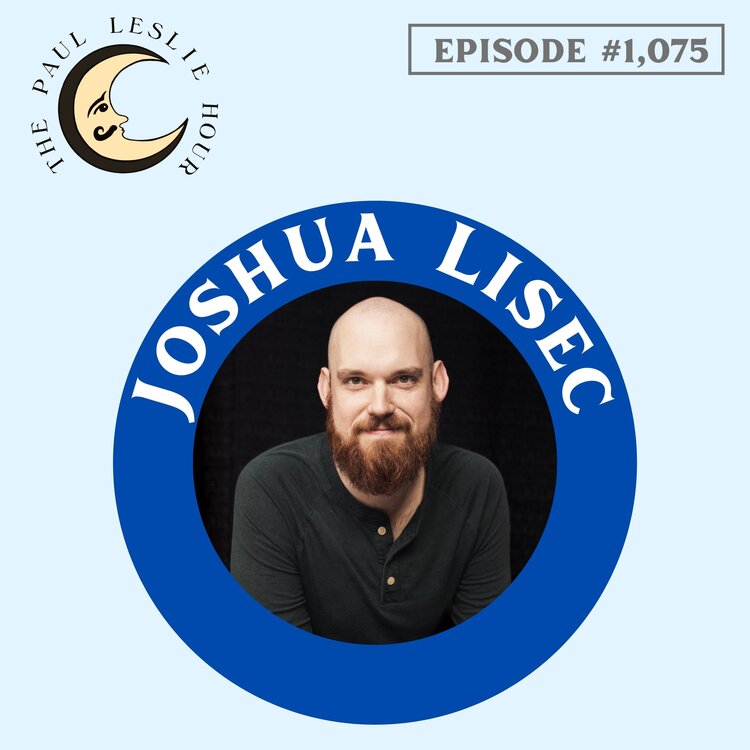
Joshua Lisec joins The Paul Leslie Hour.
Welcome to The Paul Leslie Hour, a show quoted everywhere … from the Library of Congress to The New York Post. Here on episode 1,075, we’re thrilled to present a personal interview with celebrity ghostwriter and persuasive writing coach Joshua Lisec.
Lisec writes books that matter. With Jack Posobiec, he co-authored the runaway national bestseller Unhumans: The Secret History of Communist Revolutions (and How to Crush Them).
There is much you can learn from Joshua Lisec. Get ready to hear from this compelling voice!
Real quick! Please support our mission to share the human story by going right here. Your contributions keep us going. Thank you for your support!
And, off we go!
Help Support the Show Here
• Apple • Spotify • Audible • iHeartRadio •
“I think the Joshua Lisec story is an interesting one indeed”
I have not encountered many people who can say that they are a writer and a celebrity ghostwriter and a writing coach, but I have found that writers tend to be among the most interesting people that you can meet.
Thank you. We’ll see if I can live up to that today.
And humble at that. Now, I consider writing to be a kind of art form that is just without boundaries. There’s really no limits on writing. Joshua, what has always been the purpose of the art, the work that you create?
The definition of good writing that I assert is not one that has to do with style, grammar, spelling, that sort of thing. That’s for school teachers to worry about.
People will ask me, “Joshua, is this good writing?” And I will ask back, “Did it get you to do something?” If it got you to do something, it’s good writing. And that is the beginning and end of my writing perspective.
Now, of course, that can be applied universally across industries, across niches, across types of books, fiction even. What does good fiction result in in terms of action, outcome? Well, it makes you stay up until 3 a.m. to finish. It makes you compulsively download every single thing that the author ever published. That’s good fiction.
The utility of fiction is to escape for any number of reasons from the humdrum of reality into fiction. And of course, the best fiction is written like nonfiction. And the best nonfiction is written like fiction.
“What do you think is the biggest mistake that you see people making in writing?”
That is so interesting. Now, Joshua, what do you think is the biggest mistake that you see people making in writing?
Remember in high school, college, when essays, papers, research projects are being submitted to the students, there’s generally in the grading rubric, this sort of minimum word count situation, that habit becomes, well, habitual in the vast majority of armchair writers, and that more words than are necessary are used to describe something in a vague, abstract, conceptual way, so as to leave understanding incomplete.
If someone is describing a given setting, for example, let’s say there’s, oh, this lovely little iPhone case that matches my watch and my tie. I like to color coordinate. This is what I do. I could describe this in terms of, it is a forest green iPhone 13 case. That is one way of describing it in a nonfiction way. That’s generally kind of boring.
Remember, good nonfiction is written like fiction. I could describe the texture. I could describe the round edges. I could describe any number of things about it that would be multi-sensory to allow you to imagine it in the palm of your hands, describing it like things you already know.
And I could use metaphors. I could use analogies for the function and the purpose. What’s something that is critical to the protection of a device? Well, you could liken it, if you want to have again writing it like it’s fiction, you could describe the same way that a vault protects cash money and gold and other valuables, you could say this is the forest-themed vault of my digital life. “Oh my God, that’s so cool.” Like just that from description, versus the thing that holds your phone.
And it holds your phone really well and it is snug and it is called a phone case. It also functions as a holder. You see how I’m contrasting that vivid description, multi-sensory description with an analogy to demonstrate the importance of my random smartphone case with saying a bunch of things about it that are kind of vague, but are getting a much longer word count.
We learn that in high school, we learn that in college, to write that way, to communicate that way. Saying a bunch of things. And another pattern we pick up is because we don’t want to put in time to research when we’re in high school or college writing these papers, we don’t want to spend the time researching facts and speaking from experience.
So, we think, well, what’s a way to say a bunch of things to get up to that word count without having to know anything about it. Oh, I could say this is a lovely iPhone case and it’s not just a case but it’s a holder and what I just did there is I used the AI output, stereotypical sentence construction. It’s not just X, it’s Y.
And I believe that AI uses that output so often and that’s a way to instantly tell if someone has used AI to write their stuff. We’re seeing presidents and CEOs of companies, colleges use AI for everything. We’re seeing elected leaders, dignitaries, even royalty in their statements that they’re putting out, it’s obvious they’re using AI to write it originally and they’re using that sentence structure that we all picked up while we were in high school and college and didn’t know anything about the subject matter and so we thought, well, how can we write a bunch of words and AI picked it up from us humans so AI writes like us probably because it thinks like us which is how can I trick people into thinking, “I know more about this than I do.”
And that’s how humans trick each other in their content. So that’s how AI tricks us too.
“Is there a different way that writers can look at this?”
Well, I’ve heard from several writers who say something to the effect of AI could be the end of my job. Or they say that they’re even, they’re terrified. That’s what one writer told me not long ago. He said, “I’m terrified that it’s a matter of time. Is there a different way that writers can look at this?”
Yes, we have to think about what is the actual utility of AI. Now, for me, the two ways that I use AI is to rapidly research things to try to find sources. It’s sort of a barely superior alternative to Google search or to, let’s say, Google Scholar or PubMed, where it can more quickly generate a list of sources that I can go click through and then create citations for.
And it’s also great for creating Chicago Manual of Style citations. You got to go in like the footer or in the towards the back of the book in the bibliography. But what it’s doing is it’s speeding up something that I already know how to do.
And so I can give it the prompt to do it correctly. Like I know how to do internet research to find first-party and legitimate otherwise sources for my clients’ books and for my own books. I use it in that capacity and I also find that AI is fantastic for editing transcripts of long conversations and it can cull the uhs and ums and false starts.
So when you’re looking at a transcript, it’s a solid readable transcript of a conversation without. I’ll ask AI to, and I’ll use a bunch of adverbs, because adverbs are how we manipulate other people, and we can manipulate AI by adding adverbs into the prompt.
So I will say, I will say, don’t just edit this transcript for readability. I will say, only very lightly edit this transcript for readability. That’s a Joshua Lisec super prompt. I like to use it right there. There’s lots of adverbs.
So then it will have in the output, I really like this iPhone case instead of I, you know, I kind of, I really like this iPhone case that that might be what was literally said. Therefore, send the transcript. I really like this iPhone case.
Now, if you don’t put the adverbs, the output will be I don’t just really like this iPhone case. I love this iPhone case, because an iPhone case is not just about having it and it’ll do that certain sentence structure out of nowhere. And it’ll sort of hallucinate that deceit.
“What’s the secret to being so prolific?”
Well, the people out there, they may know you from various things, but there’s probably a good number of people who know you from the world of Scott Adams. So this question, there’s??? there’s something that you said, you submitted a quote for a piece that I wrote. And I loved what you said about, Scott has said before about being the internet dad and then you said so that makes lots of us. We’re like internet siblings. Well, this question comes from one of your siblings gonna play it for you now.
“Hey, Joshua, Robert here. Just wondering what’s the secret to being so prolific? That’s my dog in the background.”
What is the secret to being so prolific if he’s referring to me?
I received it as a compliment. I may not fully deserve yet. Ha ha, gotta get a little bit of ego in there. Just a little bit. Let’s let me insert some ego in there. If he’s talking about Scott Adams, then I can speak either way. You’re talking about you. Yeah. Okay. Okay.
Well, I will expand the space for my ego to appear in this episode by quoting my own book, So Good They Call You a Fake, one of about six I’ve authored or co-authored under my own name handcuff name, and the quote is, “The best success advice you will ever receive is as follows. Impress important people.”
And that’s biblical, by the way. One of the proverbs of King Solomon, to paraphrase, it goes, “Do you see a man skilled in his labor? He will not work for unknown men, he will perform before kings.”
And you realize that part of what makes up this, let’s say, prolific nature that’s being skilled in your work is that you are capable of performing for the king, that you are good enough, that you are deserving, that you are impressive to someone who’s not easily impressed.
And so the proverb of Solomon teaches you how to become prolific. It is to become so good that kings want to be your client. It is that, and ironically enough, this is not a project that I have shared much about publicly.
A number of years ago, I worked on something for an individual associated with a royal family. And that was an interesting time. That was an interesting project. I might share more about that in the future.
In my book, So Good They Call You a Fake and elsewhere, I generally don’t make a big deal out of the celebrity clients of the celebrity ghostwriter stature that I have because their life stories are not useful templates because for one reason or another, some are born into it, they have a unique once-in-a-generation kind of gift or for whatever reason their situation is not one that is easily emulated.
You know, what’s the best way to make a million dollars? Inherit two million dollars. Okay, so that’s a joke, obviously. But that’s the largest part of success advice. So in my book, I love history or of our world today, literally or metaphorically, think, “There’s no way that’s legit. That’s got to be fake. Come here. Let me see that. I got to see that.”
And then now they want to work with you. That is the secret.
“When somebody is attracted to you in a negative way”
Very, very interesting. Now, you’re a recommended follow. I recommend everybody follow you on X, formerly known as Twitter, also on Instagram. And then you also have a great YouTube channel, something that you talked about that I thought now this is so Eiffel Tower interesting. When somebody is attracted to you in a negative way, or as they say, like a hater. And on X, it’s possible to attract people who really it’s almost like becomes like a part-time job. They just they actually are following you maybe closer than a fan would. Somebody would maybe say, oh, well, that’s bad.
Give is the right-wing comic artist Anonymous, but he is known as Stone Toss, is his name, Stone Toss. And there’s an example of his that I work into the book in which he regularly goes viral on Reddit for something that is deemed ultra-offensive to the wokest of the woke, and they absolutely hate it.
Oh, and this is so awful. Guys, look at this. Here’s another awful one. This is so awful. You got to check out his website. He’s so awful. Here’s his X account. It’s so awful. Make sure you follow him to stay up to date on how awful his stuff is. It’s just, you see what’s happening there, right?
Is there’s this massive movement of energy and energy is either going or it’s leaving or it’s going somewhere. It’s going away from or towards to and so if we think about, you know, like, oh, it’s good PR. It’s good press or it’s bad press, think about good and bad, removing them, instead focusing on attention, what gets attention, and even negative attention can be transmitted into positive direction.
An example of this, a case study that I share about in So Good They Call You a Fake, happened in December 2022, and some of your viewers, Paul, might be familiar with the Mary Sue affair, I call it now.
And that’s when I, one day, decided I was going to write about the Mary Sue archetype that has become ubiquitous in post-modern, let’s say, entertainment, culture, video games, movies, shows, comic books everywhere, right? It’s sort of the yasqueening of women, the girl-bossification of heroines in contemporary fiction.
And that’s where you take a female protagonist, and you make her literally perfect in every single way, and you make her heroine’s journey be realizing that she was perfect all along and her one weakness was not trusting herself because she is such a bad bee and all the men around her are either buffoons or bad guys and, you know, being 110 pounds she can beat up a 300-pound martial artist with her thumb.
That’s Mary. It’s not exaggeration, but that is Ray from the Star Wars anti-fanfiction sequel trilogy. That is the Jeff Bezos Galadriel from Rings of Power, that is Bo freaking Peep from Toy Story 4. Okay. This is, it’s everywhere.
And of course, it’s all in all fiction, all film, all comic books, right? Did the Mary Sue? Well, the thread racked up 13 million views and it was the number one story on social media that weekend that I released it and I was personally written about everywhere online and mainstream publications.
There were people sending me news articles like I’m just checking out the news one day and it’s Joshua and one of the most fun pieces was from the so it was a celebrity gossip website publication called TMZ. Just absolutely hilarious.
And of course, all of it was negative. Almost actually the vast majority of it was just vitriol. How dare this man say anything negative about literally perfect women? Who does he think he is? He must be a virgin incel, and of course, I have multiple children, ironic, right?
And so I would take these, oh, look at this fascist, look at this exes, look at this bigot, look at this transphobe. And so they started, I’m saying, talking about Mary Sue and they call me transphobic, it’s just what they do. Oh, he’s a Nazi fascist, blah, blah, blah.
And so every single one of these pieces of hate, I share it and I say, “Hey, thank you for sharing.” And of course, people are surprised to see that. And that did two things.
Number one, it invited more of the negative energy, which is just simply energy, attention, and as Mike Sernovich says, attention is influence. If you wanna be influential, you need attention. He didn’t say positive attention. He didn’t say positive attention.
And of course, there are people who would be future clients of mine who saw me poking fun at the mob, having a good time and going. And we chatted briefly back and forth after that.
And it was a few months later, we were like, hey, why don’t we do a book together? Wouldn’t that be fun? And that’s how Unhumans was born.
And of course, we did Bulletproof, the first and only book covering the assassination attempts on Donald J. Trump. And what is known, and what is not yet known, that the fact we don’t know it, tells us everything we need to know. If you know what I know.
“Tell us this story about the New York Times bestseller”
The story of getting Unhumans onto the New York Times bestseller list is also an example of this sort of negative energy understanding where it’s all about attention. I’m sure probably there’s a list of further questions, Paul, you wanna make sure we get to. So we can detour, we can wrap a hole, we can cover whatever territory you’d like to make sure you get your time’s worth from this.
Well, you’re very kind. What you were saying was very interesting to me. Tell us this story about the New York Times bestseller and how that came to be. That happens to be something that I always find so interesting. I pick up a book and I think sometimes how did this happen? Give us this example.
What I am about to share is 100% true as far as I know. Now that’s an opening line. That means it’s gonna be juicy. All right, maybe too much for some.
The New York Times bestseller list is famously private, perhaps infamously private, meaning they don’t share how they calculate it. On Amazon, the ranking and the algorithm behind it is pretty straightforward.
If you beat someone else, in fact, everyone else in a category, let’s say sales and selling is a subcategory. If you sell more than 75 copies in a day and it does update hourly, so if you’re leading for the day and you’ve sold 76 copies of your book on sales strategy and the next person is 75, well now you’re the number one best Amazon bestseller for sales and selling, right.
You know where you stand pretty much every time. And there’s lots of low to no-cost software tools that help you calculate with pretty extreme accuracy how many copies you need to sell to be a number one Amazon bestseller.
So that’s how this whole scam of self-publishing vanity services will guarantee to make you a number one Amazon bestseller and author your money back. That sounds compelling until you realize they’re going to pick a category like New Testament commentary, which sold two copies.
So we’re going to have our staff buy three copies of your book and make you a number one Amazon bestselling book. And your book was on tomato gardening, not New Testament studies.
Now coming back to New York Times, this whole list, we, because of our aggressive marketing campaign, Jack and I, all the platforms that we borrowed and the ruckus we made with the book and this sort of insane number of viral posts we made, both videos, audios, interview clips, speeches and interviews, and memes we made about the book.
Unhumans set the tone of the presidential campaign, and we did that on purpose because the purpose of the book was to make the country realize it’s going to be Donald Trump or it’s going to be communism.
And we wanted to make that choice ultra clear, and that’s exactly what it came down to. It wasn’t really Republican versus Democrats. It’s freedom or unhuman activity, as the book says.
And so we wanted this book to be a timely book, but also one that would be a perennial bestseller. And that has turned out to be the case. It’s sort of run away and taken on a life of its own.
But we had Unhumans, the number one bestselling book of the summer. Number one Publishers Weekly on the weekly release. Top of the USA Today, doing all the things that we need.
Strangely though, it did not appear on the New York Times bestseller list, despite being the number one bestselling book in the country. By a long shot, by many thousands of copies. It wasn’t even close. Number two was not even close.
And yet we didn’t appear on the New York Times bestseller list. Of course, it is regularly known that the New York Times board being, let’s say, at least ideologically left-wing, and that’s putting it lightly, they are known to act more like an op-ed review board than an actual bestseller list.
In fact, I believe it’s been the U.S. Supreme Court ruled several decades ago that they cannot be sued for false claims around bestseller list status, of which books they choose and which books they don’t, because it’s legally considered opinion, not statistics, not sales data, not actual, let’s say, quantitative metrics being tracked.
It’s their opinion, what is the bestseller list? You see, that’s what technically, legally it is, is what we know. So we, of course, are very frustrated. We did all this work and we did not appear on the world’s premier bestseller list.
And then I got to thinking, attention is influence. Haters are your most valuable marketers. So I got with my PR girl, whom I had privately hired and had been working with for a number of years.
We went like around the publisher and we put together a PR campaign to garner negative attention, extreme negative attention on the book. Starting first with far left-wing blogs because we knew that the book needed mainstream attention to be like a real mainstream like pop culture book, not just like this sort of right-wing conservative-aligned book, because The New York Times is known for not including books like that on their list, even when they sell well.
Like, that’s happened many times before. They’re sort of keeping it off of their list, excluding them from the list. And that’s what apparently our book was being seen as. Now, we don’t know that, but that is the perception.
Attention is influence. Okay. So I put together this PR campaign with my PR girl and it hit within about five minutes. We had left-wing blogs like Mother Jones, Vice, Vox, writing these massive hit pieces.
And of course, we gave them advanced copies of the book free instantly so that they could have something to write about. Well, we negative review laundered from the opinion blogs into newspapers, into the media.
So we had Joy Reid and Rachel Maddow and MSNBC talking about how terrible the book was. There were about three different articles in the New York Times about how terrible the book was.
And it was on the front page of the USA Today, this horrible, terrible, evil book on communism and Democrats and it’s just so not nice and so not fair and so mean.
And the vice president candidate, other Republicans, JD Vance endorsed it, which we suspected about two to three months before the announcement by the way in July. So we put his name at, you can even see in here, you know, JD Vance.
We put his name at the top because, you know, we knew, if you know, you know.
Hold the cover of the book up to the screen
On Unhumans, it is the secret history of communist revolutions and how to crush them.
And the reason the book is so despised, of course, is because we argued, effectively, that over the last 60 years in the United States, far left-wing ideologues and leaders, both unelected and bureaucrats, have successfully run a communist revolution culturally through our key institutions and here’s how to get them back.
One of which, of course, is voting for Donald J. Trump in the election. But there’s other things we lay out in the book and of course, the left has hair on fire a moment.
So all these hit pieces, it, somebody, somebody creates a Wikipedia page about the book that very week. I’ll have, that’s how you know something is mainstream, right?
And guess what appeared on the New York Times bestseller list the next week, Paul. After all this stuff comes out, and it’s on television, it’s in the newspapers. It’s on the freakin’ Wikipedia page. Guess what happened? It worked. It worked.
And we know, we know it was my little PR campaign with my PR girl because some of the language we put in that now shows up directly on Wikipedia and in the other news.
So we can actually trace the original pitch for the book to all the hit pieces about saying terrible things about as like a direct connection. Here’s our most valuable marketers, Paul.
Yes, sir. I feel like in mere minutes here, I’ve received more language. I’m fascinated by public relations. This kind of thing is just so, so interesting to me. And in mere minutes, you can’t really see that my head is just blown.
“What is something about Scott Adams that people would maybe be surprised to know?”
Very interesting. I want to go back and talk just a little bit about somebody that we know in common and that is the great cartoonist, live streamer, t-shirt icon, Scott Adams. What is something about Scott Adams that people would maybe be surprised to know?
When I would work with him on his books about two, three years ago-ish, I got quite a few questions. What’s it like working with Scott Adams? What’s it like working with Scott Adams? Once it was public, by that point.
And what might surprise some people is how easy he was to work with. There have been author clients that I’ve had over the years who are big sticklers on things that don’t matter at all.
And they’re very argumentative, and it has to be this way. We need to say it this way. And they obsess over minutiae that is evident to everyone but them is minutiae, doesn’t really matter.
And that was not at all Scott Adams. And one particular experience, a set of experiences was when we would go back and forth on things and I would critique, criticize, or otherwise say, “Scott, I think this is a bad idea.”
He would disagree with me in detail. So he would not just say, no, he would say, no, because. So when I say easy to work with, I don’t mean he was a pushover.
What I mean is I knew what he thought about things at all times. And if he liked something, he would say why. And if he didn’t, he would say why.
And that’s generally sort of the art of giving and receiving feedback that is in his talent stack. And I sure wish it was in other people’s talent stack. They would be easier ghostwriting and book writing and publishing clients.
“What is the best thing about being Joshua Lisec?”
What is the best thing about being Joshua Lisec?
You know that old set of cartoons based on the A.A. Milne books, the adventures, many adventures of Winnie the Pooh, and there would be sort of a musical version of the plush tiger called Tigger coming to life.
And he does his little song and dance routine. And he says the best thing about Tiggers is I’m the only one. It does feel a bit like that, where my experience set is so meandering from one industry to another.
I have never met a fellow traveler who’s on, let’s say, a trajectory, a path, a journey quite like mine. And even one little note about that is, so I am a certified ghostwriter by the only certifying ghostwriter body that there is, California State University Long Beach.
It’s like a master’s degree equivalent in the art and science of ghostwriting, the practice and tradecraft. And I’m also a certified hypnotist through the oldest organization in the world that certifies professional hypnotists.
And I’m the only person in the world who has both certifications. I could go into a bit more detail, but that’s, we’ll say that that’s the tip of the iceberg.
So, when I say, “I never met a fellow traveler,” I go to these different destinations and I’ve never met someone who’s with me at the previous destination. So to speak. Maybe both physically, literally, but also professionally, industrially, and regionally.
I think that would be a way of putting it. It’s neither good nor bad. It’s simply neutral, and part of the benefit of that is anytime someone new meets me, I already have, let’s say, shared context with him because I’ve met someone of their wealth before, I’ve met someone of their status before, I’ve worked with someone at that place before, I’ve written a book in their industry before, and I know how it goes.
I know what you’re supposed to do to make it work, and that sort of appears across domains, both deeply into my personal life and into my professional life across the domains.
So is that the best thing about being Joshua Lisec? I don’t know, but that’s perhaps the most interesting thing about being Joshua Lisec, is I’m the only one.
I love that answer. Well, I encourage everybody out there, it is a recommended follow on X, Joshua Lisec, and then I’ll spell that L-I-S-E-C. And then the website, tell us the website.
Yes, it’s very simply LisecGhostWriting.com. And I have for almost a year now, I’ve been doing a daily show on YouTube about 10 to 15 minutes per day per episode called “Daily Persuasion” with Joshua Lisec and that is aligning my unique filter set of being a bestselling author and a ghostwriter of 100 books now and being a professional hypnotist and doing all the things that I do.
Looking at the headlines and current events and news and what’s happening in the zeitgeist or as I say, vibes, I analyze it every single day to curate some insights to better help people persuade those VIPs of their life and career.
“What is your all-time favorite meal?”
Well, Joshua, this question comes from Glenny. This is a question I used to ask and it’s back by popular demand. It’s a simple question with actually sometimes some interesting answers. What is your all-time favorite meal?
I have recently shared my health fitness nutrition journey. I was vegan for 10 years, and that’s 10 consecutive years, but also, I guess, 10 plus years.
My mother went through a brief vegan vegetarian phase when I was a youngster, and so we ate that sort of way for a year, two years, something like that. So I have more than a decade in this space.
And I have only in the last, it would be 10 weeks. So I have been a non-vegan, an omnivore, for 10 weeks now. And in that span of time, I want to think about what has been my favorite meal.
Of course, whenever I talk about this, people bombard me with pictures and recipes and their favorite thing. You know, you got to try this barbecue sauce and you have to cook your steak this way and these sorts of things.
If I’m to think of the most satisfying meal, it’s actually not exactly a meal, but one of the reasons I left veganism was for my health because when you’re a vegetarian, you’re effectively a carbivore, which is very bad for your long-term metabolic health.
And multiple physicians reviewing my blood work said, “I am at risk of insulin resistance, pre-diabetes, and then type 2 diabetes, given my family history and my resting blood glucose.” So you got to change that up.
So I am doing a very much low-carb, close to carnivore diet, maybe like 80% meat, right? Well, there is this little bakery in my state called Purely Sweet Bakery and they have these low-carb and even ketogenic diet qualified dessert alternatives.
And there is this one, it is called the Keto No Bake Chocolate Chip Cookie Parfait. And it is mostly made up of some sort of a cream cheese type mix. And I think it’s sweetened with monk fruit.
But it tastes not quite a texture, but it’s a bit thicker than but it has that exact taste of a McDonald’s vanilla soft serve ice cream cone. That is the exact taste that they have effectively replicated.
And of course, it’s low carb. It has like two grams of sugar or something like that. So yeah, that was my second or third meal, maybe even my first snack after transitioning from, let’s say, carbivore to more like carnivore adjacent.
And it has been a marked and obvious improvement to my health physically, mentally, socially. Yes, so I won’t be going back to that.
Very good. Well, I hope that perhaps it encourages somebody who’s thinking about making that switch to go ahead and then give it a try. Well, Joshua Lisec, I always like to leave the last word to the guest. Anything you’d like to say in closing to all the good people who’ve joined us today.
Thank you for listening. Thank you for sharing it. If you found value in this, I’m sure there’s a couple of other people that are coming into mind of, wow, that person would really enjoy this and learn something about it.
In fact, I think there’s something that I just talked to them about that Joshua brought up in the conversation. We should do it. That said, the second best piece of success advice I can offer is to live fearlessly.
You should live courageously. And what that means is someone tries to trap you in, let’s say, a rhetorical trap. They try to cancel you or come after you or otherwise embarrass or shame you.
Good. That’s your opportunity to get attention. And attention is influence.
Well said. Joshua Lisec, thank you so much. I hope and pray that this is not our last meeting.
Thank you, Paul. It’s been my pleasure.
All right. You have a wonderful one.
You too. If I can ever be of service, please let me know.
Sure thing, Paul.