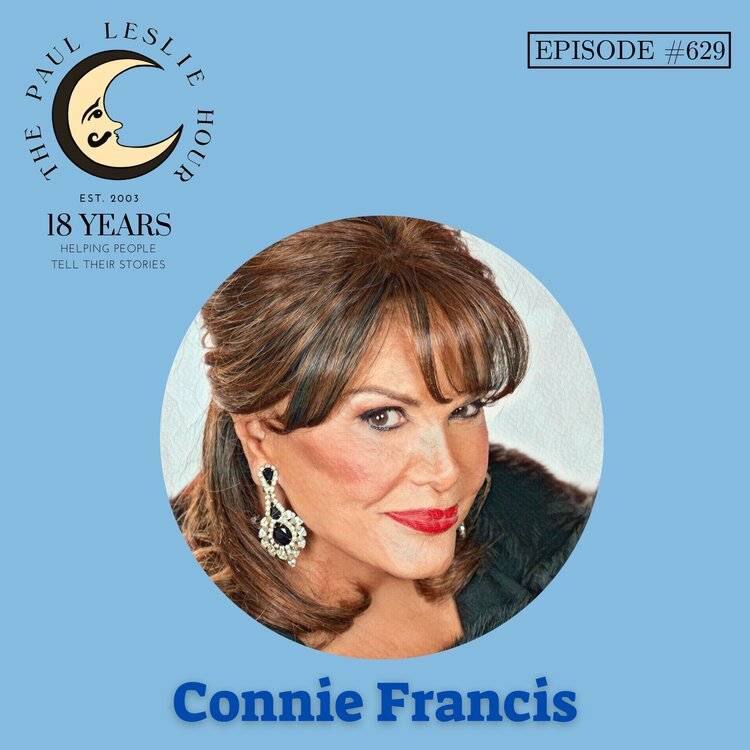
Connie Francis brings in 18 years of The Paul Leslie Hour!
She is one of the most electrifying and illuminating singers the world has ever known. Connie Francis is in a class by herself. She is one of the most prolific recording artists and has sang in several languages (English, German, Italian, Spanish, Hebrew, Japanese).
She is one of the great all-time concert draws. Since her 1958 debut LP “Who’s Sorry Now,” Connie Francis has one of the most impressive recording careers ever.
It’s a great pleasure to welcome a legend who somehow manages to remain humble. The legendary Connie Francis is right here on The Paul Leslie Hour.
Help Support the Show Here.
Subscribe/stream on the following platforms:
• Apple • Spotify • Audible • iHeartRadio •
Consider sharing this interview on Social Media.
Visit Connie Francis Online.
The Connie Francis Interview on The Paul Leslie Hour
Well, ladies and gentlemen, I’m pleased and honored to welcome you to the Paul Leslie Hour, now officially in our 18th year with this very show you’re tuned into, and with us is one of the most illuminating and electrifying singers the world has ever known.
Connie Francis has a voice that is as unmistakable as it is in a class by itself. Connie Francis is one of the most prolific recording artists of all time, and she has sung in several languages, English, German, Italian, Spanish, Hebrew, Japanese, and quite a few others. Her song “Who’s Sorry Now” was listed by RIAA as one of the songs of the century. She is one of the great all-time concert draws. Connie Francis, I’m honored on behalf of our listeners, thank you so much.
It is my pleasure Paul.
The pleasure is all mine but is it true you prefer, despite your legendary status, you like to just be called Connie?
Yes.
“It’s a great feeling”
Well Connie, thank you so much. What has always been the purpose of the art, the singing that you create?
To reach millions of people throughout the world, I wanted to, as a young child, my father talked to me about this when I was 14 years old, that he said, “Someday if you ever do make it, that’s a long shot. I want you to internationalize American music. I want you to sing in German and in Japanese because they’re going to be are two biggest allies and of course Italian you have to do an all Italian album” and this is when I was 14 years old and I was just making demonstration records.
It must be incredible because you have one of those voices that has reached all the corners of the world. What is it like knowing that there is someone probably this very moment listening to a Connie Francis song?
It’s a great feeling.
So you mentioned Italian there and you are of Italian heritage. Why do you suppose so many of the great American singers are of Italian descent?
Well, if you ever spend a week in Naples, Italy, you’ll know why. Everybody sings in Naples. Everybody sings in Italy. It’s just part of our culture and part of our nature.
Developing the voice
How did you develop your voice?
I didn’t. I used to copy everybody else when I was making demonstration records. They would say, “Connie, give us some of that good old Patti Page. Give us some of that good old old Rosemary Clooney, give us a little Teresa Brewer and so I was imitating everybody else when I didn’t have a voice of my own until I recorded “Who’s Sorry Now” because I hated the song so much I wanted to get it over with and I didn’t imitate anybody else. I just sounded like myself for the first time.
It seems like there’s a huge universal lesson in that about being yourself.
Yes, that’s true.
Nonetheless, one of the things about many successful people is success doesn’t happen overnight. What do you think the best way to handle disappointment or adversity is?
Well, one of the things that You must have, when you set out to be a star, to be a star in show business, is ability to accept rejection because you’re going to have a lot of rejection before someone comes along and says, “Hey, you’re great.”
The biggest honor that I have was my trip to Vietnam
Has there been a biggest honor that you’ve had?
The biggest honor that I have is was my trip to Vietnam. That to me was the most unremarkable and incredible experience of my life.
Why would you say that? What was it about that experience?
I never felt more needed in my life and to bring a touch of home to our boys over there was a thrilling experience experience.
Is it possible with all of the recordings I’ve spent quite a great time going through and listening and you have one of those catalogs it is so rich and vast could you say that one of the albums the full-length albums you made is in particular a home run?
My favorite album was my Spanish and Latin American favorites. I recorded it in Abbey Road with a 72-piece orchestra, and I was 21 years old. And the feeling I got from that album it’s an amazing album. And it was also my father’s idea to record a Latin album. My father was very instrumental in my career.
Must have been incredible recording there at Abbey Road.
And it was. This was pre-Beatles
Wow.
Well one album in particular that I really, really love from MGM records the one you made Connie Francis Sings Award-Winning Motion Picture Hits. What a great one.
I recorded that in Rome.
In Rome?
Mm-hmm.
Are you a big movie fan?
A big movie fan.
Could you say that one movie in particular is one of your all favorite?
“The Godfather” without hesitation, and “Gone with the Wind.”
You have good taste.
I must have watched it twenty times.
It made the charts around 80
From throughout your catalogue, would you say that there’s a song you’ve certainly had some great hit songs, but would you say that there was one that you would say is the most underrated? That you thought didn’t get as much attention as it deserved?
Yes, Al di là.
It made the charts around 80. But it was my biggest international hit. And the song that was most popular when I sang it in foreign countries. Even Romania.
Now Romania, that’s country that I have been to. I’m hoping, in particular, I was reading about that. You can tell us about your experience there.
Well, it was frightening because it was the first time an American singer had been invited to sing behind the Iron Curtain. And my father didn’t want me to go. He thought that it was dangerous because In his mind, I was America’s Tokyo Rose at that time. He felt that my daily shows, my weekly shows on Radio Luxembourg, which went behind the Iron Curtain and reached countries in Tunisia and behind every Iron Curtain country, was of that influence on communism.
And he was afraid that I was invited there to be killed. He said, “You’re going to come home in a box.” And actually, I contracted typhoid fever there, and it was deliberate.
It was deliberate, you said?
Yes, it was in my food. It was a, it was a thrilling experience performing for those people behind the iron curtain. They weren’t allowed to shout out. They weren’t allowed to stand up. They weren’t allowed to raise their voices. They weren’t allowed to whistle. They just had to stomp their feet as they enjoyed the show. And The people who looked like they were in straitjackets there and I saw communism for the first time and all of its horror and it’s something that I never take lightly., That communism and fascism are two failed doctrines and politically. I’m always conscious of news media that favors either one, either far left or far right.
Interesting. I can see a lot of truth in what you’re saying. Have you learned something about people having performed in so many places and in front of so many crowds through the years?
Well, my two favorite people were the Scottish people and the Filipinos. I thought they were the greatest people I ever sung before.
That’s so. It’s so interesting Filipinos I’ve been to the Philippines as well there I hadn’t been to Scotland, but Filipinos are just some of the most. The loveliest people so I have to concur with you.
Why did you do so much traveling, Paul? Well, how did you do that?
Well, Romania was just recently, but I actually grew up in part in the Philippines. My parents had moved there.
So you agree with me.
Oh, absolutely
The night he was brought to my home was the happiest hour of my life
Connie can you think of a happiest time in your life?
The night that my baby was brought to me. He was adopted and the night he was brought to my home was the happiest hour of my life.
Can you remember looking in his face for the first time?
Oh, yes. It’s indelible in my mind.
That’s beautiful. I’m sure you’ve made a lot of people smile in saying that.
I hope so.
One of the interesting things about you, you know, we’ve been talking about this various languages that you have recorded in, but also just in terms of styles of music. One of the albums I also enjoyed was your country duets record. What do you think about country music?
I love country music. My father instilled that in me when I was ten years old. There was only one country station in New Jersey on Sunday afternoons, and we would take a ride in the car and listen to Paul Brenner, this disc jockey who played country music, and my father said, “Instead of listening to the music that you’re listening to, buy yourself some Hank Williams records and learn about country music,” because country music has more to say than any of the pop songs you listen to on the radio every day. The lyrics are so incredible.
You just gave me a great quote. Now, what about doing the duets with Hank Williams Jr.? What was that like?
That was fun. Hank was only 19 years old. We did that album.
Has there been a favorite duet partner of yours?
No, because I haven’t done any duets, except with Hank and Marvin Rainwater when I was 19.
One of the people that I got to interview, God rest his soul, the great songwriter, Sir Les Reed, and he was telling me how he told me how thrilled he was with the album you made of his songs?
Yes, it was a great album, unless it was a very underrated arranger and writer. I mean, he wrote all of the Engelbert Humperdinck and Tom Jones. He wrote Kiss Me Goodbye for Petula Clark, and, he’s written some unbelievable material. And I felt that he was underrated, so did a tribute album called the song, called the Connie Francis Sings the Songs of Les Reed. And it is one of my best albums.
It’s It’s a great one. And he was fond of that record, he told me.
I know he was. We had a wonderful time together. He was a true gentleman.
Well, Connie, how do you view songwriters? Your name inevitably comes up when someone thinks of Neil Sedaka or Howard Greenfield, or as I have been saying, Les Reed. How do you look at the songwriters that are out there?
Well, Neil and Howard were responsible for many of my hits. They wrote Where the Boys Are. They, Anytime I had trouble finding a song, I would go to, go back to the mills, that was to Howard and Neil for a song. And Neil was a genius and Howie was too and unfortunately passed away. But they were, it was fun to work with them. We were both, we were all kids together and we were at the most exciting time of the record business in the late ’50s when everything was just starting to kick off.
Now, you mentioned earlier in the interview a lot of singers, and I’m curious, being that you’re one of the great, great American and international singers, who would you say some of your favorite all-time singers are?
Bobby Darin, Judy Garland, Frank Sinatra. I love Barry Manilow. I love Ray Charles. I like Michael Bolton, I have lots of favorites and I keep them on my own playlists because I can’t identify with a lot of the music today. So I go back to my favorites all the time.
Well, I’m right there with you. I was born in the 80s and I feel the same.
Right.
You mentioned Sinatra and I’ve always thought it was interesting that you share a birthday with him.
Yes, we did we shared a birthday.
(Fame) can be fantastic
Would you say that fame is good or bad or both?
It can be, it can be bad, but it’s what you make it. It can also be very good. It can be fantastic.
In what way would you say it can be fantastic?
You get paid for doing the thing you love doing best. And in the meantime, making millions of people happy.
There’s somebody that I want to mention. He’s a mutual friend of ours then I have to say through the people I’ve met through the years he was one of the nicest people I’ve ever met and I’m talking about Oleg Frish.
Oh yes, Oleg is sweet and he’s a sweetheart.
Very sweet.
He came to my house to interview me here.
What did you think how interesting to be to have someone know so much about you who comes from Russia.
Yeah, that was amazing to me.
We love you, Oleg, if you’re listening.
The best thing? Getting reservations
What is the best thing about being Connie Francis?
Getting reservations. There are a lot of perks to being county’s managers. A lot of things that aren’t good, but a lot more perks than not.
Reservations. Do you have a favorite type of food?
Italian, of course.
If I had to place a bet, that’s what I was going to say.
Of course.
Well, it’s been a great pleasure to have you here on our first show of our 18th year, and we have people listening from all over.
Wonderful. Congratulations on that.
Thank you. Thank you. In closing, is there anything you would like to say to all the people who are tuned in?
That I love them, and I love that they love me.
Well put. Well anybody can check out ConnieFrancis.com please do. And Connie, we love you.
Thank you so much for spending time with us. It’s a great pleasure to do this interview. I’m honored.
My pleasure Paul.
Alright Connie.
Bye bye.