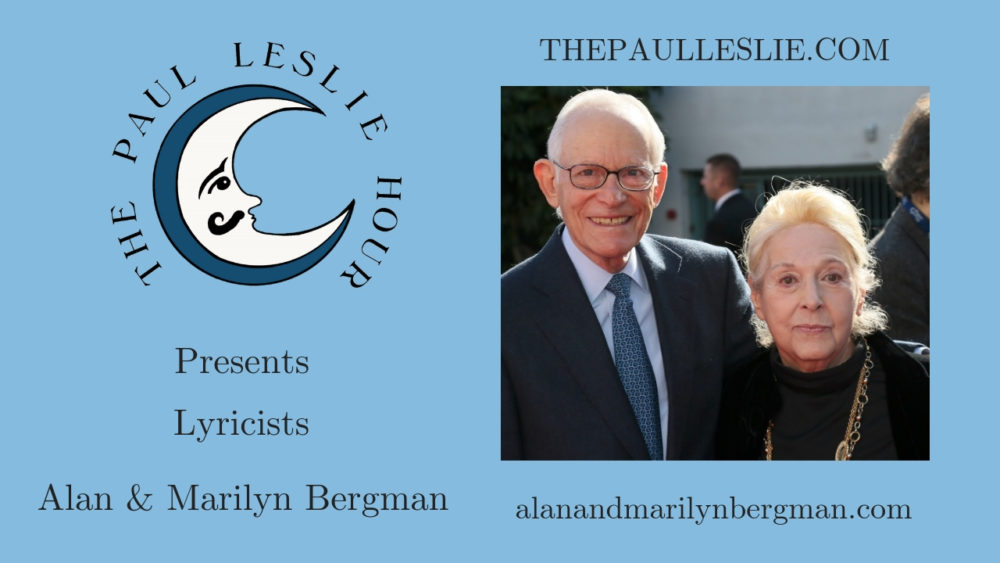
Alan & Marilyn Bergman, two of the most important song lyricists in the entire world are here on The Paul Leslie Hour to talk about their storied life in music. Alan & Marilyn Bergman wrote songs with some of the greatest composers in music: Michel Legrand, Johnny Mandel, David Shire, Sérgio Mendes, Dave Grusin, John Williams, Marvin Hamlisch and others. Their songs have been sung by the likes of Frank Sinatra, Barbra Streisand, Gladys Knight, Johnny Mathis, Vic Damone, Tony Bennett, Michael Jackson, Fred Astaire and hundreds of others.
Don’t touch that dial, the married Bergman songwriting team are up next right only on The Paul Leslie Hour. The words of Alan and Marilyn Bergman are here to stay!
Help Support the Show Here.
Consider sharing this interview on Social Media.
Like us on Facebook Follow us on Instagram & Twitter.
Visit Alan & Marilyn Bergman online.
• Apple • Spotify • Audible • iHeartRadio •
The Official Alan & Marilyn Bergman Interview on The Paul Leslie Hour
Transcription by Lori Domingo
Ladies and gentlemen, it is my pleasure to welcome one of the world’s great songwriting teams. It’s a great pleasure to welcome Alan and Marilyn Bergman.
Marilyn: Thank you so much.
Alan: Thank you!
Most stories are best from the beginning. Before you knew each other, what was life like growing up?
Marilyn: Terrible! (Both laugh). No…we both grew up in Brooklyn
Alan: and we had very similar…
Marilyn: very similar upbringings…
Alan: Yeah…
Marilyn: lower, middle class families, both with mothers who were determined that their kids would be exposed to culture so at that time there were a lot of free things going on in New York…the Philharmonic, for example, had free children’s concerts every Saturday morning at Carnegie Hall and I…
Alan: unbeknownst to each other, our mothers took us there on Saturday…
Marilyn: we were there at the same time.
Alan: Yeah
Marilyn: many worlds apart (laughs).
Alan: and years (laughs). So that was terrific
Marilyn: and we both went to rather progressive schools, chosen carefully by…it’s amazing how similar our backgrounds were. Schools also that had encouraged reading and writing and, you know, open classrooms…that kind of thing.
Do you ever wonder if you’d met before you “officially” met?
Marilyn: Well I don’t think we met but we were certainly in the same place at the same time.
Alan: Yeah.
What about early music loves? What did you all listen to?
Alan: Well there were two in that class. First of all classical music because, you know, every Saturday morning we had the Philharmonic and then that was…
Marilyn: And there were music appreciation classes in schools in those days which, you know, at least we got to hear and learn the language of classical music when we were very young.
Alan: And then there was that marvelous music that came from the Broadway stage by the great songwriters of those days: the Gershwins, Cole Porter, Berlin…and we grew up on them. We would…we would sneak in in the second act of all those shows…
Marilyn: Yeah
Alan: (Laughs) We never had money so we would wait…oddly enough, we both did this unbeknownst to each other…we’d stand outside and go in on the second act with the crowd and if there wasn’t a seat, we’d stand. We saw a lot of second acts.
Marilyn: There’s a poetic justice about this cause now we see a lot of first acts (both laugh). We shouldn’t be saying this but there’s also a few more walkouts.
Alan: There’s a symmetry there (both laugh).
(Laughs) Well you mentioned a name there, Cole Porter’s, so what lyricists have influenced you the most?
Alan: Uh, well, I had one of the great lyricists as a mentor, Johnny Mercer, and…
Wow!
Alan: yes, he spent quite a bit of time with me encouraging me and disciplining me and teaching me, really. I would not be here talking to you without him.
Marilyn: Thank you Johnny Mercer.
Alan: Yeah, thank you Johnny Mercer, and then, of course, all those who are producing still. We’re still learning. We learn from Stephen Sondheim all the time.
What was Johnny Mercer like as a person?
Alan: Oh, he was wonderful. He was, uh…
Marilyn: complicated
Alan: Yes…very complicated but…
Marilyn: He came from Georgia
Alan: Yeah, not too far from where you are.
Savannah, Georgia.
Marilyn: That’s right.
Alan: Savannah, yeah…but, you know, it’s hard for me because I loved him and he was so good to me, and Marilyn,too, had a mentor from the lyrical ranks.
Marilyn: A very good lyric writer named Bob Russell who was really a pop song lyric writer. He did a few films but mainly he wrote songs…he wrote ‘Don’t Get Around Much Anymore’ with Ellington and ‘Do Nothing till You Hear from Me.’ He wrote ‘Brazil.’ He wrote a lot of very good songs. I use to play the piano for him. It was my after school job because he was a lyric writer who didn’t play the piano and there were no CDs in those olden days we’re talking about.
Alan: No tape recorder
Marilyn: Well, there was reel to reel tape but that was very cumbersome so if there was somebody who would play the piano and play these songs, these melodies, over and over for him as he worked…that’s what I did. He told me later when I came out to California where he had moved from New York in my college years…during those years, he moved out here and I came out here at one point because my parents had moved here and I said “There’s nothing to do in this place. I don’t know anybody and I don’t know what to do,” and he said, “Write songs.” I said, “What do you mean, write songs?” He said, “Well, you learned more than you did those years that you were playing for me.” So he introduced me to a young composer and the first song we wrote was recorded by Peggy Lee and then he introduced me to Alan, with whom he was working the afternoons. He would work with me in the morning and then he would go work with Alan in the afternoon and he introduced us and the three of us did a tour together and one of the first fruits that ripened was a song called ‘Nice and Easy’ for Frank Sinatra and I think that kind of made us think, “well, maybe this is serious,” and we can make a real career out of it. (Laughs)
Well what was your first impression of Alan Bergman?
Marilyn: Oh my dear (laughs). Well actually, before I even met him, the first time I saw him he was walking on, uh…there was one street in Hollywood, Selma, a street called Selma near our…all the music publishers had offices and I saw him walking on the street there one day and he was wearing, in my memory, a dark overcoat and he was carrying a briefcase and he didn’t look like anybody else in Los Angeles. He looked like he just got off the train from someplace back East and I thought he looked like an accountant or door-to-door salesman. As a matter fact, (laughs), he was a door-to-door salesman. He was going to publisher’s offices to try and sell his songs. But that was actually the first time I saw him but the first time I met him, I really don’t remember other than the fact that we started writing that very first day…the three of us…with this composer who’d introduced us whose name was Lou Spence. And, we started writing and there was, uh, a common language and communication and we wrote a terrible song that day but we realized that there was a collaboration possibly that might be interesting so we continued working together…the three of us every day…we would meet at about 10:00 in the morning and we would work until 5:30, 6:00. So after the better part of a year, I think, we got to know each other very well in those hours every day and then we got a call from Frank Lesser(???), another great writer, whose work has influenced greatly as well. He had already written ‘Guys and Dolls’ and “I Went Charlie’(???) and a couple other wonderful things and he had a publishing company and he had writers under contract and he called us up and asked us if we would come to New York and would we consider doing…moving into this stable of writers. It was during that trip to New York that we had really what was probably our first date right Alan?
Alan: Yeah. Yeah. It was near Christmastime and we walked a lot on Park Avenue.
Marilyn: In the snow. I think it happens in that trip to New York. We never signed the contract with Frank Lesser for reasons that are not important but we later signed a contract with each other…a marriage contract.
This question is for Alan Bergman. What was your first impression of Marilyn Bergman?
Alan: Well, I remember walking up…we went to work at her house…her parent’s house…and she as waiting at the door. There was kind of a long walkway to the…and I saw her and as I got closer and closer, I knew this was a very special, remarkable woman and, uh…(laughs)
Marilyn: All of this from walking up the walkway…
Alan: Yes…but there it was…I knew there was something special about her.
When the two of you are writing a song, what is that process like?
Alan: Well that’s like pitching and catching. One is very verbal. We prefer to have the music first. It goes back and forth, pitching and catching like one is the pitcher and one is the catcher (laughs). Yeah, well, and one is the creator and one is the editor and that goes back and forth within seconds and when we get four or so bars finished that we like I sing them cause it’s very important that the lyrics, the most important function of a lyric is to sing and so I sing along with the tape.
Marilyn: And he sings very well.
Alan: As we progress, we hear it and sing it and continue writing.
Marilyn: And sometimes it’s good and sometimes it’s not (laughs).
Alan: And then the re-writing comes in because, you know, songs, like anything else, are not written every…they’re written over and over. You keep trying to make it better.
Earlier you mentioned this song, ‘Nice and Easy.’
Alan: Yeah.
Tell us about that song.
Alan: Frank Sinatra was making and LP, an album in those days (laughs), of lightly swinging love songs and he wanted to, uh, his manager sent out a call and I’m sure every songwriter within a very far or near distance wrote a song trying to get the title song for that LP and, you know, when you write for somebody like Sinatra, he’s a piece of the theater, you try and write a custom-made suit for him so we came up with this idea, ‘Nice and Easy,’ which he did do. Of all the songs that I’m sure were written, ours was chosen.
Tell us about putting the lyrics to ‘The Windmills of Your Mind.’
Marilyn: Well, ‘Nice and Easy’ was I believe in 1960 or ’61 and a few years after that, Alan and I continued writing together and by now we were writing with other composers as well. We were introduced to Michel Legrand. who came over to do some work on the ‘Umbrellas of Cherbourg…
Alan: No, it was the ‘Young Girls of….’
Marilyn: “Young Girls of Rochefort’ which he had just finished…it was the second musical after…it was the musical after ‘Umbrellas’
Alan: Yeah
Marilyn: Somebody introduced us to Michel and that was really when it happened. I have to back up a little bit if I may. One day Quincy Jones called us and asked us if we’d write a song with him for a picture called ‘In the Heat of the Night.’ That was Norman Jewison’s film and he wanted a title song which was to be sung by Ray Charles. Well, I mean, that was a heaven assignment. So, as a result of that, not only did we write the song but our relationship with Norman Jewison was born and so on his next film, or one of his next films, he called us and asked us if we would write some songs for the film with…
Alan: Michel Legrand
Marilyn: Yes with Michel, who he wanted to do the score for the film. And one of the sequences of that film, now I’m getting to the answer to your question (laughs)…one of the sequences of that film was a glider…Steve McQueen was flying a glider…he had just finished masterminding a great, complicated bank robbery. There were a lot of problems and he went up in this glider to think it out I think, and Norman said that he wanted a song in this silent sequence and when we saw it, it was long and there was nothing but perhaps the sound of a little wind. He said he wanted a song that would just underline this whatever mind-trip that was happening to the character. So, I don’t know, Michel wrote about seven or eight wonderful melodies, one different from the next, then we all chose this one, which was an unlikely melody. We thought it would be something more agitated or whatever. We chose this melody. I don’t know where this lyric came from. I really don’t. It might have been…Alan thinks it had something with the circular movement of the glider. I….
Alan: And with the anxiety…
Marilyn: Yeah, the restless thing. I don’t know but I think my take on it somewhere in my brain was the feeling of going under anesthesia. There is a kind of circular disconnect of thoughts. It’s very hard to explain because I don’t think either of us really know where that song came from.
Alan: Yes, well, we did have the scene as now described and so the intention of Norman Jewison, the director, was to tell us that he wanted us to underline the anxiety of the character.
Probably one of your most celebrated songs is ‘The Way We Were.’ What was the inspiration behind that lyric?
Alan: You know sometimes (laughs) the stars are right…you have a great movie, a fantastic director who understands music, a song of Sydney Pollock, a marvelous composer, Marvin Hamlisch, and the best singer in the world, Barbara Streisand, to write for. So that’s a lot of good things.
Marilyn: And the title…
Alan: And the title…
Marilyn: This and ‘The Heat of the Night’ were the only time we got to write title songs, where the titles really were valuable to us…
Alan: Provocative to the lyric…
Marilyn: Right…’The Way We Were’ was the title of Arthur Lawrence’s book on which he based the screenplay and it was a wonderful title and as Alan said, we got to write for the best singer in the world.
Alan: And, you know, Sydney knowing the power of a song and music…the song…the function of the song the first time you hear it is a corridor back into time, taking you back to when they were in college and that’s the first time you hear it. The second time you hear it, which is most important, is at the end of the movie where the two characters meet. They haven’t seen each other in years. They meet by accident. They meet by accident and you hear the last half of the song which brings you back to their lives. So in both cases, it’s taking you back in time, “The way we were…”
On that note, the new album from Barbara Streisand…
Alan: Yeah…
What did you think of the album featuring your lyrics, the album titled, ‘What Matters Most’ that Barbara Streisand recorded?
Alan: Oh geez…
Marilyn: Well aside from the fact that it’s such an honor to have her honor us with this album, we find it very difficult to be objective about her because, I guess as you heard, we both think that she’s extraordinarily talented as an actor, as a singer, and as a director and it all comes into play when you listen to her sing and as lyric writers, there’s nothing that she doesn’t uncover in a song. She…and she finds layers that maybe we didn’t even know where there sometimes and that dramatic ability that she has, that intelligence, coupled with her glorious voice…I don’t know…it’s, um…
Alan: You know, she’s recorded about 64 songs of ours and it’s just a thrill, a privilege every time….every time.
Marilyn: Yeah..
So many people have recorded your songs: Frank Sinatra, Rosemary Clooney, Tony Bennett, Fred Astaire, Ray Charles, Barbara Streisand…is it possible…could you pick a interpretation of one of your lyrics?
Marilyn: God! That’s very difficult. When you say Fred Astaire, I think of ‘That Face.’ When you say Ray Charles, I think of ‘In the Heat of the Night’ but when you say Tony Bennett, I think of ‘How Do You Keep the Music Playing?’ When you mention Rosemary Clooney I think of ‘Where Do You Start.’ And Barbara….I think of 64 songs (laughs). We’ve been graced and that list made me catch my breath moment. I’ve never thought of it quite that way but how lucky can you get?
It’s quite amazing.
Marilyn: It is, isn’t it?
Could you pick a favorite composer that you’ve worked with?
Alan: Oh, that’d be difficult. We’ve really had the pleasure but to write to melodies of Michel Legrand…not only Michel Legrand but Dave Grusin…
Marilyn: Marvin Hamlisch
Alan: Johnny Mandel, John Williams, Henry Mancini…there are so many
Marilyn: That’s as stunning list as the singers
Alan: Yeah.
What is Marvin Hamlisch like to work with?
Marilyn: A joy
Alan: He’s absolutely a joy
Marilyn: A joy. He’s quick-witted. He’s quick thinking and he’s so talented.
Alan: Yeah
Marilyn: He’s so talented. And he can execute at the piano. All of these names that Alan just mentioned, they’re all able to execute immediately at the piano what they hear which is remarkable. His ability not only to hear it and think of it, but to express it immediately so that we’re turned on immediately…sometimes it’s not immediately…
Alan: No
Marilyn: There are…we feel that there are words on the tips of those notes and we have to find them. That’s our exploration.
Could you pick a lyric that is the most meaningful to you?
Marilyn: Oh…meaningful…meaningful…uh, well the most meaningful lyric at this moment…it might have been different had you asked me the question a year ago or a year from now…but at this moment, I think ‘What Matters Most’ is probably…it speaks to…I think, what we believe and what we really feel about relationships and about loving. It’s with a beautiful piece of music by Dave Grusin, who is a wonderful composer and a great pianist and a great friend and that lyric, and I’ve listened to it a lot lately because of Barbara’s remarkable record, it says for us what…it’s almost as if someone else wrote it down speaking for us but I feel deeply about that at this moment.
What makes a good song a good song?
Alan: Well I think the combination of a unique melody and an original lyric.
Marilyn: You know, we always say to each other when we finish something and we don’t have any feeling about it, “What the world does not need is just another song.” There are millions of songs and unless you have something to say, it’s like anything that you write…what is it that you have to say that’s either not been said before or not been said before in this particular way? So I think a good song first of all, what now is a dirty word but we lean on it very heavily, and that’s craft. Alan said earlier that one of the first obligations of a song is to sing or be able to sing. That’s what makes the songs different from poetry for example. Lyrics have to sing on the notes that they’re married to and feel good to the singer. Not only that, but that really determines, to a great extent, the writing of a lyric. But the idea…what is it you’re saying and can you say it perhaps in a way that’s not been said quite that way. That’s a funny answer to your question isn’t it?
I think that was very well-put. This is a question for both of you. What is the best thing about being Alan Bergman? What is the best thing about being Marilyn Bergman?
Alan: Well, we have an extraordinary life together. We love what we do. We have a real passion about writing. When you do it with somebody you love and in addition, have a wonderful family…I’ve got a daughter and a granddaughter….what could be better? It’s extraordinary.
For my last question: What would you like to say to anyone who is listening to this?
Marilyn: After you asked me the question…something about what lyric…I don’t remember how you phrased it…and I said ‘What Matters Most’ I think this is chaotic time all over the world and it’s like all the pieces have been thrown up in the air because it was broken . It is broken. And I think we’re trying to find a way to put pieces together in a better way and to heal the world. Occasionally, somebody writes a song that says something about that. I would love to write that song. We haven’t but I think this is maybe a song that could contribute to a little healing but first you have to break it up and that’s what’s happening now and I think that’s healthy. We have to look forward to putting the pieces back together again.
Alan: And hope for peace.
Thank you very much. I have greatly enjoyed it.
Alan: Thank you Paul.
Marilyn: It was a pleasure talking to you.
Alan: Yes. Thank you for calling.
Thank you very much and a good day to you.
Marilyn: Thank you…and to you. Bye.